Episode Transcript
[00:00:00] Speaker A: Welcome to the Independence by Design podcast, where we discuss what it means to be a business owner and ways to get unstuck from the day to day so we can design a business that gives us a life of independence.
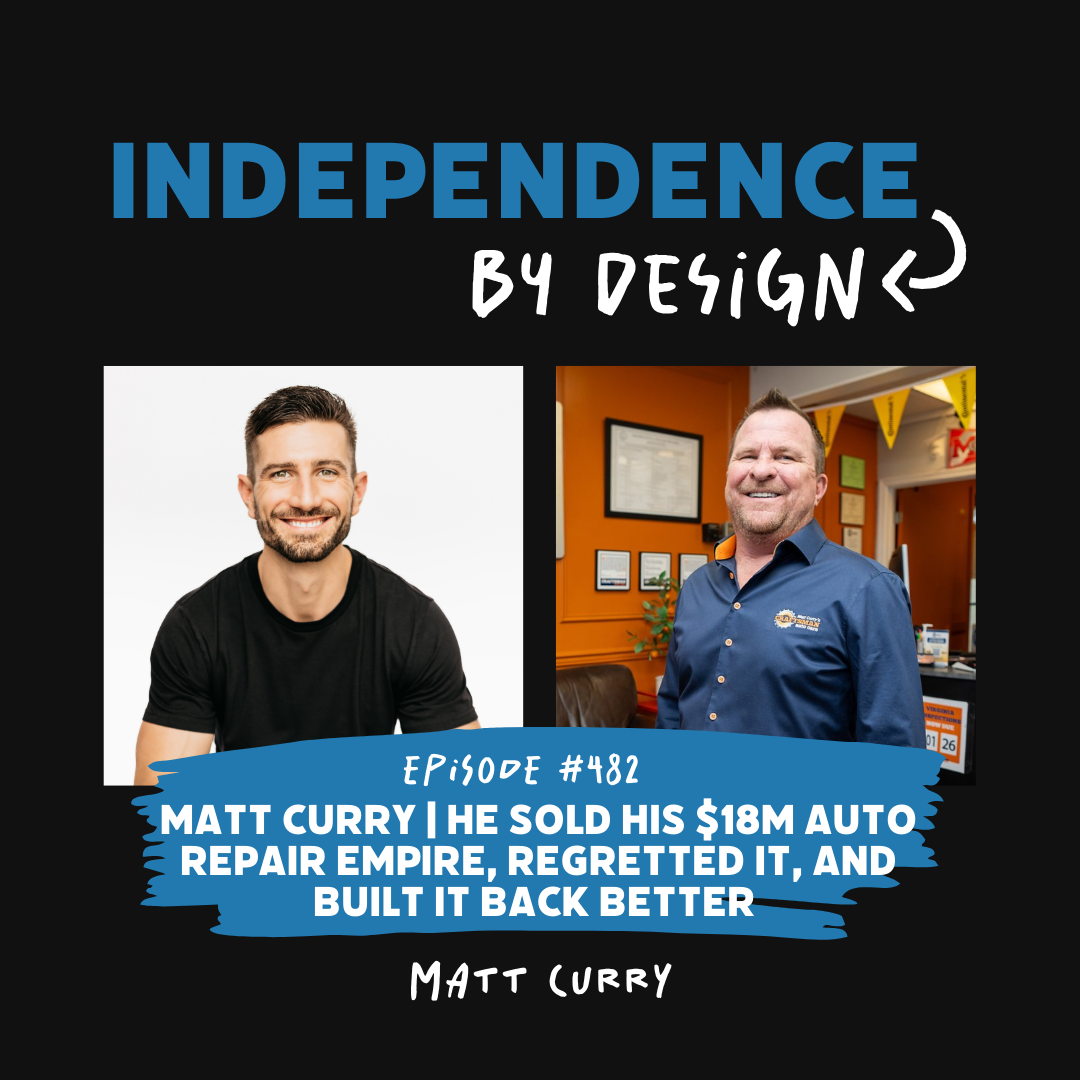
You're in for a treat. There's a lot of ups and downs in this story with Matt Curry, who started Curry's Autobody with $103,000 of credit card debt and grew it up to 10 stores, sold it to private equity. They blew the whole thing up within 12 months. And he restarted, got back in the game, and now is doing $36 million with eight stores. He's got auto techs making 300 grand, and he's completely reframed his mindset as an owner. And I just absolutely had a blast because not only do we talk about his book the ADD Entrepreneur, what it was like growing up with add, how that was a superpower as it came into scaling his company the first time, and then what he learned after he sold and why he's back in the game and how he thinks about his business now that he's in it for round two.
Ton of lessons to be learned here. Can't wait for you to listen in. So here's my interview with Matt Curry, so love to just talk through the story arc. Sounds like you have a pretty cool story. And I was doing some poking around, and I'm interested to hear about it.
[00:01:19] Speaker B: Sure. I mean, well, we could begin at the beginning, I guess. I guess really the beginning is 1978, when I was in between sixth and seventh grade.
My parents took me to Mass General Hospital in Boston. And for three days of. Two days of intensive testing and.
And after two days of putting square pegs and round holes and doing ink blotter tests and all this crazy stuff. So, like, three doctors and white lab coats. I'll never forget. Third day, my parents were there, and they said that I had severe ADD and slight dyslexia. And that's basically I was gonna have to work two or three.
Two or three times harder than anybody else to achieve any type of success or whatever. So they put me on Ritalin. I was one of the first written guinea pig babies.
[00:02:00] Speaker A: Oh, my goodness. Yeah, at sixth or seventh grade, it was in between.
[00:02:03] Speaker B: Yeah, that was the summer between sixth and seventh grade. And it was seventh grade that I was put on Ritland.
And which was kind of weird because, like, every day, like, I'd get a go to lunch, and then I'd have to go to the nurse's house and walk down the halls with my friends and I have to go to the nurse's hospital and take my little magic pill.
And sure enough, I get almost straight A's.
I never got straight A's. Got like five A's and a B like every semester. And then they wouldn't keep me on a long term because I didn't know the long term effects of rin. So, you know, I went back to my normal ways, which I think is, you know, I wrote a book, it was a Wall Street Journal bestseller. The ADD entrepreneur had to harness your superpowers to create a kick ass company.
I think taking me off the RLAN was one of the best things I ever did. I think that over medicated way too many kids, you know, so many big time.
[00:02:55] Speaker A: And Matt, quick comment. I always mentioned before we hit record, like my dad and I both kind of have that we're. We're labeled as that. And I was. I very similar. I've never, I was never formally diagnosed like you, but like I remember sitting in class going like, I don't know why everybody's paying attention and what, like why they're doing this. And I'm just like, I was supposed to follow along and I got prescribed to Adderall, 30 milligrams, freshman year of college.
And I was like, this is better than any drug I've ever taken. It's just like, it's just quiet quite
[00:03:24] Speaker B: crazy up trying to start the shit,
[00:03:27] Speaker A: you know, that's what I mean. You're just like. I'm like, yeah, this stuff's legal. And all I had to do is get on a call with a doctor. Like, would you like 30 milligrams?
[00:03:35] Speaker B: Like. Sure.
[00:03:36] Speaker A: Like I can highlight the shit out of textbooks now.
[00:03:40] Speaker B: Right. I actually tried it as an adult and I didn't like the way it made me feel, so. Right.
[00:03:44] Speaker A: Well, that's right. I want to go back to like you said that it was like a superpower getting off of it. And I would agree from personal experiences too.
How was it different for you and how do you think that the skill sets kind of go into your book and what it means to be an entrepreneur?
[00:04:00] Speaker B: Well, I mean, you know, 80 I think is, you know, it's like I said, my superpower gives you the ability to, to do, to multitask, to go in a bunch of different directions, to have a huge amount of energy.
You know, you can focus on the things that you really like or really good at.
[00:04:17] Speaker A: Sorry.
[00:04:17] Speaker B: But you know, you, you learn to delegate the things that you're not good at. Like I'm not good at details and I know what I want, right. And I get an auto repair shop or in my financials or whatever, but I'm not actually going to put the financials together, right. But I know the reporting that I, that I want.
So I think, you know, the ability to multitask and have tons of energy and to create and lead teams, I think it really helps and I think it helps with leadership people to see that energy and feel that energy and, and all that. So I think that's how it's kind of helped me.
[00:04:50] Speaker A: How did it, how did it impact your perception of yourself?
[00:04:56] Speaker B: You know, that's a great question. I never really feel like it did, like I don't even, didn't even know. And I remember this, you know, succinctly, you know, going to the hospital and going to the test and I, you know, when they said that I was like, huh. And I'm going to work two or three times harder to have any type of success. And I'm like, I didn't feel any different than anybody else. I mean, yeah, I didn't study very hard and still got B's and A's, B's and C's. You know, I mean I wasn't super interested in school. I was interested in doing, not learning. You know what I mean?
[00:05:27] Speaker A: I do.
[00:05:28] Speaker B: I mean I didn't, I didn't, it didn't make me, I was indifferent to it. I think it is more important to my parents. You know, I'm the youngest of seven kids so you know, we're pretty close knit family. I mean and you know, quite frankly it's probably a stretch my parents financially bring me there and doing all these tests.
But yeah, and I think it was like the teachers and you know that, that brought it to my parents attention saying hey, this kids can't sit still, you know, this guy's off the wall, you know, and I love it so much.
Yeah, he's kind of crazy, you know and yeah, I mean I was involved in sports and just high activity guy in my whole life. And so I mean you think it's
[00:06:12] Speaker A: kind of wild that we're like forced to sit still in like rows for 8 hours anyways just as a human being.
[00:06:18] Speaker B: Agree. I mean and my mom always said and she's brilliant, you know, kids learn differently, right? You know, different people learn differently. I learned by doing, I don't learn by, you know, I want to get out there and get my hands on it and all that.
[00:06:31] Speaker A: So did you lean into the Doing then? Because the reason I asked that question is because I think I find it so fascinating because like out of, I mean, so many people will take a label and then they'll use that label to either their benefit or their weakness or their, like their narratives kind of loop on. But did you just go into doing and then how did you, how did that show up through your childhood?
[00:06:50] Speaker B: Well, so being the youngest seven kids, we never got allowance or whatever. We're just like, you know, if you want to work, if you want money, go work. So shoveling driveways and cutting grass and all that. And so when I could get a real job as 15, I started mopping floors and cleaning bathrooms and learning how to change oil and tires on cars and. Yeah, just, you know, got really good at mopping floors and changing oil and changing tires and then moved into the management and sales side. I was, I was always good with people and good in sales.
[00:07:18] Speaker A: How old were you when that happened?
[00:07:20] Speaker B: Well, my brother managed a tire store and he started taking me when I was 10, 11, on weekends, give me like $5 a day and literally cleaning bathrooms.
And then When I was 15, I was able to get a real job and doing the same thing.
Yeah, I didn't get promoted. Right. So I was 17, I went into management and sales and by the time I was 19, I was managing independent Goodyear store. I was one of the, one of the youngest managers in the country, I think. And then by the time I was 20 years old, I was running the number two Goodyear store in the privately owned good restaurant country. So that was back in 86.
[00:07:57] Speaker A: What was driving you? Like what, what got you excited? What, like, why were you doing it? Like, what was, what was the reward for you at that time, back in the 80s?
[00:08:04] Speaker B: I mean, you're working open to close six days a week. There was no such thing as a 40 hour work week or work life balance, something like that. So I was just always driven to, you know, I don't know, I guess I kind of wanted to be the best, kind of want to prove myself. I, you know, I was money motivated. You know, I like to have, you know, even back then I was making like 65, 70 grand a year. Back in 86, you know, when I have friends coming out of college and I went to college for like a year and a half, two years to drink beer and chase girls and find my wife, I guess.
[00:08:36] Speaker A: Hey, what? There you go. That sounds like it was worth it.
[00:08:39] Speaker B: Okay. I mean, I mean I was, I started full time one semester and worked Part time. Then I went the next semester. I got promoted, store manager. So I was working full time, going to school part time. Then school went away.
But I mean, I was making twice the money as friends that were graduating with law degrees back in 86.
[00:08:56] Speaker A: And do you ever like go back and think about those guys and gals in the lab coats and go like, what's up with this?
[00:09:03] Speaker B: I kind of do. You know, it's funny, I was at podiatrist yesterday, I think, and the guy was cool doctor. And he was talking, he's like, you know, I had some foot problems. And he's like, hey, you know, what are you doing? Do you guys travel a lot? I'm like, yeah, it's one reason why I get all set as we're leaving for five weeks in a couple months to Australia, New Zealand, Tahiti. And, and we were talking. He's like, man, and this guy's a doctor, he's like a surgeon, you know, high up there. And I'm like, you know, we're talking about traveling. He's. I can never get away for that long, you know, the most I could do is like, he's got to see
[00:09:37] Speaker A: feet every day, probably like 15 of them.
[00:09:38] Speaker B: Yeah. He's like, he can't get away. And I'm like, I can do whatever I want. I can leave my business for a year. I mean, like, it be fine without me, you know, I was like, man, that sucks. That dude just went to college for 12 years and you know, he doesn't have any freedom, but you know, he has some freedom, you know.
But that was just like yesterday that happened and I was, he's like, most I can do is go to Europe and it's like 10 days at a time because practice would fall apart.
[00:10:04] Speaker A: And how have you, how have you processed how ridiculous like the system is like that where all of the like, like where that is the more commonplace, like how have you processed? Like how you. Yeah, like how that just hit home
[00:10:18] Speaker B: yesterday, to be honest with you. I mean, I mean, it hit home hard yesterday, I guess.
I mean, I've worked really, really hard to get where I was, where I am. I mean I, I started Curry's Auto Service back in 1998 on $103,000 and 13 credit cards.
And last $20,000 I had my bank and a $35,000 loan from my father in law back in a shitty industrial park with four parking spots, no visibility in a four parking spots. When you're, when your product is cars is not super great. And we built that up to 10 locations and you know, doing, you know, eight figures, you know, doing $18 million a year. This is back in. When I sold the first time in 2013 and, you know, sold for well under eight figures. And, you know, it was great. But that was us, 47 years old. That was great for about eight months, you know, maybe, maybe a year. But then I was like, you know, now what? You know, I wrote journal, bestseller, I did some consulting, I did a little bit of speaking. And then I was like, you know, so I mean, I forgot your question.
[00:11:26] Speaker A: How that. Because it.
We're tied into freedom here and like in. It's. What you were saying is. What I'm hearing is it's the hard work to earn the freedom. But like, it's just such a fascinating thing where like there's so like. And I. It.
I'll give some context, Matt, because, like, I think like, the correlations that I see and I think there's a lot of data out there. Dyslexia, adhd, like. Like I have an allergic reaction to authority. Like, there's just, there's. And there's a lot of these common attributes to entrepreneurs who end up being free. Personal responsibility, eating their own dog. I mean, like, all this to then like the people that sat really, like, attentive in school who then went down this rabbit hole. I mean, by the way, attorneys. I mean, like, they literally can't go to the bathroom because they're unbillable minutes. And I'm just like. It's like this complete trapped hell. And I go, thank God, me and all the people I talk to every day. Delinquents.
[00:12:22] Speaker B: If you're going to work at a big five law firm and you're working 100 hours a week, the first, you know, five, who cares?
[00:12:27] Speaker A: Like, what's the point, right?
[00:12:28] Speaker B: So what I realized and I kind of Getting back to your question. So when I sold the first time, you know, you sell for freedom. You know, the reason why you start you want to be an entrepreneur is, you know, ultimately, you know, money. But it's not just the money. Money buys you freedom, right?
Whatever you want. But what I realized when I after I sold after about a year is, you know, we traveled the world, we did all that, but I was traveling the world anyway. I mean, I was doing whatever I wanted to do anyway, and I didn't have to be there every day. I mean, I could leave my business for a year now, it would still be fine.
[00:13:02] Speaker A: I mean, could you have done that prior?
[00:13:05] Speaker B: Yeah. And I I just. So my goal was always. I've been in the automotive business my whole life. I'm like a one trick pony, right?
And my goal was always to build the 10 stores and sell and I made it there. And I guess at the time my wife and I were. Judy were like, you know, you know, yeah, we're kind of burnt out. You know, we got, we got a huge offer, let's take it. And you know, I regret it now but I mean, you know, you can't live life with regrets because I'd have 20 stores. I can, I could have done what I, you know, I could have done what I did without selling. I could have gone away from it. But I should have done is taking a six month break, put somebody in charge. You know, I had people doing it, you know, I had people doing, doing my operations and stuff for me anyway, what I should have done is just taken maybe a break and thought about it a little bit better, longer and all that because now, I mean I started so I sold in 2014, started back up in 2017. We've opened eight stores in eight years and we'll do $36 million this year.
You know, probably one of the highest reviewed and most reviewed auto repair shops on the planet. I mean we have.
[00:14:11] Speaker A: You having fun?
[00:14:12] Speaker B: Oh yeah, having a blast. I mean I've been racing coming, I've been racing cars for 30 some years. But we had a race team. I don't, I just had back surgery a couple years so I kind of stepped back from the race team. But we had a very serious race team that, let's see a couple of trophies. We had a 76 podium percentage for two and a half years. I'm, I mean, you know, we still travel whenever we want. We can do whatever we want. I got people for, you know, I got really great, awesome people that are well trained and you know, we, we know what we expect and you know, and all that stuff. So we've got this.
[00:14:45] Speaker A: What I want to, what I want to unpack, Matt, because I, I appreciate you laying the landscape and as I was talking to Bill prior to jumping on with you like you, like I, I've lived this. I understand and I'm going, I totally get it because like in, in what I want to understand is what changed in your perspective because if you're doing the same thing, you're just doing the same thing a different way with a different mindset.
[00:15:14] Speaker B: Well, I realized I could have, I could have do, done what I'm doing now without ever selling, you know, What? I mean, I could have. I had the freedom I had. I didn't realize what I had. I kind of say, how did it.
[00:15:27] Speaker A: Why didn't you realize that? Like, what was the. What was. What was blocking you?
[00:15:30] Speaker B: Dumb and stupid? Because I think my goal was always to, you know, to build the 10 stores and sell. And I got. We got an offer for, you know, basically $10 million when they had five stores. And I'm like, $10 million or five stores were the X and 10 stores worth. You know why?
[00:15:47] Speaker A: Yeah.
[00:15:48] Speaker B: You know, X plus two at least. And. And that's where I wanted to be. And. And I don't know, we had a lot of fun and all that, but it was, you know.
You know, just got. What do you do now? You know, I mean, you can't sit on.
[00:16:02] Speaker A: On your. You ever read. You ever heard of Bo Burlingham's book?
[00:16:04] Speaker B: Finish Big Finish Big? No.
[00:16:07] Speaker A: Oh, dude, you love it. So Bo was.
Yeah.
Bo was the editor of Inc. Magazine for seven years, and then he. He wrote Small Giants and the Great Game of Business with Jack Stack. And he. So I. I read his book, like, the month after we sold, and the whole thing was. Most owners, 75% of them regret the business after they sell because they don't know who they are, what they want and why. And I. And I was like, oh, that's me and my dad. And so we're like. We're, like, looking at this, and I'm like, so he. It's a lot of psychology. And so let me just show you. I'm really interested to hear your. Your respite or your reaction to, like, how I've processed this, because I want to see if we can unpack your journey and your thoughts and your decision tree. Because what I learned, because, I mean, 500 episodes and so many people, it's. Repeat the story. What I'm hearing and what I believe is this owner operator dynamic is where most people get burnt out of the job or the juggling cash flow and all of these responsibilities that we would, like, have a lot to do with the job. And then when people in myself go through a transaction like, oh, the goal's not revenue or net income or employee count, it's valuation and cash flow. But then by the time I learned that, it was already gone. And I was like, I was playing the wrong game. And then I was like, oh, no. And so. And then, like, when I learned about private Equity and, like, ESOPs and all this shit, I'm like, wait a second. We can own an asset make a half a million to a million bucks a year, have a team and then like pop in and out and do whatever we want, but still have our fingerprints on impact all over the place. And it was like, I call it the red pill in the matrix. And like, we take this red pill and we're like, huh, I can do the same thing. But it's a, just a different mindset. I, I don't know, I'm curious what your thoughts are on this.
[00:17:56] Speaker B: Well, I think after I sold too, I didn't realize how much money I spent.
I mean, because the, the business sucked up a lot of, the lot of.
[00:18:05] Speaker A: You get a lot of the write offs and the travel and all that.
[00:18:09] Speaker B: So I mean, yeah, there's a lot to unpack there. I think, you know, you got to build awesome, awesome policies, procedures, have awesome people.
And you know, we had all that and I think, you know, we were kind of, my wife and I were burnt at the time. We had a really good offer.
[00:18:28] Speaker A: What were you burnt out about though?
[00:18:29] Speaker B: Well, I think you, you nailed it. Like when you wake up every morning as an entrepreneur, you're waking up with a, with a pit in your belly, right? You know, you're always like, you know, worried, do you have enough money? You know, are you going to have enough customers? Are you going to, you know, is your business going to survive today? You know, so it's just, it's a daily stress, but it's a, you gotta like, you gotta embrace that stress, right? And I, I enjoy it. It's part of the game, right? I mean, for instance, I, you know, I check my balances on my accounts every day and it's February, we just paid taxes and all that. And I'm like, oh my God. I was telling Susan, my assistant, I'm like, oh my God, where did our money go? You know, we got a hunger now start paying slow and all that, you know, and we're a cash business. I mean, we create, you know, over a hundred thousand dollars a day and we, we, we are, we move through the business every day, right? You're not waiting 30 days or anything.
So I mean, you know, I think part of the game and part of the stress, but it's a good stress. You learn how to embrace it is waking up with that challenge every day, you know, with that, that feeling in the pit of your stomach. Are you going to live to fight another day? You know what I mean?
[00:19:39] Speaker A: What was it like having none of that when your wife and you were traveling?
[00:19:42] Speaker B: It was great for about, you know, six months, you know, and then.
[00:19:45] Speaker A: Do you have, like, withdrawal? Almost.
[00:19:48] Speaker B: I mean, for the first, you know, like I said, six months was really good. We travel. We traveled all over the place, and we traveled all over the place before. I mean, I've been like 84 countries, right? So, I mean, I could have.
We traveled all over the place before we saw it. And it really didn't change my life, except that I now had no place to report to. I had no place to go to. I didn't. I mean, like, what I do now is. And what I did before is I wake up in the morning, I'm not spending a lot of time in my office. I'm at my stores, talking to my people, thanking them, talking to my customers, thanking them. And I mean, literally, it's like having a coffee shop business. Like, you know, just, hey, thanks for coming in. Appreciate you guys, you know, and I didn't have that anymore. I mean, sure, I've got things that I have to do. Check balances and make sure bills are being paid and make sure I'm employees and customers are happy. But, I mean, we've got it so dialed in. And I've got, you know, really good people at every level that I don't really have to worry about that anymore. But I had that before, and I didn't realize what I had. It's that type of thing where you don't realize what you had until you don't have it anymore.
And then the other thing that was really hard to see, Brian, was, I mean, I sold to a private equity company, you know, that had, you know, $2 billion company, and they drove my company into ground. I mean, we were voted the number one auto repair shop in North America by Motor Age magazine, top three by Tire Review, best of in Northern Virginia by Northern Virginia magazine. And they took that and they burned it to the ground. Within six months, they lost every employee, I think, but one.
[00:21:18] Speaker A: And within 12 employees did you have.
[00:21:20] Speaker B: I had like 106 employees at the time. And the only guy standing was a guy named Andrew Gunn, who works for me today. In fact, all three of his sons were from me as well, which is cool, but. And then they lost the. The revenue went in half. I mean, they just burned into the ground. That was really hard to see all that. It was a private equity company. All they cared about was stock price, stock price. And they. They didn't. They had like a thousand stores, and they only had Internet, like 6 or 700 of them. And they would fax the stock Price to the stores every day. That's how they ran their company, that all they cared about was stock price. They thought employees cared about their stock price because of their 401k or whatever they had there. And the employees don't give a. About your stock prices. Right. They care about, you know, what your company feels like. You know, they care about, you know, are they going to get paid well, they're going to be treated well, Are they going to get awesome benefits? Are they going to be appreciated? You know, and that's why our employees love us, because we do all that. We. They know that we appreciate them. And we pay 80% of their health insurance and we, you know, pay in the top 1% in the industry, probably. But I've got technicians, I've got automotive technicians making over $300,000 a year.
[00:22:29] Speaker A: Oh, that is awesome.
[00:22:31] Speaker B: Yeah, I've got.
My top guy, I think made 358 last year.
Eight of my guys. At least. Eight of my guys make it over 200. I mean, we pay.
[00:22:40] Speaker A: Do you think they have more freedom than podiatrists?
[00:22:44] Speaker B: And they get three weeks off a year, plus five personal days so they could go to Australia for two, three weeks, you know.
[00:22:52] Speaker A: Yeah. What happened with the PE firm? Like, why did you choose a private equity firm? Like, how did, like, walk, walk me through the decision tree. Like, what did you understand about valuation? Sounds like you went from 10, 20, like you had like some kind of mental math about how, how much the company was worth. Like, what, what set. What was the first domino? And walk me through those dominoes.
[00:23:12] Speaker B: Well, the first domino was, you know, when I had five stores and, and they took me to lunch and gave me an offer and I was like, hm, you know, that's good. But I can't live off of that. That's not fu. Money. Right.
And so I just kept it always in the back of my mind. And there's some things I did wrong. I mean, they were probably paying the highest percentages, but I didn't shop it around. I should have. I mean, now, I mean, the multiples, like, I get, I. I get offers weekly. I've turned. They quit calling me because I know them all and. But I mean, now they're doing multiples like 12. I mean, back then it was like six.
I could literally probably sell this business for 40 or $50 million. I'm not selling it. I mean, it's never for sale. My son's involved. I mean, I wouldn't know what doing myself. I sold the first time at 47 years old. Plus, I like my employees too much. I like my customers too much. I already saw what a private equity firm does the first. I'm not gonna let that happen to my baby.
[00:24:12] Speaker A: So did you. So did they give you, like. So when you actually started. So the first domino is like, you kind of had that first conversation.
Did they. So let me. Let me get this correct. So that was like five stores, and then you went to 10. And then you decided, like, kind of you hit your mental goal and then did you pick up the phone and answer a question or did you hire an investment banker? Like, what was the process?
[00:24:33] Speaker B: Well, started the conversation with these guys again. I knew them.
[00:24:36] Speaker A: Oh, so it was the same people that had the conversation.
[00:24:38] Speaker B: Okay, people. And I mean, in hindsight, I did a lot of wrong. Right?
[00:24:43] Speaker A: I mean, I got 500 episodes you can listen to, talk about all the things I did wrong.
[00:24:46] Speaker B: Yeah, I mean, I should have stopped it around better. These guys are probably paying the most, but I probably could have gotten, you know, at least $3 million more. Playing some people off each other. I invested all the money with one guy. I went to travel for a year and, you know, I got like a 3% return. The market was doing a 14 return, and I wasn't paying attention to my money. So I probably lost $3 million there instead of maybe splitting it up to three different people. I mean, I could write a book and all about all the I did wrong, you know, and it would probably be worth some money to somebody because, you know, I wasn't paying attention.
I guess I was just stupid and naive. Right. You know, I got all this. I got all this money. It is a few money, at least for most people. And, you know, had interviews with three or four different financial guys, decided when I liked, went away for. Basically, you're traveling for a year, came back and wasn't paying attention. Came back and I'm like, you know, what the hell? You got, like two and a half or 2.8% return and stock market was returning 14%.
And I'm not a big.
[00:25:49] Speaker A: Did you. Did you. Did you have an understanding of, like. I mean, had you ever had liquidity like that personally?
[00:25:56] Speaker B: I mean, every dime I ever had was invested in my business. I mean, good money. It got well, so I went from. So when I started my business, I remember in the. It was four bays with four parking spots in the back of a shitty industrial park. I started with $103,000 and 13 credit cards.
The last $20,000 I had in the bank and a $35,000 loan for my father.
So I mean, I had, but I was also 28 years old. We just had our second kid. I mean, so I, I, you know, totally rolled the dice on it and it worked out. I had all my debts paid off within two years. We expanded within like 16 months. So we had the, the. We had like seven parking spots now and another 2500 square feet.
And then we opened. After two years, we have our second store and we just, we just took off. I mean, I was a woman entity and Northern Virginia area. I've been doing automotive repair here for 45 years. So was really involved in the BMW.
[00:26:55] Speaker A: You just kept rolling and rolling and rolling the dice just over and over again, huh?
[00:26:59] Speaker B: Yeah. And then I had some brokers out there and like, people would call me, hey, I got the spot. And you know, so I, I had some really great spots at. It was. Curry's Auto Service was the name. And I mean, I never should have sold. I mean, I, like I said I would. In fact, I talk to people, I advise people. Sometimes they call me and you know, I'm involved in some networking groups and Mavericks and Cadre DC and all that. And I talk to people periodically and they say, hey, I want to sell. I got this. You know, last one, she owned a dog walking business and she had, it was like a franchise and she had like 103 franchises or something crazy like that. Like dog walking. Yeah, she is, Somebody wanted to come and buy her and she's young, younger, ish, you know, younger than me. And, but it was, it was a franchise and the franchisees were driving her crazy. And I was like, first of all, like, don't sell. You're young, you know, you're making good money. You know, why do you want to sell? And then she just got into the whole story. Like her franchisees are driving her absolutely crazy. She was going through a divorce and she found a, you know, a family office type of situation that wanted to buy her and all that. So it was a little different. But, but I typically, especially if they're younger, meaning like in my, I'm 59, so in my world, you know, sub 60. I mean, if you have a good business and you're. It's running well and it's running. This one wasn't, wasn't running without her. Like I, I could literally leave for a year. My business would be fine. But I, I typically advise people against not selling this if it's, especially if it's a good business. You know, if it's Cash flowing and you're making money and you're, you know, you're generally happy with it. But you gotta find your happiness. You know what I mean? It doesn't come to you. You gotta go find it.
[00:28:48] Speaker A: Walk me through, what do you mean by that?
[00:28:50] Speaker B: Well, I mean you can always be pissed off at something, right? I mean, as a DVD guy, you know, I mean, you're always striving, you're looking for the next big thing. You always want to be better. You always want to be, you know, I don't know, you're always, I mean, at least in my operations we're always pursuing professionals.
At least I like to think that. And you know, so you can, and there's a lot of things like when something doesn't go right, if you have a customer problem, for instance, where, you know, you do something wrong and it happens. I mean, we're working 5,000 cars a month. I mean, so when you're working on 55,000 cars a year, 60,000 cars a year, I mean, things are unfortunately every once in a while going to go, not going to go your way and you can get pissed off at it, which I used to. I mean, I have a short fuse and all that. Or you can, you know, you know, as I've gotten older and maybe mature, possibly you know, my fuse has gotten a little longer and you just take it more as a learning lesson. And you know, we, we have a big thing that we call two minute meetings. I told you, I don't spend a lot of time in my office. I like to be out of my stores and all that.
And so we daily insist on stores have two minute meetings where we talk about and it's, it's, it mess. It's messaging. Basically it's enforced, reinforce, you know, hey, we're really busy today. It's really important that we test drive every car before and after we work on it. Make sure we check all the fluid levels and tire pressures on every car. Make sure we do full, full inspections. Maybe the next day we're not that busy. So it's important that we do all those things as well.
So it's messaging and then you talk about maybe some other specific problems or you get a company party coming up or whatever. But you always want to enforce and reinforce your company message and you don't do it daily. So many meetings are important and like when I go to a store, I mean maybe even if they already have one, I'll have another one and I'll just thank everybody for being there and Talk to them about, you know, upcoming business and you know, making sure why quality, you know, making sure they know that why we insist on, you know, these quality controls and, and doing things the way, you know, having processes, policies and procedures and making sure they're done the same way 5,000 times a month on every car.
[00:31:09] Speaker A: I think walk me through how that building this machine in this system and you're talking about SOPs and all. Like walk me through your, your relationship with building a machine with your ADD personality and like how does like delegation, building the machine, how do you reconcile those two and then how have you done it differently the second time?
[00:31:34] Speaker B: I, I haven't done a lot differently in terms of standard operating procedures and all that, except for embrace technology more like we do a full digital vehicle inspection on every car. So there's more tech, more different, better technology involved.
But I, I've always been good at delegating is I'm a high energy dude. And like, you know, when I took over the, when I retired the first time and started my start all over again, caught my second career or whatever, I was in that store, running that store every day, six days a week for two years, you know, fine tuning all of the policies and processes. That's awesome, right?
[00:32:11] Speaker A: Were you having fun doing that? Like, what was that like having a bus?
[00:32:14] Speaker B: How is there open to close? We took over a store that was doing like $25,000 a month in Alexandria, Virginia which is outside of D.C. and within like six months we're doing over 200,000. Within like eight months doing over $300,000 a month. And so then within 18 months we're going on a store too.
And that store was buying or building
[00:32:37] Speaker A: these stores as you're going.
[00:32:38] Speaker B: Yes.
So we acquire, we build. I've got two buildings being built right now. We own property with lease property having proper use and zoning for automotive is, is, is tough. So we own four of the properties that three or four of the properties that we have now, then we lease the others. So we'll do whatever we have to do. But we've got two ground ups going up and hopefully the next 12 to 18 months will be open. But so yeah, just kind of turn around Kings and it's, you know, once you get everything dialed in and everybody knows what you want and you, like I said, you preach the message.
[00:33:16] Speaker A: It's are you funding it with, how did you fund it this time? Did you put in your own capital into it or are you cash flowing from capital?
[00:33:23] Speaker B: I mean we own the whole thing. I own the whole thing the first time. I mean. But.
[00:33:27] Speaker A: No, I understand but like, but like when you're building and buying these next ones, are you rolling the money from the current operations? Are you using bank debt or.
[00:33:35] Speaker B: No. I mean we just opened a resting store and it was about a half a million dollars to get it open. It had to be cleaned up and painted and you know, parking lot redone and all new equipment. We just funded the cash.
[00:33:46] Speaker A: We had the cash so from the current company. So you've just been rolled like so.
[00:33:51] Speaker B: Yeah, we didn't go in any debt. We paid cash for all the equipment. We always buy the best equipment. We always buy the top of line stuff. And yes, we didn't take any pain clothes or anything. So.
[00:34:02] Speaker A: So and okay. Which is awesome. I just. More, more clarification. So you start that first store that's doing 25 grand. You get it up to like 300.
Are you taking that cash flow and then rolling that forward or did you and your wife ever take into your personal retirement or the, the funds that you sold the first time to fund any of this?
[00:34:19] Speaker B: Took a couple hundred of our, you know, so not much though stores, but not much. Yeah, the second store we bought the property and they had. It's kind of confusing. They already had an SBA loan. We ended up taking over their sba.
[00:34:33] Speaker A: Okay. Okay.
[00:34:35] Speaker B: We had the cash in the business to fund it and it's like I said, it's a great automotive and we're collect. We don't. We're 99.9 retail. So we collect that cash every day. So we do 125000 in sales. We get that, that hits the bank the next morning or at midnight that, you know, that night. So we're you know, in a good position there.
But generally speaking, I mean I try. I mean we can get bank money if we need it and if we had an acquisition come up, we'd probably do that.
[00:35:04] Speaker A: But you're cash flowing it for the most part. Yeah. Well and the reason I was asking because you know, with Bill just talking about like because we. He has got goals to do something similar to you and like his whole goal is to be the owner working on the strategies. Like we've talked about doing the stuff that you're doing. And so it's just interesting to hear how you know, because the whole buyer build, we've got properties that we, you know, we're looking at and we're targeting, trying to figure out. So it's just cool to hear that you're Once you build the machine, the thing can keep rolling forward.
Back to my. Back to the question, Matt, about, about your delegation and like it. I think that there's this correlation between the ADHD and the energy.
And then I'll add my own anecdote here is like, Because I resonate with how you're describing yourself. There's.
I never wanted to do any of the.
[00:35:50] Speaker B: Right, like, like that's exactly right.
You know? Yeah, you hit the, you hit the nail on the head. It's like, I can't fix cars. You know, I'll be telling people I'm a sales guy. Right. I mean, I, I think, I think sales is one of the best jobs in the world. Right.
You know, you know, you convince people to do something they don't necessarily want to do. All right.
One of the greatest pleasures you get out of life, I think. But I mean, I, I can't fix cars. I mean, I, I haven't worked on cars since I was 17 years old. I'll be telling somebody, I'll be selling somebody $5,000 auto repair and they, okay, great. Are you gonna, are you gonna do the work yourself? I'm like, no, ma'. Am. You don't want me working on your car professionals to do that. You know, so it's. Yeah.
[00:36:34] Speaker A: Does that, does that ripple all the way into then your executive team and like, walk me through your leadership team and stuff like that.
[00:36:40] Speaker B: So, yeah, so there's Ming and we are.
Our leadership team is pretty small for 100. We have 120 some employees now, but it's just me. I've got two operations guys. Vernon, who's been with me for 30 years, he's my right hand man, but he's doesn't want anything to do with retail or customers. He does facility management, mostly stores and all that, fixing equipment. And there's always. You have eight locations, you know, and you know, 65 bays or whatever we have and all that. There's always something to do, right. So he does, he does facilities management as well as some other stuff. Then Richard is my operations guy and he does, you know, he's in a store. I told him, I mean, you. I don't. He doesn't really have an office. I mean, we have you going different
[00:37:27] Speaker A: store to different store.
[00:37:28] Speaker B: Oh, you want to be in the store? Everything happens in the store. So we want to be. He's working in a store or, you know, training or whatever. And then we got my cfo, who's my nephew, he lives out in Montana.
He was in the business for about six years as an assistant manager for us from, from Curries from our previous life. And he's got his. Went and got a CPA and all that. And he worked in our accounting department as well. So he, he runs our accounting department and as well as with my assistant chief, Susan works, does everything.
So she keeps my everything love that manages me and then she works in our account so it's a full time job.
And then my wife is our chief marketing officer and she's got Asha and Lindsay who are awesome on her team. And so that's it. I mean that's. And my son, I mean he runs a store and he's a. He's in charge of our tire operations and all that and he'll be running the company, you know, one day.
[00:38:29] Speaker A: But how's it, how's it working with your son?
[00:38:32] Speaker B: He's great. I Wish I had 10 more of them. I mean he's got his.
So when he got out of college he wanted to go have his own success and didn't want to want to work in the company. So he went to government contracting for three or four years and worked on a race team and worked on a part of a crew.
And then you know, about three years or four years into that he's like, dad, is that still offer. Is that offer still open?
I'm like, absolutely.
So he finished his master's degree. He's a really smart kid. He loves the business. He. He's. He's racing this weekend. Like I said, I had back surgery about two years ago and I'm. I've only been in a car once since because I don't want to get to that back surgery again. But anyway, so yeah, he's really into it. He's doing a great job. He doubled business at the swap. He started as a service. He's been in the. Around the business and in the business his whole life and he start. He's been just changing tires and changing oil and summer jobs and stuff.
And he started as a service manager, got permitted to store manager and like I said, he's a smart kid. He's got his master's degree and he doubled. He doubled business at one of my stores last year. So he's doing a great job.
[00:39:41] Speaker A: Yeah, it's so fun. You guys talk shop a lot.
[00:39:45] Speaker B: Yeah, I mean but it's all good stuff. I mean, you know.
[00:39:48] Speaker A: Right, right.
[00:39:50] Speaker B: That's stupid.
[00:39:54] Speaker A: That is not a foreign word.
[00:39:58] Speaker B: Stupid going on.
[00:40:02] Speaker A: Oh, I remember.
[00:40:03] Speaker B: I know.
[00:40:03] Speaker A: Well, that's where the reason I was Asking Mary is like. I mean, even one of the biggest things that I missed when we sold is like, I mean, business is my sport. And like, my dad and I are. I mean, my dad similar to you. I mean, he was like, I mean, he's a copy sales guy. He was a hustler. And so, like, I immediately was like, we have nothing to talk about.
And I was just like. And I just missed it. And so like, even the fact that we're, we're able to.
[00:40:27] Speaker B: Because he's.
[00:40:28] Speaker A: He's going to be going till the. I mean, till he can't anymore, until he can't pick up the phone and talk to people.
He does tax mitigation stuff for people because he's. Because we paid so much in taxes. He just has a very, very, very large passion for helping people save money in taxes. But, like, he'll be like, Matt, if you can just picture this, so he's turning 65 this year and he will like, wake up, blow his leaves in his yard, go to Home Depot, calling people like, go to Home Depot every day for like. Because he, like, it's like there's anything
[00:41:00] Speaker B: else to do, right?
[00:41:01] Speaker A: Like, he has like a second Home
[00:41:02] Speaker B: Depot eight or nine years ago. Now I live in the water and I'm like, you can't start, you can't sit in your dock and start drinking three o' clock every day, you know?
[00:41:12] Speaker A: Well, he tried to because, like when we sold. So I was 27 when we sold. I'm turning 40 this year.
And my dad was shit. So he's 25 years older than me. He'd been 52, 53 and see yourselves. And he, he lived on a lake at that time. He'd be calling me like, you want to come out to the lake? Drink some captains? And I'm like, no, I'm working, dad. Like, everybody else is working too.
[00:41:34] Speaker B: Everybody else is working, right?
I was fortunate that I have neighbors that, you know, like I said, I live on the water and that were retired or, you know, so I had some friends to play with, but, you know, not as many as. As.
[00:41:47] Speaker A: It's probably a good thing there wasn't too many friends to play with because he, he'd be sitting at the VFW or something like that, 24, 7. And I think right back to like, it's.
I think business is fun. And that's what I'm hearing you. And like, what I think is it's so cool.
[00:42:02] Speaker B: Exactly. Right? I mean, you know, I was having fun before. We're having an Absolute blast now. And I.
And maybe it wasn't as fun, you know, I got this. Sorry to interrupt you, but so I have a friend of mine, his name is Warren, and he has the largest minority owned hospitality company in North America.
[00:42:23] Speaker A: Wow.
[00:42:23] Speaker B: He's probably, he's probably a billionaire by now. Anyway, great guy. And I was talking to him, we're out having a beer or whatever, and I'm like, yeah, man, I got this off. I'm thinking about selling my business.
And he said, why? And I'm like, I got a really good offer. And he's like, you know, but, you know, if you're still having fun, why. And that didn't really resonate with me at the time.
And you know, it was more of a stress and I didn't think, you know, I didn't think I would miss it and I missed it. And I was weird waking up the next morning looking at your account. You got a lot of money in your account when you have money you'd ever seen before but you had no place to go.
[00:43:02] Speaker A: In Bo's book finished big, It's a lot about like, because I like, I. I have talked so much about the technical of like transactions and valuations and deal structures and finance and like leadership team complex. I mean like, I've spent 11 years talking about this stuff, Matt, but then the other half of it, it's like the perfect 5050 mix is all psycho psychological. And so Bo's book is like, we don't like the worst thing you could ask an entrepreneur after they sell is what do you do? Because you know, how we started is. Well, I used to.
It's like, like.
[00:43:33] Speaker B: And like big book.
[00:43:35] Speaker A: Yeah, it's a finished big book. And what's really interesting today, yeah, you're gonna love it. And Bo has been on the podcast quite a few times and like personal high of mine is he's got this small giant summit. And so his book said, yeah, small giants. It's, you know, it's the small giants is like what you are like. When I think about what is a small giant is a privately held business that is like a lot of them end up doing like ESOPs employee transitions. It doesn't have to be. I mean, and I'm pretty neutral as long as people are intentional on what they're trying to do. But I spoke at his conferen as a keynote and as like literally the whole reason I've spent 11 years doing this is Bo's book. But the thing that I realized, Matt, there was no answer to okay, great. Because Bo's book was. He realized that so many people regretted it, but it was not a. How do you, how do you avoid that?
And so that's why I went and I spent 11 years building this owner's playbook. Like, okay, what do what? Like, I spend most of my time, Matt, going like, what the f do you want? I got this client who's like worth an insane amount of money and it's like, why do you like, if you don't want to be the CEO, why you can hire a CEO?
[00:44:45] Speaker B: Yeah.
[00:44:45] Speaker A: If you want to code.
[00:44:47] Speaker B: I had a really good CFO at the time and you know, we got got head sometimes.
[00:44:54] Speaker A: But adhd, entrepreneur, cfo, I mean, come on, man, that's going to happen no matter what.
[00:44:58] Speaker B: And, but I mean, I, yeah, I mean I could have. What I should have done is either hired a part time CEO or put somebody in charge and just gone away for six months and you know, really thought about it and that's what I would, you know, tell anybody thinking about their selling their business, especially if they're, you know, I mean, if they're still in good health and they're not 65 or 70 years old and they're just, you know, they're done. But is really, really be intentional about it and really think about it. What does your life look like after that? And I don't think I've ever, I, I don't think I put enough thought into that. I just thought I.
[00:45:31] Speaker A: Because it's very reflective, right? Or you, you have to reflect a lot. I mean, because you have to go like, what do I want? And it's. And what? So, so I have this scorecard, Matt, where I say there's time, cash flow and wealth. Those are like our three things.
And I should even show you like what this Venn diagram is because the.
When I think about what do we want? It's like, well, I want freedom over my time to be able to do whatever I want, whenever I want, with whoever I want, for however long I want without blowing up my life.
But I just can't not look at feet. So then it's that, well, obviously we need enough cash flow to live our Life, whether it's 300, 500, whatever the hell it is. And there's probably the want, there's the need, and then there's all the way up to the want.
And then the wealth is only to protect our time and our cash flow. I mean, you can't take it with you.
[00:46:21] Speaker B: So the funny part is, is I Didn't realize how much freaking money I spent.
[00:46:26] Speaker A: You know what? You know, trust me, I could live
[00:46:30] Speaker B: off a half a million dollars a year, and you know, I can't.
[00:46:33] Speaker A: I know, I know.
[00:46:35] Speaker B: That's okay. Because, you know, the business based on the cars are the insurance, it pays for, you know, a lot of. So it's not just so. Yeah, I mean, that part of it is.
[00:46:44] Speaker A: Did you ever, like. Like, when you're going through your normalized EBITDA or anything like that, did you ever, like, what the normalized ebitda, where you're normalizing your cash flow or anything? Like, it's like, back to your point. Like when, when we sold. Same thing with my dad. Like, copy your sales guy. Like, he, like. So the, the joke my dad and I have together is the only way that my dad likes to see the world is from the bottom of the pool. The moment he comes up and takes deep breath, it's too peaceful for him,
[00:47:09] Speaker B: so he has to, oh, my God, that's me.
I love the chaos.
Yeah, exactly.
Yeah. Give me chaos.
Make it work.
[00:47:20] Speaker A: So, like, when he had all of a sudden this, like, we had the bank wire, I got a big chunk of money. He obviously got most of it. And he's like, like, how do I spend this and make this all, like, chaotic as much as possible to recreate my.
[00:47:34] Speaker B: Recreate my chaos that I missed so much.
But, yeah, I mean, I, you know, I.
Hang on. Susan? Is anybody up here? Okay, sorry. I mean, I didn't realize how much freaking money I spent. And, like, I thought I could live off a half million dollars a year. And it's, you know, trips and cars
[00:47:53] Speaker A: and insurance and, well, and that's where.
[00:47:55] Speaker B: Oh, my God, when I had to pay $4,000 to get my car fixed at one of my buddy's shops, I was like, audi or push it, and then run into Galen's shop, and he's like, yeah, man. I was like, four, six hundred dollars. How do normal people afford this?
And I swear to God, it was the first thing I was the first I've ever paid to get my car fixed in my entire life. I was like, 48 years old, 49 years old.
[00:48:18] Speaker A: Oh, it's so funny. So. Oh, my God, so many funny stories. I, I, I did a workshop for a bunch of entrepreneurs, and we were talking about normalized Z. But then the cash flow and the wealth and all this. And one guy raised his hand. He's like, ryan, not a single owner in here knows how much tires cost.
[00:48:33] Speaker B: Yeah, right.
[00:48:36] Speaker A: And then oh, my God. So when I.
[00:48:39] Speaker B: Well, I never paid for a meal in my entire 20 years, right?
[00:48:43] Speaker A: Well, we had. We had every fishing and hunting trip because we took all of our clients and all of our family. And so, like, we're like, holy shit. Each one of these trips cost 20 grand. And then it was like, should we keep doing this? And it's like, oh, my God. How about this one?
[00:48:57] Speaker B: I went to Russia. This was years ago. Flew MiG 29 fighter jet at 77, 000ft above the Earth. Saw the curvature there, saw outer space. And all that was in Russia, 10 days. It probably got, you know, 100 grand. I didn't pay for that. You know, I mean, it was a business trip with a bunch of other entrepreneurs, right?
So, I mean, that was all interconnected.
[00:49:18] Speaker A: And then that's why, like, what I try to do, man, is helping say, okay, well, what is the actual goal? So we reflect on. Because people will come and say, like, I want to sell my. Well, that's a narrative that we're having right now. But what are we actually trying to solve for? Is it the job? Is it cash flow? Is it the wealth? Like, what I'm trying to do? Because I don't care what people do, Matt, but I just want to understand. So that way they understand, like, if we're going to make a big decision, let's solve for the actual goal.
[00:49:46] Speaker B: You're consulting people and they're talking about. They're thinking about selling. Especially if they're, you know, I would say, sub 60 years old and have a successful business. I mean, yeah, I would have them call me. You know, I mean, I'm willing to talk to him. And. And because, I mean, they gotta. All these things that we're talking about now, they need to think through, like, you know, how much money do you really spend? Well, you know, what, pro. Well, like you said, what problem are you actually trying to solve? You know, are you, you know, and what are you gonna do afterwards? I. I didn't really think it through, to be honest, Ryan. I mean, I was, you know, kind of a naive, I guess. You know, I knew you had, you had that.
[00:50:23] Speaker A: It sounds like you had the goal. My, by the way, my dad was. Hit 20 million. He hit 20 million. I don't know what to do now.
[00:50:29] Speaker B: Yeah, that's close. I was. Yeah, right there. I was right there.
[00:50:32] Speaker A: Yeah. And. And which I find it fascinating and fun because it's like leveling up the game to say, hey, this can be a perpetual game that we're playing.
And then it helps us recalibrate the relationship we have with the business. But I find it really fascinating about you know, like the ADHD type of personality which so many people I see, Matt, where they actually can't, they're not as good at delegating. So then it's like this self perpetuating prison that they've made themselves into, you know, I mean, where it's like do anything, you know.
[00:51:07] Speaker B: I mean, I think so. Yeah, you're right.
But yeah, because they put all the pressure on themselves, you mean? And.
[00:51:13] Speaker A: Mm. Yeah, like they're, they're, they're the. Either their leadership team isn't capable or they're the yes person where they're constantly cleaning things up or like so almost to the point where. And I've seen a matt where it's like even a hundred million dollar companies that I've worked with were like, if that person doesn't go in, the whole thing unravels. Well, it's like, well, no shit, you're stressed. Like the guy, a guy I Talked to yesterday, $100 million company, he's like, he's dealing with debt and cash flow, lines of credit, jobs. I'm like, well, no wonder you're fricking tired.
[00:51:41] Speaker B: Like CFO and accounting department and just have re. You know, they should be generating reports and reporting to you and having a 15 minute meeting on, you know, daily or a couple times a week. But yeah, I mean, I don't want to be doing anything. I mean I want to be, I want to set, you know, I want to set the agenda, so to speak. You know, set the mission and the, the workflow or how we get things done, the policies and procedures.
But I mean like I don't hire people. I really don't fire people. I don't. I mean I've hired my core team but, but Richard and Vernon do all the hiring and you know, I do very little firing.
The fire thousands of people in my career. I don't.
[00:52:26] Speaker A: But now you've got your team, what thoughts do you have about give them
[00:52:30] Speaker B: the authority to do it too? That's the, that's the other thing, Brian, is, you know, a lot of these, everybody's other people are, you know, they're just, they want to consolidate everything within themselves or something and they don't control their people. Yeah, control. They don't give their people the authority to, to make decisions and you got to be able to do that and trust them.
[00:52:49] Speaker A: What have you. What's been your journey with building leadership teams and Trust with people and outcomes. Like how, what's your dynamic there?
[00:52:59] Speaker B: Well, so I've been really blessed in that like a lot of the people that work for me now work for, for me before. So like the guy, Richard, who's my vice president of operations, he started with me when he was like 18 years old as a tire changer 25 or 30 years ago. Vernon, my right hand man, is, runs my facilities and he also does all the scheduling. He does other things, but he's been with me for 30 years. Andrew Gunn, who's one of our managers at one of our stores and all three of his sons work for us, he's been with, we've been together 25 years. So a lot of the people that work for me now, I mean, I would say, you know, 40%, maybe somewhere in that range, have worked for me before. And they know that we're a known entity to them. Like, they know that we treat them really well and that we pay really well and we have the best facilities and best equipment and we're, you know, fun happy place to work. And you're always going to be treated fairly, with respect.
And then you get, I mean, like, there's a shortage of automotive repair techs. They say there's like, I don't know, I want to say I saw that. It's crazy, 100,000 or something. It's a big number. We don't have that problem. I mean, we don't have a shortage about a repair techs. So I mean, I think in terms of building teams and all that, it's, you know, we, we hire really good people. We have a really good system. We expect people to work, you know, within our system, you know, following the policies and procedures. And if you come to one of our stores as a new employee and you're not following the system, my other employees will tell you, you know, this is the way we do things. Or they'll come to us and say, hey, this guy's not going to work out.
A good employee doesn't want a shitty employee. He doesn't want to work with a shitty employee.
[00:54:40] Speaker A: You've built the critical mass of that it sounds like.
[00:54:43] Speaker B: And we got, we've got, our culture is, is amazing and we're just automatic repair. But our culture is, you know, really second and on. And it's.
[00:54:51] Speaker A: Because where do you think that comes from?
[00:54:53] Speaker B: It comes from leadership, management, from messaging, you know, you know, we go, when I go to my stores and I'm usually in, you know, two or three or four of my Stores. Every day, that's where I drive around. I go to stores, I talk to my guys, I go and I thank my customers. I think my guys, you know, I make sure that it's little things like, you know, we print out a ticket and you come in for an oil change, check your brakes or whatever, you got to write the time due out on the top and due out by 5 o'. Clock. If I go into my store and I also have one ticket that doesn't have a time due out on it, there's a reason why. So anybody can look and say, oh my God, it's three o' clock and this car's due up by five. We haven't got it in yet, we need to get it in.
So I think it's just having standardized policies, procedures and making sure everybody follows them every time and, and what I call enforce and reinforcing the message.
And you know, people like it. You know, I think that people like it when they have, when they have a work within a system that works. When they have a chaotic system that doesn't work, they don't like that. But you know, when you have a proven, well known system and they know that works every time that people appreciate.
[00:56:05] Speaker A: What I, I agree with a lot of that. Well, no, what I, what I'm trying to, when I. No, no, I agree with all of it. I guess one of the questions that I have, because I'm thinking about a lot of my, my clients that I'm intimately involved in where like I hear like, let me, let me say it like this. I believe a lot of that has to do with you because of your happiness, your energy, your leadership style. I mean I, I've only known you so far for like a little over an hour, but like I can tell and like it would be probably fun to work for you.
And so, you know, these, these long tenured people that are working for you probably emulate your morals and values and your style to a certainty. So then it just propagates, Matt. And when I find, and then, then there's no shortage of text and so it doesn't shock me, to be honest. But then I, when I think about, you know, some of the other, like the clients that I work with are like, they're amazing human beings like you. And then you go shoot. Like we don't, they don't have the 25 year old army of lieutenants right below them. So then it's like, then you just kind of like. And by the way, Matt, like when I started in my Family business. And I can. I have a. I have a keen eye to this because it was the shittiest culture ever. I didn't want to go have a beer with anybody that worked at my family business.
And I was just like, all of you suck. And, like, and we're paying you, and I have to work with you. And, like. And I say, like, when we finally started, like, because I had fired 55 people by the time I was 25. I mean, it still sucks. I hate it too. Like. But, like, I say, like, if this was the rock and we finally got rid of some key people up top, I open up the rock or lifted up the rock, the maggots just came out because it was like, oh, this behavior is no longer acceptable. And it just is just hard to go from that to like, I read this book, Zappos Delivering Happiness. I don't know if you ever read that book.
[00:57:57] Speaker B: Yeah.
[00:57:57] Speaker A: And I was just like, let's build that kind of company, Right? And, like, I'm just trying to figure out, like, so when I say I agree with all the stuff that you're saying, but, like, the transition is really hard.
[00:58:07] Speaker B: 100 agree with what you said. I mean, the fun factor is a big part of it, right?
[00:58:11] Speaker A: The fun factor.
[00:58:12] Speaker B: Yeah. I mean, we gotta have fun what you're doing. And we. When you go into any of our stores, when there's an energy and people are happy and people are smiling and all that stuff, we have what we call the ten foot rule. If you're within ten feet of a customer, you're gonna stop, smile, say, hey, thanks for coming in, and all that.
[00:58:29] Speaker A: That's awesome.
[00:58:29] Speaker B: That just. That transfers to everybody and everybody. I mean, you can walk in our stores, and there's like, just amazing energy and, you know, and the fun factor is super important. But anytime I've taken over any stores. Yeah. I mean, you're gonna weed through those people that just aren't gonna be part of the team, and you just get rid of them. I mean, it's higher, slow fire, fast type of situation.
You know, sometimes, you know, you got to make an example of somebody and fire them in front of your team. Like, you know, this shit's just not gonna play out, right?
[00:58:59] Speaker A: Yep.
[00:59:00] Speaker B: So an example of that, when we took over the first store that was doing like, $25,000 a month, there was like seven or eight people, and we kept all of them. You know, within a month or two, we had one. And he's still one of our best employees, our best technicians.
[00:59:17] Speaker A: Oh, cool.
[00:59:18] Speaker B: Yeah. So it ended up. And that. That's always the case. We took over a store and exist.
[00:59:22] Speaker A: I bet you changed that person's life compared to what they had before they were making.
[00:59:25] Speaker B: He was making $35,000 a year. He's making. He's on the top text making over 250 a year.
[00:59:32] Speaker A: That's so cool.
[00:59:34] Speaker B: Yeah. I mean, he's bought a house, he has a new truck.
[00:59:38] Speaker A: How good does that make you feel?
[00:59:40] Speaker B: That's so cool. He loves it. And he's amazing. He's one of our. He's a great technician too.
[00:59:46] Speaker A: And Matt, when I think about, like, so. When we. So, because I like, I, I love that impact. Like, I help people go to school and get their masters and like, buy their. And like, you know, it's like we grow the pie. Everyone has more fun and gets more wealthy. And like, when I didn't have that, like, I still. Because I don't have any employees right now. Right. Like, I, I miss that level of impact.
Even though I've, like, got a lot of freedom and I've got good income and all this stuff. Like, like the, the level of impact of having 115 employees that like, it's, it's more beneficial, it's more gratifying to me to make impact through the company like that than to donate to charity.
[01:00:25] Speaker B: Yeah. So we like to do both. We're. Food insecurity is a big. My wife and I have a heart.
[01:00:31] Speaker A: That's awesome.
[01:00:32] Speaker B: So. But yeah, I mean, seeing our employees thrive and seeing them, you know, being able to buy a house or, you know, we, we pay for all their training and you know, seeing them start as a, maybe an apprentice technician and move up to a technician and move to a full flat rate technician and, you know, they're making. Maybe they started making 50 grand a year as a, you know, an apprentice guy, and then within three or four years they get $150,000 or, you know, it's. It's amazing. And we have a career path and we, we offer that career path to people and you know, when you get a job with us, it's not jobs. You know, we want, we're trying to build a career, help you build a career.
[01:01:11] Speaker A: So how do you message that and package that up so that way, like, even though, so even though in the broader market there's a shortage, shortage of text, I would say that there, if we even double click into that, there's a shortage of intrinsically motivated, happy people.
[01:01:28] Speaker B: Yeah.
[01:01:28] Speaker A: How do you find those people and keep them message to them.
[01:01:31] Speaker B: Great question. I mean, I think maybe they kind of find us both, you know, we, you know, we're constantly, you know, advertising. But I mean a lot of them, they find us. We get them from referrals from other people and they, and you know that if you want to Craftsman Auto Care or my competitor, I mean we've got, you know, whatever 10,000 or three of my stores have over a thousand. Well, we have almost 10,000 five star reviews on Google. Right. All three of my stores are Perfect Fives and we're 4.9 stores. Right.
So we have technicians and employees come to us and say, you know, I want to work for you because you're one of the highest reviewed auto repair shops on the planet. You know, and that, that's been a big theme lately because we during COVID so we paid, the managers get, store managers get 10% of net and service managers get 5%. Etc.
[01:02:24] Speaker A: Cool.
[01:02:24] Speaker B: There was no net profit during COVID for like, I mean there was, there's a couple weeks, started closing at noon, you know, going from 30 cars a day to three cars a day. Anyway, so we came up with this thing. We gave them, still give them the net if they were to make net profit. But we're like, all right, you know what, we're going to pay you percentage of gross profit if you get so many five star reviews. That's kind of our way to do quality control, you know. So you gotta have a minimum 25, five star reviews a month is where we started. And then you get I think 2% of the gross profit. If you get 35, you'll get 3% of the gross profit. So it started during COVID and then it's costing me a whole lot more money because now I'm paying two bonuses systems. But you know, what's created is, it's created like this awe from our people going, wow, we are working for like the most amazing, highest rated cool air shop on the planet. And that has allowed us to attract employees, obviously attract customers. Like I said, I go to my stores almost every day and introduce myself and thank the customers for coming in, introduce myself as the owner. Oh my God, your reviews are so incredible. I mean we hear it all the time.
[01:03:39] Speaker A: So that's fantastic. That's fantastic. I just absolutely love it.
[01:03:42] Speaker B: Great. So I think I'm a well known entity in the area I've been doing automotive repair called DMV, District of Columbia, Northern Virginia and Maryland for 45 years. And so I'm a well known entity in that in the Space.
And people know that we pay them well, they treat them well and that we have the best customer service and we have some of the nicest facilities. I mean our facilities are clean and they have the best equipment and organized and they're run well. We have like pro managers that, you know, manage the shops really well. And an example here, I'm in McLean, which is right outside of D.C. and this is a store that was owned by a family, really well known family in McLean for, since 1948, I think.
And the last of the brothers wanted to retire.
It's in McLean, Virginia, downtown McLean, Virginia.
And he's just done it. He's down to basically himself running the business. And they were doing 20, $25,000 a month and he opened five days, he was done.
And I got this business for next to nothing. $75,000 for the business and plus the rent.
And this, this started six and a half million dollars last year, over 1200. It's, I think it's, I think it's a perfect five star on Google and it's got over 1200 reviews and. Yeah, so I mean, walk me through, like what?
[01:05:03] Speaker A: Okay. I'm so fascinated with this. So like, okay, you buy it, you close it. It's day one.
[01:05:10] Speaker B: I never close.
[01:05:11] Speaker A: Well, no, no, well, you, when, when you close the, when you, when you close the deal.
[01:05:16] Speaker B: I know what you.
[01:05:16] Speaker A: Yeah, yeah, yeah, yeah. Okay, so let's say you, it's day one.
What, what are the, like the, the five to ten things that you do and in what order to, to get that kind of velocity. That's crazy.
[01:05:28] Speaker B: Think we probably closed on the deal on a Friday and we worked all through the week and getting new computers, painting everything. We got the showroom. Then we never, we never closed. We stayed open, but painted the whole thing. We put a new awning up, you know, new parking lot, new equipment. I mean it, it takes a couple of weeks to get it all done. We hired people. I would always go to the store. Wherever we open a store, I'm generally there for the first at least couple of weeks to a month. Like this store I work, I.
Every store that had opened up until recently, probably up until store five, I worked at that store for the first, you know, Alexandria is the first year and a half year, Fairfax is the first six months and then this store the first, you know, six months to get things going and, and to get it. There's a system, you know, we don't just shotgun stuff. There's a system I want, you know, a workflow and an order, order of things need to be done by and making sure things got done in that order and making sure that we, you know, follow the proper workflow. So and just hired people and this guy was down to himself basically. That's why he wasn't doing so much in sales and he was just burnt. And they're a great family but we got this deal for next to nothing and it's, it's, you know, for a Six Bay store in downtown McLean, it just rocks. It's.
[01:06:46] Speaker A: So then what, as you're putting in your like 10ft rule and all the different loyalty stuff and all the systems and processes and all the stuff that make you, you is, are you doing something on outbound marketing? Is it mailing, is it radio? Is it paid to generate the traffic to get people to like rethink about that location?
[01:07:07] Speaker B: So Curry's auto service, we used a lot of radio. WTOP was $25,000 a month and all that. We don't do any radio now.
Marketing is about 1% of our budget, you know, which we have a, I mean 1% market is about 1 or 1% of our gross revenues rather. And we actually have a 3% budget. But we do do a mail out especially on the new location, new store. Okay.
We have a customer base of, you know, over 100. I don't know, I'd have to check a lot. Big, huge customer base. And we text and remarket and email them. We don't do any radio. I mean our marketing's low. We don't have to market our Google reviews speak themselves and our customers.
[01:07:52] Speaker A: So when, when you buy that location and you're now putting all that stuff into it, like how do you increase the amount of traffic then?
[01:07:59] Speaker B: So we say yes.
That's what we do so much. We say yes. I think it's chapter eight in my book. You know, we just say yes.
You know, I'll tell you a story a couple years ago that three years ago, maybe two or three years ago, we have a condo in Vail. We're big skiers. Nice. We're at, we're at a condo in Vail. And our sales are hovered around 1.4 million a month. And I'm like, why can't we get over this?
So I did my laptop out right off the mountain having a beer. I said I'm willing to listen to my phone calls. I was listening all the way, you know, and I was an absentee owner at this point. I was like, okay, I got four or five stores, whatever you Know, is
[01:08:43] Speaker A: this, this round or the. The first round. Okay.
[01:08:45] Speaker B: Yeah. And this is going back. It's either two or three years. I think it's three anyway. And I think. I think it's three this month. And I'm sitting there drinking a beer, listen. And started listening to phone calls. And I was listening to all the ways we said we're saying no.
Yeah. And it was because I wasn't paying attention. We weren't training it enough.
And my operations guy wasn't paying attention. It was kind of before AI had the ability to grade stuff for us. Now we have it, you know, AI do most of it anyway. I was listening to all the ways that we were saying no to people. Literally, it wasn't convenient for us. Instead of making it convenient for the customer, you know, by saying, yes, absolutely, go on in. You know, we're like, oh, well, you know, we can do that today or we can do it tomorrow. And like, or whatever. It was just. It was mind blowing.
Mind blowing. I went almost.
I was, I was going nuts. And that right there, it was.
It was the absentee owner not paying attention. And basically, what are the series of
[01:09:51] Speaker A: things that you did to convert it from all of that to saying yes? Like, how did you, how did you. How did you go there?
[01:09:56] Speaker B: Came home early.
I had a. All hands meeting with everybody, got everybody together. I had store manager meetings. And I was like. And we started listening to phone calls. I had my marketing department. I had me. And I hated. It's the worst job in the world to sitting there listening to phone calls. Right. And I got rid of people. I fired people, made examples out of them. And I'm like, why did we hire this person in the first place? I screened my operations guys, and it was amazing. We went from, you know, without opening any more stores, we went from like 1.3 or 1.4, averaging like month after month to like 1.8, 1.9 without. With no more stores, just saying yes.
And it changed the whole culture of the company.
And, you know, it was obviously my fault because I wasn't paying attention, but I also, you know, reprimanded, you know, pretty, pretty, pretty harshly, my operations guys.
And I'm like, you know, this can't happen. I don't want to.
[01:11:01] Speaker A: Are these the guys that have been with you for decades?
[01:11:03] Speaker B: Yeah, but they weren't listening to phone calls either.
And, you know, we made it a big. We made it a big habit. We made it a forced habit to have listener phone calls and get rid of the people that weren't you know, that weren't doing it. I mean, literally, they had this woman who was stuck on the side of the road. Okay. This girl answered the phone at her store.
The woman was stuck on the side of the road, car wouldn't start. The tow truck driver recommended that she, that he, that he towed the car to us. So she calls us and they're like, well, I don't know if I can get to it today or whatever, ladies. Like, I really need to look at today. And it's just saying, yes, sure, come on now. We'll take a look at it, you know, and then like, if we can't get it fixed, we'll get a ride home or get a rental car, whatever it takes. Right? So now I, I teach this whole class on saying yes.
[01:11:53] Speaker A: Awesome.
[01:11:53] Speaker B: Yeah. The three solutions come up with, you know, is it good for the companies to say yes, is it good for the customer and is it good for you personally? Right. And come up with three possible solutions. You know, where are the solutions? Get the car in, let's take a look at it. And I can get it fixed, give you a ride home, get you a rental car, give you a loaner car, whatever it takes.
So. And that, that changed a lot of stuff.
[01:12:15] Speaker A: And that's so cool. You know, it does remind me of that Zappos book because I remember important. I mean, the fact that Tony Shay has passed. But like the, like there was that story of he was drunk with his buddies and because he had a customer service like this. And then he's like, you watch this, I will call. They didn't know who he was. He called his customer service and they ordered him a pizza at 2 in the morning.
[01:12:38] Speaker B: I remember that. Tiffany say or whatever.
[01:12:41] Speaker A: Yeah, yeah, yeah, yeah. It's like, yeah, just.
[01:12:45] Speaker B: Yeah, I remember that story.
[01:12:47] Speaker A: It's funny how, how wild, how wildly different is like everything you've just described.
And then being owned by private equity.
[01:13:01] Speaker B: I'm not earned, but I was never earned by Brad. No, no, but like, but oh, how is it different?
[01:13:05] Speaker A: Well, because like when you said that you're the PE firm drove your last business in the ground after six months. Because like, because like when you're only looking at the dollars and the stock price, like, like everything that you're just describing, Matt, like, this is what brings in money, right? Like, it's the customer service, it's the intangibles and that's the financials are the, the end result of all of the work and customer service that you're putting in. And the culture. But you can't see that necessarily in the financials. And so how wildly different. If this is your DNA, what was it like we're like at that business? I mean, did you ever work for them or did you just sell it?
[01:13:42] Speaker B: They wired me a bunch of money and I left.
[01:13:44] Speaker A: So how was it watching what they did?
[01:13:47] Speaker B: She's like killing my baby. Right. But I think the difference.
It was terrible. It was like, well, you know, doesn't take your firstborn. But I think the difference is, is caring versus not caring really. And in. In any business, it's like, you know, do you really care and nurture the business? And I think it shows that my wife and I and my operations guys and, you know, we do. We care. We nurture the business and we nurture the people and we care about the people. And I think that shows to everybody in the business. And, you know, I mean, having the two minute meetings, it's not just the one thing, it's the everything. Right.
[01:14:25] Speaker A: I like that a lot.
[01:14:26] Speaker B: Yeah. So, I mean, you got to have the right people, you got the right message. You got to preach the message and enforce, Reinforce the message. You got to say yes, and you, you know, and you need to talk about it and preach that every day. And. And it's got to come from the top down and bottom up.
[01:14:45] Speaker A: You know, I love it.
[01:14:46] Speaker B: It's kind of like an old boss a long time ago. The upside down pyramid. Right.
[01:14:53] Speaker A: I go like this.
[01:14:57] Speaker B: We're here at the bottom or at the bottom to serve everybody else. We're not at the top.
[01:15:01] Speaker A: Servant leader. Yep.
[01:15:03] Speaker B: So. And yeah, one of.
[01:15:04] Speaker A: One of my clients, he is in the Marine Corps and he's got this picture behind him and it's.
So instead of the. The tyrannical person that, you know, whipping the people with all the people, you know, they're in the chariot and all the people, it's the leader at the front going like this and pulling everybody forward.
[01:15:21] Speaker B: It's.
What do you think the whipping is going to continue into morale improves. Right?
[01:15:26] Speaker A: Yeah.
What. What are your thoughts? It sounds like your, your son, like, how do you ensure that the company continues to grow and this flywheel propagates without you? When you actually look at the financial transition, are you looking at esab, family transition to your son? Like, how do you get. The bigger it grows, the more interesting in that conundrum?
[01:15:49] Speaker B: Yeah, I've looked into ESOP a couple times. Not sure. It's just, it's. There's a lot of moving parts to it. I Mean, what I would probably do is just transition, transition out of, you know, being, I mean, I was gonna say day to day, but I'm not really involved in the day today.
[01:16:07] Speaker A: That's what I mean. Like, as the asset grows, your estate plan becomes challenging. And then like, I, because I just walked through, I did an internal bio for one of my clients and we, the amount of, we went through to like, shrink wrap the company valuation, defensible value, all this stuff to get in the estate. I mean, there's just a lot of stuff going on. That's why I was just curious, like, as it grows and if there's actually a transition thought process, my right now
[01:16:30] Speaker B: is like, basically give it to my son and just keep getting paid, you know, I mean, I, I, you know, not.
[01:16:37] Speaker A: That's what I mean. But like, with the valuation, though, as it grows, it's harder to give things away is what I've.
[01:16:43] Speaker B: I know. You know, I'm too young, I'm not too young to start thinking about that, but I, I have no plans to retire anytime soon.
[01:16:53] Speaker A: I know. I'm just, I'm sorry, I'm just challenging because retiring, retiring of a job is different than like a family estate where you have, you have this pie chart of wealth.
And like, I have watched, I personally, personally I've watched a couple of my college buddies, like, the amount of they've gone through where like, they buy it from the parents, but then the parents don't have estate planning, taxes. And it's just like all this going on where, like, just interesting because again, retirement is like job and then there's estate planning is asset. And I don't know, as you continue to crush it, you're going to grow the value of this thing by a lot.
[01:17:24] Speaker B: Yeah, I mean, we got two more stores, you know, already set it open. I don't plan on retiring soon, but I mean, to your point, anything can happen. Right. So it's something I need to think about. But like, so my deal is that we're never selling. Like, I don't want to sell. My son has, you know, like, you know, said to him a couple months ago, hey, we got another offer for like, you know, whatever, $35 million.
Those clowns. Right, right.
[01:17:48] Speaker A: I agree. Well, and that's. But that's why, like, do you have, do you have any other kids besides your son?
[01:17:52] Speaker B: Yeah, my daughter, she's not interested, so.
[01:17:54] Speaker A: Understood. Like, I very much understand and I love the mission and I think that there's a lot of nobility and I love it, but as that valuation goes from 35 to 50 to 100, you can't just give it to your kid because then the IRS will be like matt, that's not allowed. By the way, I want 40% of my free freaking taxes. And you go, I wish I would have.
[01:18:14] Speaker B: We need to start thinking thinking about.
[01:18:17] Speaker A: Because then you can actually keep it because then you're. If this, if your son has it then you've got another 50 years to grow that. But there's just like I. You might actually know these people. Rachel Andreessen, she. I'll have to go back and look at what is the company. She's third generation. Her dad, her grandpa started with one gas station and they have 1100 now.
[01:18:38] Speaker B: Wow.
[01:18:39] Speaker A: So I interviewed her and they have this entire.
Because I mean I was in a family business. I worked in a lot of. I've like so many things can go wrong, but so many things can go right. But she has this way where like they have like a governance and they. This thing just prints Money and like
[01:18:54] Speaker B: 1100 stories you get economies of sale. Economies of scale is out of the. You know, out of this world. Right.
[01:18:59] Speaker A: And they're not selling it for all the reasons that you're saying. But they have then like a team and then like they have the.
I mean it sounds like they've done a pretty good job making sure that as the pie grows and more families
[01:19:09] Speaker B: are involved see what they're doing. But yeah, there's something we. We need to start thinking about that. So I guess so that way you
[01:19:17] Speaker A: don't have to do anything. That's my point. Like so that way you don't have to take the offer or something happens. It's just, just interesting. I was just curious.
[01:19:24] Speaker B: Well no, it's something that we, you know, it's. It's been in the back of my mind that we need to figure out what we're gonna do and how we're gonna make.
[01:19:30] Speaker A: At least you're not racing as much.
Just kidding.
I had a. I had a guy where his main key executive was doing all that racing. He goes. Every time he goes racing, I go,
[01:19:43] Speaker B: my son's racing this weekend. And I'm like, yeah, like God damn it. Why did I get him involved in that?
[01:19:48] Speaker A: Matt, this has been an absolute freaking blast. I is last, last question for you is like if you were to go back to yourself, 28 years old, 103 grand in credit cards and all this stuff and you were to say a couple words of wisdom to your 28 year old self, what Would you tell them?
[01:20:07] Speaker B: Just do it. I mean, it worked out for me. I mean, that's what I was. I would say when you're that age, you can take the chance and you know, I mean I, I went to college long enough where I paid attention class long enough to hear him say, you know, take all the risk while you're young. Right. So what I would say is, to anybody is you got to begin at the beginning. You know, I started changing tires and mopping floors and cleaning bathrooms and changing oil and learned everything about the business. You know, I served for 11 years or whatever, 12 years. I learned everything about the automotive business from the bottom up from some of the best managers and you know, took away and threw away some of those things I learned from some terrible managers. And yeah, so I'd say begin at the beginning, learn everything about the business. And you know, just because I, in my book, I said just because you make, you make an amazing barbecue doesn't mean you can, you know, open a restaurant, right? So you, you know, you gotta, you gotta know what you're doing. Begin, beginning, learn everything about the business. And you know, once you've mastered the business, I mean, you know, I think and you've done like I, I ran seven different stores for three different companies and tripled or quadrupled sales everywhere I went. Figured if I could do it for them, I could do it for myself.
It worked out okay.
[01:21:20] Speaker A: Last question, actually. Now apparently I lied. If you were to go back to your 48 year old self who was thinking about selling, what would you tell them?
[01:21:27] Speaker B: Don't do it. Take some time off and you know, you know, take three months or six months off and think like, get some counsel, you know, I mean, get some better counsel. Get some people that aren't, you know, I talked like three different attorneys and you know, they were looking at this dollar billable hours. Yeah, that's what they saw. Oh yeah, absolutely. Do it. You know, you're gonna make a shitload of money and all that.
[01:21:50] Speaker A: Well, they're also wondering like, oh man, wouldn't it be nice like I'm projecting my trap situation onto you, Matt?
[01:21:55] Speaker B: Like I would say, I mean, if you're, you know, younger, ish, you know, 48 years old is pretty young. 47 actually was when I sold. I would say, you know, you need to really, really, really consider a get. Like some of your most trusted friends and advisers, people who are entrepreneurs and people have no skin in the game and ask the why, why are you doing what is, you know, I think that you got to really ask the why.
Yeah.
[01:22:26] Speaker A: Thank you so much for coming on the show. This has been so much fun.