Episode Transcript
[00:00:00] Speaker A: Welcome to the Independence by Design podcast, where we discuss what it means to be a business owner and ways to get unstuck from the day to day so we can design a business that gives us a life of independence.
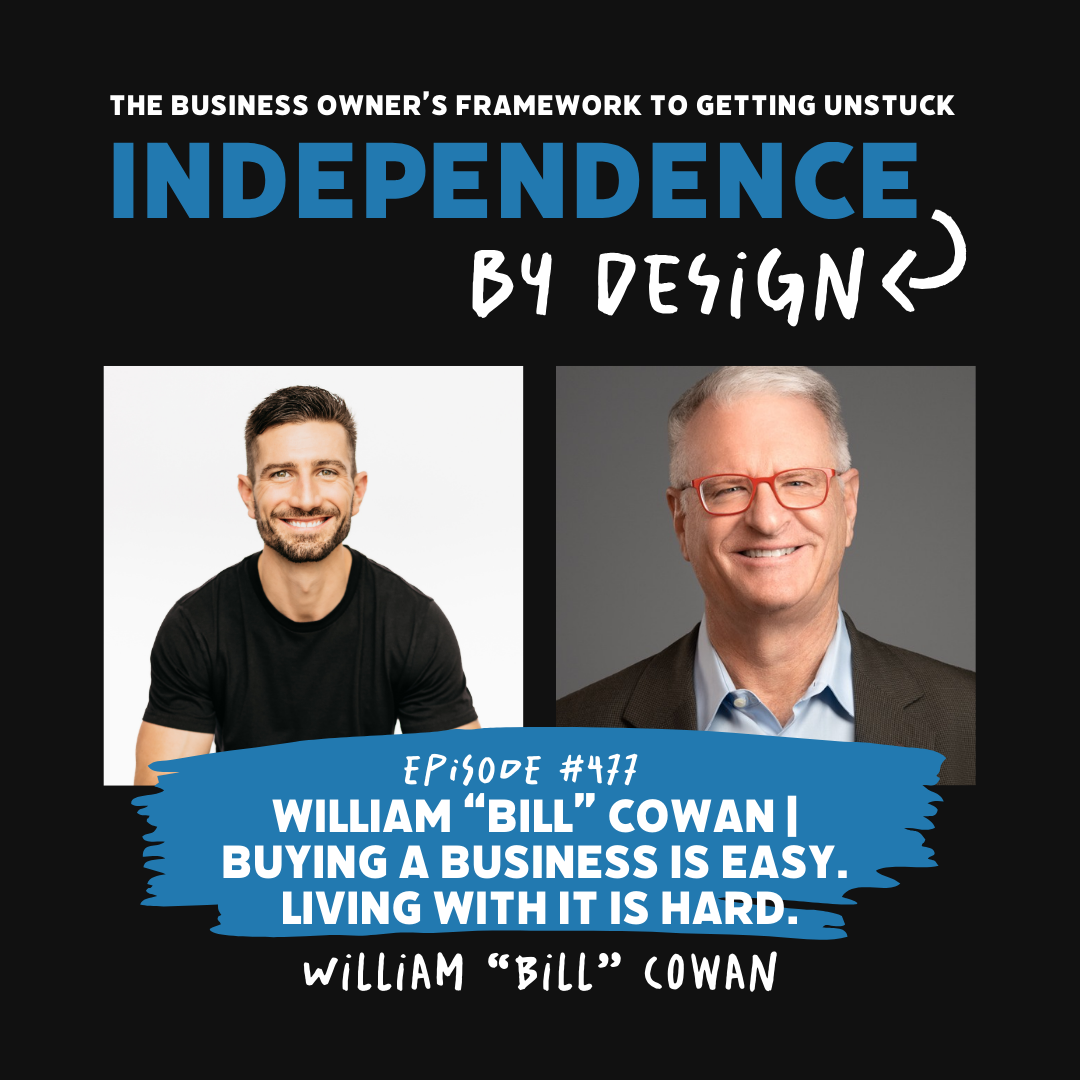
I was very excited to have Bill Cowan on the show because he was in a Vistage workshop that I gave four years ago and since then has launched his own group. And I was able to present to his group of entrepreneurs.
And I found out that Bill was the previous owner of Biolawn, which is a lawn care company that I personally use and really enjoy their services.
And so when I heard that Bill had bought that company, grown it and sold it, I couldn't wait to get him on the show. And he's going to be walking you through his whole journey, going from veterinary school and medicine to medical device to a higher education, to actually buying Biolawn, growing it, selling it, to becoming a business chair. I absolutely love hearing the context and the background behind why people make decisions. Bill walks us through what he actually capitulated on when he ended up buying the company and how he thought about that as he was growing a lawn care company when he didn't really care about lawn care and he actually wanted business to business and ended up being business to consumer. Just fun. Just hearing how people make decisions and how he ended up where he is today and what he thinks about the journey of buying, growing, and selling a company.
I know you're gonna enjoy this conversation because it was super fun to hear the full story arc. So without further ado, here's my conversation with Bill.
Well, Bill, I'm excited to have you on the show. It's been a couple years since we saw each other and. Yeah, I appreciate you, I think, was that. Did I see the post on LinkedIn and then you reached out, or did I read?
[00:01:43] Speaker B: No, I actually, the way I, you know, I. In my conversation on Chris Jones's podcast.
[00:01:51] Speaker A: Oh, that's what it was.
[00:01:52] Speaker B: Your name came up and I thought, hey, I should. I should let Ryan know that his name came up on that podcast. And so I shot that to you, and you said, hey, you know, we've talked about being on my podcast. Let's do that. Let's do it. Yeah, let's do it.
[00:02:07] Speaker A: Well, I'm excited and, like, I think we can set the stage for the listeners and then we can, you know, follow the story arc. The reason I'm excited to have you on the show is, you know, you and I met four years ago when you were about to launch your Vistage Group, I think.
[00:02:20] Speaker B: And I was just on the verge of launching. Yep. So I was in another. I was in a Vistage Group. Group about to launch A Vista.
[00:02:26] Speaker A: Okay. And when you told me like your.
Because it was Biolon, I think is what it was. Right.
[00:02:32] Speaker B: Yeah. So I have a. I have an unusual history, I guess.
[00:02:37] Speaker A: Why don't you give us a story arc and then we can unpack it.
[00:02:40] Speaker B: So. All right, well, I'm gonna. I'm gonna tell you. I. I grew up in Hopkins, Minnesota and went to University of Wisconsin for biochemistry. But I was really a pre vet, wanted to be a veterinarian.
Incredibly passionate about that. And so I got in the University of Minnesota after I finished up my biochem degree and graduated from the U and thought, all right, I'm going to be in private practice the rest of my career and I'm really excited. And about three years in, I got a. I was in small animal medicine and I got a call from a classmate who was the program director of the vet tech program at the Medical Institute of Minnesota. He said, hey, do you want to teach? It's like maybe. So wound up taking that and was an instructor there. But then he got promoted and so I got promoted to run the program. It was the largest vet tech program in the country.
And then I got somebody on my board for the program was working at Guidant Medical Device.
So I wound up going to Guidant out of that and ultimately became director of clinical studies, running pacemaker, defibrillator and congestive heart failure studies all over the world out of. Out of my department. It was an amazing experience. First of all, just being in a.
[00:03:56] Speaker A: Business, was it medical device? This might be a stupid question, Bill, but was it medical device for animals or for humans?
[00:04:01] Speaker B: For humans.
[00:04:02] Speaker A: Okay.
Making that transition there.
[00:04:04] Speaker B: Yeah. So it was.
It was remarkable. You know, it now is Boston Scientific. Guidant got purchased after a bidding war between three, I think it was no, Johnson and Johnson and Boston.
And so, I mean, people would literally come up to you and say, thank you for saving my son's life, and with tears in their eyes. And you'd start crying because you met people who were alive, because the devices we were making. So I love that time. With guidance and an incredibly well run company, an amazing leadership team, incredible culture. Everything that came good in my life, in a way, professionally, came out of that experience.
But then I got kind of tapped a lot. Yeah, it was amazing. And then.
[00:04:53] Speaker A: So would you.
Oh, go ahead. Well, I was just gonna say, like, I mean, like, how confident you are with how you said that. I mean, is there a certain, like, list of things like, what now that you have such a huge exposure to, like, lots of different types of companies and stuff? Like, what. What are some of the things that you look back and go, like, God, I'm so glad that, like, that's unique and that's what I took away from that.
[00:05:14] Speaker B: Well, boy, let me tell you a quick story. I had nothing but good bosses in most of my career.
I know a lot of people that look at me when I say that and are like, really? I've never had one good boss. You know, pretty much all good bosses.
There is two exceptions, but we don't talk about them. But one of them, his name was Jeff Sims, was really an amazing guy. And at one time he said to me, guidant doesn't offer you permanent employment. It offers you permanent employability because of what you'll learn here.
Cool. And it was true.
I learned so much from that experience that I could kind of go off and do anything with that background.
And I would advise anybody who's early in their career is build that portfolio of experiences that will let you do anything you want to do.
And so ultimately, I got tapped on the shoulder again, which has happened so many times in my career. I feel really lucky for it. Argosy University was looking for a president, so I left and went back to education, was president of Argosy.
That's where I met my first bad boss in my career. I did not agree with the chair of the board, thought the direction he wanted to go was not right. I was ultimately proven right there later. And so I left and I went to Brown College. I was president there, but for about six years, I was thinking, I want to own my own business because I haven't experienced that. I've been in these more larger organization environments and just want to know what it'd be like to run my own small business. So I was looking, and that was a tough search because when you decide you're going to move on and you're still in a leadership role, that foot in two worlds is not fun, you know?
[00:07:13] Speaker A: Yeah.
[00:07:14] Speaker B: Yeah. So.
[00:07:15] Speaker A: So how long were you doing that?
[00:07:18] Speaker B: Six years.
Whoa.
[00:07:20] Speaker A: You lived with that foot in each world for six years?
[00:07:23] Speaker B: It was terrible. It was terrible.
[00:07:25] Speaker A: Yeah. That's kind of mentally. I lasted six months or it was not like six. I'm sorry. Couple months when I. Because it's that all in mentality is.
[00:07:33] Speaker B: Yeah, you have to be. When you're a leader, you have to be all in and when you're looking to buy a business, that's a distraction, that's not good.
[00:07:42] Speaker A: What were you.
[00:07:42] Speaker B: What.
[00:07:42] Speaker A: What activities and efforts did you go through, Bill, in order to, like, look and like, how did you. How did you start wrapping your head around what did it mean to buy a business or run a business?
[00:07:52] Speaker B: Yeah, you know, I. Well, one of the pieces of that, you know, I.
[00:07:56] Speaker A: Part of the process.
[00:07:57] Speaker B: I hired several different brokers on that path. So I really learned about business brokers, and I. I had some that I were good learning experiences from the perspective of don't work with them again, I.
[00:08:13] Speaker A: Know what I don't want.
[00:08:14] Speaker B: Right. I know what I don't want. And that. And actually, that's what kind of led me to be on Chris's podcast, because I did find that Sunbelt did a great job. That was ultimately who I landed with after two or three kind of bad experiences. And. And so in any case, I, you know, in terms of. I, you know, I created a list of what I was looking for and why I wanted to do it and what was important to me, and that was a good thing to do. But it's also why it took six years, because I would. I probably evaluated 25 businesses over six years, and I always find. Found something that didn't fit with my list, you know.
[00:08:54] Speaker A: How many did you look through to even get to those? 25.
[00:08:57] Speaker B: Oh.
Oh, man. A lot.
I mean, it was just a thousand. Yeah, well, no, no, not that many. Not that many. That kind of time. But, you know, I don't know. I mean, a lot. I don't remember the number. It was a long time ago, but it was. It was a pain. It was ultimately what happened, Ryan, was I realized that I couldn't live like this any longer, so I actually resigned.
A great job, college president, you know, cushy.
One of the brokers said to me, why do you want to buy a business? I mean, you know, he's like, this makes no sense why you want to do this. I just wanted to have that experience on the PI index. I'm a venturer. I wanted to have a new adventure, and buying a small business was going to be a new adventure.
[00:09:46] Speaker A: So before we move on, I got some clarifying questions on this, because was there someone in your family or some person or experience along the way that provided you with the, like, hey, this is the experience that I want to chase. Like, how did you. How did you understand what that experience or what even have that inception of that vision.
[00:10:10] Speaker B: You know? No, my dad drove Taxi for blue and white cabs.
My mom was a.
A baker's assistant at popping fresh pies.
There was no entrepreneurial thing in my family, but, you know, I. I shoveled everybody's driveways as a kid and mowed their lawns in the summer, you know, and, you know, I mean, we were the poorest family on our block, so I always had that financial crunch in my back of my mind. I think that probably drove it a little bit.
[00:10:50] Speaker A: Was it back to the broker's question of why you're leaving Brown? So what I'm trying to understand, Bill, is like, was there a, you know, a personal growth moment that you wanted to challenge yourself with that you weren't getting at Brown? Was there income or wealth in pursuit that you were looking at, like, what.
What felt misalignment?
[00:11:10] Speaker B: It wasn't. It was. It's never been wealth for me.
I've always assumed I would get compensated well if I did good work. And I. And I always have. So I've never been driven by that. It's. It's wanting a new adventure. I get three years in to anything. I'm. I get bored.
I. I just get bored. And if I'm bored, I'm. I'm. There's probably nothing that makes me more miserable than being bored.
[00:11:40] Speaker A: I'm laughing because I. Man, do I relate to that. I actually, I. I've been. Yeah, I. I very much relate to that.
[00:11:47] Speaker B: I mean, throughout, you know, my. My wife, three years in, she'd look at me go, oh, here we go again.
And so, you know, so it was. It was wanting. And, you know, the other piece was for sure was that experience of the. The chair that I didn't agree with, but was unable to.
[00:12:10] Speaker A: Remove him from your situation.
[00:12:12] Speaker B: Yeah, I mean, I knew that it wouldn't work out. I knew. I knew he'd be gone, but I wasn't going to go through the two to three years it was going to take for him to be gone.
[00:12:19] Speaker A: Yeah.
[00:12:19] Speaker B: Got it. I didn't want to tolerate that. And so, you know, but. So having my own business, where I could do what I thought was right without that, you know, higher level. And I always, you know, even though I'd been president and, you know, at high levels, I was. I was, you know, I always had somebody above me and I wanted to know what it'd be like to be the final decision maker.
Of course, I learned that's really hard, too, you know.
Right.
[00:12:53] Speaker A: There's always someone, whether it's the customers or someone in the. Someone in the situation's got a say in it.
[00:13:00] Speaker B: Yeah, well. And even, you know, you're kind of two persons. You're. You have this obligation to the business and you have an obligation to your family and to your future.
And you're, you're at war with yourself sometimes a little bit, you know. You know, and that was something I'd never experienced before, which I'm glad I did, because I see that, you know, in the peer group, I see that tug, that challenge going on for owners all the time. You know, they want to take care of themselves and they also want to take care of their employees and their business. And sometimes those two things feel in some sort of conflict and it's uncomfortable. And when I had a board and was the president, you know, it felt like my fiduciary responsibility was super clear. I had a responsibility to, to ownership or whatever. And when I was the ownership, it felt like less clear, even though it shouldn't have.
[00:13:59] Speaker A: Well, it's small, small digression for a second because I think it's super relevant to what, you know, as I was giving you the update on my coaching program, like the ownership goals of what someone wants out of the cash flow and the valuation and what timeline it can be paralyzing. I think, Bill, to have it be up to us. But if we don't identify that point B, you're just ignoring the constraints. Right. So like private equity or venture capital or public companies, like the ownership goals and the mandate over reinvestment versus distribution and in the valuation and what timeline is very clear. And then it becomes very fuzzy where it's like, oh, I'm both hats on the operator and the owner. But if we don't identify those ownership goals, then it becomes so loose. And then like every decision almost becomes like this anxiety attack because you don't know how to contextualize it against the trade, because the trade offs aren't clear without that goal. Anyways.
I think it's interesting because it isn't very clear very often because we're not. No one's forcing us to come up with the clear goals.
[00:15:01] Speaker B: Yeah, no, that's 100%. Right. And I do think that's why the program you're doing makes so much sense, because you do sometimes need to be forced to go through that exercise and understand it with greater clarity because then you don't have some as much of the tug of war.
[00:15:21] Speaker A: It'll still be there, but at least the trade offs can be clear. Right?
[00:15:24] Speaker B: Yeah, it's. There's clarity around it. Versus often there is what if this, what if that. Yeah, yeah, exactly.
[00:15:30] Speaker A: So you, okay, you're going six years. You. You pull the plug to go all in. So if you. Have you found your. Your hit target by the time you. No.
[00:15:40] Speaker B: So I, I decided I needed to just. I wasn't going to do it if I didn't burn the bridge behind.
[00:15:48] Speaker A: What'd your wife say in your.
How old are you? What's the timeline? What's your family situation on this?
[00:15:53] Speaker B: My. My kids are about seven, eight, nine.
[00:15:57] Speaker A: Okay.
[00:15:58] Speaker B: And right around there.
And so I'm. I don't know. How old am I? You know, I'm in my early 50s or something like that, I guess. And so, you know, prime earning years. And, and everything's going great. I mean, I'm not really working tremendously crazy hours. I'm getting compensated very, very well. Life is great.
[00:16:18] Speaker A: Is your wife working? So, like, what is she working?
[00:16:21] Speaker B: But she works. She was a founder of a nonprofit.
[00:16:23] Speaker A: Okay.
[00:16:24] Speaker B: And there wasn't a lot of profit in the nonprofit, so she wasn't.
So it was.
[00:16:28] Speaker A: You were the breadwinner.
[00:16:29] Speaker B: Yeah, I was a breadwinner. And my wife is amazing. She completely supported me in that, even though she shouldn't have. You should have said, you're not quitting without a better plan than this.
And, but, and I, so I, I put in notice and I said, I'll stay as long as you want me to stay. Ultimately, they had me stay six months.
And. But when, but once I did did it absolutely lit a fire under me. I went, I went all in because I had the anxiety of, well, I don't have anything set up. And that anxiety drove me Now.
But here's the deal is what I did is I made a couple of compromises.
Really. One primary compromise on.
On my list is I wanted to. I want, you know, one of the things on my list was a B2B business, and I compromised with a B2C.
And I remember a couple of months in, or even a month in maybe I went, wait a second, why am I in B2C? I. It was on my list. It's right here. Why did I.
Because that anxiety that it created does cloud your thinking. You know, like, I started ignoring things because I wanted to conclude a deal. Ultimately, it worked out really well. It was successful and did a successful exit and all that. So it was, it was all. Well, it was the right thing for my family, gave me a lot of flexibility. So it was great. But if, If I were to advise somebody, you know, don't you don't need to make that compromise, you know of. On. On your priorities of what you want to do. And I, I did that and I wish I hadn't because I would be interested to have the experience I imagine which is B2B is a different kind of animal.
[00:18:23] Speaker A: I think. I think there's a really good gold nugget in there. Bill of like anxiety even though it can be healthy to drive us to get stuff done can cloud our judgment. But like that's where it's interesting balancing like the clarity of the goals to drive the. To drive the accountability instead of the fear I I had. We have this saying of my dad who I think a lot of entrepreneurs like this and I think interesting if your visage group of the people you know like so many of us like to see the world from the bottom of the pool. And like the moment my dad would get up from get some air he wouldn't know what to do. And so he would do make a decision to push himself down. And I watch people after they sell like they do the same situation because they're used to that cortisol rush. But we'll get to that after you've talked about your, your. Your journey of the exit. But I don't know, it's. It's a balance between the anxiety and the clarity.
[00:19:15] Speaker B: You know it is and actually it's interesting you say because you know I read a book, good book. Pause principle about the power of the net. The need to pause periodically because your brain thinks differently in a pause than it does in execution. And what have you. And that's what. That's what happens in a peer group is you. You pull out of your normal conversations, you're pulled out of your normal day to day tactical drive to create lists and get things done. And your, your brain, a different part of your brain engages and in a safe environment with people you trust and who can kind of keep you grounded and you come up with things you might not have if you do that on a regular.
[00:20:04] Speaker A: I love it. So when you were going back to as we and by the way I appreciate. Let me talk or ask me the most many questions about the purchase of the business because I think it's really fun Bill hearing the context that people and the trade offs that they went through when they jumped into it and then as you grew it and then as you saw it and then you're on the other side. It's just interesting to have the kind of the story arc because it's like it provides meaning to like, when you made a future hard decision, did you understand business valuations where you're getting like an SBA loan? Were you using personal funds to buy the business? Like, because what level of risk was in understanding evaluations did you have as you were going in to looking at the companies?
[00:20:46] Speaker B: Yeah, I didn't understand it as well then as I do now. I did use, I did ultimately decided to use personal funds because it gave me some flexibility that was, was helpful.
And you know, the, you know, there's another piece to this. The decision for me.
I had grown up, like I mentioned, you know, not the richest family on, on the block. Right.
And I thought it taught me some great lessons to, you know, I mean, I remember, you know, times being tight at times as a kid and my mom, you know, trying to, you know, scrounging enough money to get food on the table. And I thought that was helpful for me and I actually wanted my kids to have that experience.
Like I was looking at them going there, these kids are spoiled. You know, I can't help myself.
[00:21:42] Speaker A: Now let's make this difficult for all of us. The bottom of the pool.
[00:21:45] Speaker B: Like I was saying, yeah, they, they lack for nothing. And so I real literally said to them, hey, I bought a business. We're not going to take, I'm not going to be getting paid for the first couple of years and things are going to be tight. And even when we could pay for it, I just kept using that as a, as a way for them to, you know, have. They had a couple of Christmases with not many gifts and they still talk about it and they are incredibly financially responsible, which, you know, so I, you know, I, it had, it was good to have that tight period right after you buy a business. It was good for my family.
[00:22:23] Speaker A: So when you, how did you land on. So you said business to consumer. What was the business? How did you land on it and why?
[00:22:31] Speaker B: Yeah, so I, you know, I wanted some, you know, I had on my list something in education was one option, something in healthcare because I have both backgrounds or something that had an environmental upside. You know, so I looked at solar energy as, as one of the companies and you know, something that had an environmentally positive fact.
So ultimately, after a lot of different companies, I looked at, you know, I came across Biolon, which had this organic focus, organic lawn care.
And it wasn't. I really a lot of passion about lawns. Just another piece of this puzzle that I kind of compromised on a little bit. But I like the organic piece. And so that's really what led me to that? And it had great financials. I mean it was a well run company, was growing, just a nice curve. It was the first company that every company, other company I looked into, I found, oh, this is really why they're selling.
[00:23:29] Speaker A: Oh, that's such a good comment. Like, like how many times, like how much time did you invest until you figured out what those things are and what, what's a handful of examples of why people were. There was a health that changed everything.
[00:23:48] Speaker B: Yeah. There was a healthcare company I looked at that I probably was, I never got to true due diligence with any of the ones that I looked at. So thank God. But I don't know, I was you know, a couple of weeks in on that one and then in my research I went, oh, there's a, there's a, there's a Medicaid, a Medicare reimbursement change that's coming next year.
That's why, that's why they're selling, you know, because otherwise if it hadn't been for that, this was an attractive company to buy. But yeah, the change in, in reimbursement was going to be very harmful to this company. And so the stuff, it was things like that that you would discover. Oh okay, I'm not interested in this.
[00:24:36] Speaker A: What was the reason for the biolon sale and was it a franchise or.
[00:24:41] Speaker B: No, although it would be, it would make a great franchise.
[00:24:44] Speaker A: It's not a franchise.
[00:24:46] Speaker B: No, no it, it is not. No.
[00:24:48] Speaker A: So what, what was the size of the operations and like why were they selling at that point?
[00:24:53] Speaker B: Oh, it was, it was about 600k in total revenue. So it's not, not, not that big. And which, and the, the owner wanted to go into ministry and, and that was, that was the reason.
And so it, so he, he, he, he wanted to exit. He was a real young guy.
[00:25:20] Speaker A: And how long would the business been around?
[00:25:23] Speaker B: It had been around maybe eight years or something like that, but he had three years, had taken it from like a hundred to like 600. Like wow. Yeah. And, and then I tripled it. And so, so that was kind of.
[00:25:39] Speaker A: And how, how long did you own it?
[00:25:43] Speaker B: I own I. Nine years.
[00:25:45] Speaker A: Okay.
[00:25:46] Speaker B: Yeah. And, and, and which is, which is not my plan is donut for three to five years.
And there was a product defect that I had, I had to clean up before I could exit. It wasn't our product, it was product we bought from somebody else and it was, it was marketed as incredibly, this incredibly safe product.
Oh no, it was from a, from a human health Perspective. But it wasn't, it wasn't from a plant care perspective.
And so I want to get, I'm.
[00:26:19] Speaker A: Going to want to get into some of the gross stuff. I just want to. So when you, in nine years, you don't. You can share whatever numbers you feel comfortable, whether it's revenue, employee count.
[00:26:27] Speaker B: Yeah.
[00:26:27] Speaker A: Or. But when you say, so, like, what was the growth? And like how, how was the operations, the size of the operations when you, when you sold.
[00:26:37] Speaker B: So. Well, like I said, I tripled it and actually more than that, but.
Which is a complicated story, I guess. But it, I actually, the last several years, I actually restrained the growth.
I, I would cut off marketing when I could because I, one of the, one of the reasons I shouldn't be in a, in A, B, 2C businesses, I had a very difficult time with any complaints.
[00:27:06] Speaker A: Oh, interesting.
[00:27:07] Speaker B: You have thousands of clients.
[00:27:09] Speaker A: Yeah.
[00:27:09] Speaker B: You cannot run a business without complaints. And I would give, I would, I would lose sleep over complaints.
[00:27:16] Speaker A: I just apparently don't read the comments is what I've been told. Yeah.
[00:27:19] Speaker B: And so I just, was. I, you know, and so I, if I, you know, I would always try to never take the risk of exceeding our capacity to fulfill our commitments.
And so that was one piece. The other piece was, at a certain point in that industry, your number of buyers declines a lot. There's just not many buyers. And I wanted to keep it at a size that was sellable to a bigger, bigger group of people.
[00:27:50] Speaker A: You guys, I mean, like, you guys grew up. I mean, like, you're I, your brand. And I mean, like, I, I think when you told me, when I found out your workshop that you, it was Biola, I'm like, my God, I've been using you for years.
[00:28:01] Speaker B: Yeah.
I mean, the first, all that growth came in the first three years.
[00:28:07] Speaker A: Wow.
[00:28:08] Speaker B: Yeah, it was, it was, it was. The growth was. And then I kind of, kind of held the comp. Held it back because I didn't, I, I, My goal wasn't to build an empire. My goal. Well, this goes back to a story we didn't get to. I had decided I wanted to run peer groups before I bought Pylon. Oh, really? Yeah. I decided that's what I wanted to do and that's what I was going to do it. And I, I actually met with Floyd Adelman.
I don't know if you know Floyd.
[00:28:37] Speaker A: But he rings a bell.
[00:28:38] Speaker B: Yeah, he's, he's a great guy. He owned, I think, I can't remember if it's 10,000 auto. A champion auto, auto parts store back in the 70s and 80s and he owned one of the two, I can't remember which one it was. But anyways, very successful businessman. He also started a peer groups called Inner Circle.
And, and so I, I had lunch with him and I asked him about, you know, you know, starting a peer group. And he said, you know, Billy, you know, you have an interesting background, good executive experience, but you've never had to worry about making payroll.
You know, you haven't experienced what a small business owner's experience. You really need to do that before you're going to be any good as a running peer group. So I, so I stopped the idea. That's my business, I'm going to run a peer group and bought a business and joined a peer group. And so my goal wasn't to grow Biolon into this big thing. I wanted to do it for three years while I was in a peer group and then sell it and start a peer group. That was the end game.
[00:29:46] Speaker A: Well then three times longer than you thought.
[00:29:48] Speaker B: Well then this, this, this product defect thing, you know, caused me to have to, I just, it didn't make sense to sell it because I had to kind of see that through. Which, which we did. We got, got everybody through that and, and then, you know, so then I, then I sold it and was able to go ahead and start the peer group thing, which is what I really wanted to do.
[00:30:09] Speaker A: When you look back, if you were to jump on the call with Bill, who's buying Biolon, what are like the three pieces of advice you would give him?
[00:30:24] Speaker B: Oh, well, the biggest one would be what about the B2B bill?
[00:30:33] Speaker A: Well, you've already bought by one.
[00:30:35] Speaker B: I've already bought it.
[00:30:36] Speaker A: Yeah. Like don't rub it in your old past self space.
[00:30:41] Speaker B: Yeah, you know, that's a great question. I, I, in retrospect, I probably should have not put the governor on the growth of that business.
I probably should have leaned more into growing that.
The problem was I don't have a passion for lawn care.
It doesn't ex, you know, it's not, you know, it's the only, it's the first business I ever was in where I didn't love everything we were doing. You know, when I was in medical device, I loved everything we were doing. When I was a practicing veterinarian, I loved everything we were doing. When I taught. Oh my goodness, did I love teaching. Loved everything about teaching.
I liked running the business of Biolon, but I didn't really have a big passion for the, the actual Performance of fulfilling contracts.
[00:31:35] Speaker A: How did that, how did that dynamic ripple into your mental health, your family, like the business culture, like your leadership? I mean, how did that impact you?
[00:31:48] Speaker B: I think it definitely wore on me. I had, you know, I met with a business, a business guy that I had a lot of respect for, Ron Eckstam, a great networker. A lot of people, if there's a lot of people on this podcast, are going to know who Ron is because he's at every networking event that ever existed. And he, I don't know, maybe a year in, I met with him and I was pretty haggard. And he said, how much are you exercising? I said, well, not at all. He said, you need to start exercising.
Because I did feel stressed by, by being in a business that I didn't have that passion for. It used to be, you know, I'd wake up in the morning, I couldn't hardly wait to get into teach or to, you know, get into, you know, work on the medical device stuff, you know, because everything about it was interesting and fun and so, so I, you know, I, I learned that I had to exercise pretty much every day. And that was, you know, kind of turned that around and kind of got me back into a, A good energy state.
[00:32:45] Speaker A: So what was it like, Bill, buying the business, so taking your financial accumulation that you had until that point, putting a lot on the line, and it sounds like it wasn't B2B. So there was a big, huge miss there and you weren't passionate about it.
Did. How did you, did you process it? How did you process, did you have regrets? Did you, like, think about, like that, you know, you could have stayed at, you know, the, the Brown, you know, teaching and like, how did that, you know, I.
[00:33:16] Speaker B: Staying at Brown was not for, you know, I mean, I.
[00:33:18] Speaker A: Okay, so you didn't ruminate on that?
[00:33:20] Speaker B: I didn't want to. I didn't know. I didn't have regrets about that.
[00:33:23] Speaker A: Okay.
[00:33:23] Speaker B: I did have, I definitely had regrets that I didn't stick to my list. You know, I, I, you know, I didn't need to, you know, I did find before my last day at Brown because I, I think I was there for six months before I finally was, was done. I did close about a week after that. So I could have gone a couple more, three more months and, you know, just took a little bit more time and found something that would, that, that also absorbed my passion because the one thing that I, you know, I read it, I read this while I was looking, you know, find a business you enjoy running. Because you're going to be doing it a lot, you know, you're going to be doing it 70 hours a week, you know, at least at first.
And that really got, it really got drove home to me in the process of running that business is, you know, I don't love the, you know, what we're doing. As, you know, performance is not in my core. I don't love that.
And I wish I was doing something. I just, I love what we're doing. Like you, you don't have to pay me to do this because that's every other job I had. I almost felt that way. You don't really have to pay me to do this. This is so much fun. Being a veterinarian, working with animals. I loved it. You know, it was just a great thing. And I also got paid as like this extra thing, you know. And so anybody who's going to like leave corporate America to own their own business, make sure it's something you love doing because you're going to do a lot of it and you know, you want to love all aspects of it.
[00:34:56] Speaker A: What was the, the dynamic of the B2B that you were so focused on? Like what, why were you so focused on B2B? What were you trying to get out of that and why did you capitulate on the B2C?
[00:35:08] Speaker B: Well, I, I think one thing is, you know, you know, when you're in B2B, you're just in a lot more, I guess, professional relationships, you know, and you're cultivating long term professional relationships.
You know, in a B2C there's a lot more transactional and, and you're. I always, I think of it as trolling. You're trolling for problems. You have a lot of lines in the water and you're going to catch some problems no matter what you do. You're going to catch clients that you wished you hadn't caught because they want to make your life miserable.
[00:35:44] Speaker A: And do you think there's any business that, that doesn't apply to you, though?
[00:35:47] Speaker B: I, I think it's, I think you're right to a degree that's probably true.
But I just think in a B2B you're not, you don't have so many lines in the water. There's a better probability of, of having, you're developing deeper long term relationships, you know, because your, your business, you know, your businesses are more intertwined, it's less transactional.
I think at least there's more potential for that.
[00:36:17] Speaker A: I can see that. I could see that what were some of the things that worked well when you grew so fast? And like what, like how did that show up and what were you doing?
[00:36:30] Speaker B: Yeah, so, you know, it was a lot of, was reputational. I think we had a great reputation, you know, and we really did.
I think I enhanced that because I had this, you know, in veterinary medicine you can't have any failures. You know, you're, you're dealing, you're a family doctor for the patent. So you really, you have that ownership ethic of making sure every outcome's as good as it can possibly. I brought that into the business. I really worked my tail off to try to have, you know, create a business that had very few complaints. In an industry that complaints are actually fairly high. It's really, you know, you're, you don't, you don't control the weather, you don't control the, the, the substrate. You know, there's, you know, within limits. And so, so, you know, I, I think that was a big part of it. You know, I, you know, we did a lot of old school marketing that nobody else was doing. Everybody, you know, kind of moved away.
[00:37:27] Speaker A: From like paid mail. Mailers and stuff.
[00:37:30] Speaker B: Yeah, mailers and stuff. And they really, they really worked. And you, you could kind of set your, you could say, I'm going to spend, I want to grow this much. And if you spent this much on marketing, you would grow that much. It was very, you know, you know.
[00:37:43] Speaker A: You could see the through line, which.
[00:37:45] Speaker B: Is not very, it was a formula. Yeah. And if it was an industry where if you worked really hard, you'd almost always be successful. And I think a lot of industries that's not always true. You know, you can work really hard in medical device, you know, you can do a medical device startup and work incredibly hard. And it just, it's not in the cards. That was an industry that as long as you worked really hard and you were reasonably intelligent about it, you would pretty much were guaranteed a success.
It was a very cash flow positive. You're always in positive cash flow, which was really nice.
[00:38:19] Speaker A: Which is really nice. There's a lot of people listening here going, yeah, wouldn't that be nice?
[00:38:24] Speaker B: You were always, were in positive cash flow. And that was customer deposit.
[00:38:28] Speaker A: That is the benefit of B2C prepaid services.
[00:38:31] Speaker B: And so that was fantastic. And you know, it also I had young, still had young kids who had things that I need to deal with and it gave me a lot of flexibility to be able to take care of them. So it was a great choice. Ultimately it all worked out. You know, I did well on the exit. The new owners are doing really well and love running that company.
And they're both master degree to horticulturalists from the University of Minnesota. This is what they love doing.
[00:38:59] Speaker A: They're not vets.
[00:39:00] Speaker B: Yeah, they're, they're, yeah, I'm a veterinarian. I'm just, this isn't, you know, I did, you know, I switched industries five times in my career. One of those was not the right industry for me.
[00:39:12] Speaker A: What did you learn about yourself by not being in, what did you learn about yourself with that experience?
[00:39:23] Speaker B: Well, I don't know if, I mean, I imagine I learned a lot of new things. I don't know that they feel that new. I mean, I, what I learned, I've learned over and over again is I can, I can walk into almost any industry and figure it out.
You know, I did figure it out. I, I figured out how to do something I'd never done before.
And you know, that it's, it's a great confidence builder when, you know, no matter what I land on, I'll probably figure it out and I'll be fine and I'll, you know, I'll make it work.
[00:40:00] Speaker A: What is your, what's your process for dissecting what to do and what to work on? Like, and my, maybe my follow up question to that, Bill, is that because you bought the business, here's where I think it's a unique dynamic that I've, that it's a divergence that I've seen of people that I've interviewed is like when they have this understanding of how valuations work because it starts changing your behavior.
So you bought a business so you kind of understood, I don't know if you, I mean you understood what created value and you know, they're going through due diligence and they're always, you're finding the why someone's trying to sell. How did that understanding of valuations and you knowing that you wanted to get out from day one, how did that impact what you were doing in the business and how you were making decisions?
[00:40:41] Speaker B: Yeah, there's several questions about it or I think there's several questions embedded in that question. You know, one was it was incredibly helpful to know on day one, my goal is to sell this business in three to five years.
Because everything I did was around how do I make this the most sale, saleable business possible?
How do I make it such that I get the best multiple I can get? You know, so I, I, you know, right away I'm like, how do I build a team that will I can leave behind? How do I divorce me as a person from the business?
I would guess that the majority of our clients didn't know I was the owner.
I, you know, something I had to stamp out amongst the office staff is, well, let me talk to the owner. No, no, no, no. I don't want them to care about the owner. I want them to care about the business.
So, you know, I was constantly creating documented processes and procedures so that, you know, the next owners could take it over and have that all in hand, you know, and that would be part of the, essentially the IP for the business is how do we do things?
So I always had an eye to that as I, as I built it. And that was very helpful. Kept me very focused on that, that end game in the in.
[00:42:10] Speaker A: Because I think the trap that people get into. When you said that you were kind of suppressing some growth, I mean, it sounds like there's practical reasons for.
And I'm curious, I want to hear a little bit more about the, like the spectrum of buyers and stuff like that. But what I see, Bill, a lot of people get stuck in is this solving for annual income, like reducing costs because they want more K1 income versus the normalized Z. But in the multiple growth, which is just, you're reinvesting. So any thoughts and like that mindset and how you like, did you.
[00:42:44] Speaker B: Yeah. You know, I kind of alluded to this earlier and it's, it at times might be a flaw, but I have had a lifelong philosophy of believing that if I work hard, I'll get well compensated.
So I've, I've kind of never worried about, in anything I've done.
I never, I've never really worried about how much I'm going to make. I've never negotiated a salary.
I, I've always just expected that I'm going to be treated right, whether it's by people who employed me initially. And then in my business, I just, if I work really hard, you know, I will make the money I need. And it, and so it, it was, it. I wasn't kind of focused on that. I know some people are like, how do I make sure I'm going to make this much this year? I didn't kind of, I didn't start that way. It was like, I'm going to work really hard to make this as successful a business as possible. And I assume that if I do that there'll be enough money left over for me. And there was, I mean it, you Know played out that way. So I was less intentional than your. I think you're, I think in your, that's embedded in your question.
[00:44:01] Speaker A: I think that's a fair, fair point. Have you, with your visage, in your exposure to other business owners, have you seen any examples where someone assumes that and it doesn't play out well?
[00:44:15] Speaker B: Assumes the way I operate. Yeah, yeah.
I don't, I think that that almost laissez fair way of, of, of approaching it is not common. So I'm not sure I've actually run into that before.
[00:44:34] Speaker A: Really.
[00:44:34] Speaker B: I don't know. I think, you know, most of the owners that I work with, I mean, I think that's probably in there somewhere. But I don't think, I think I've been pretty.
It's part of what let me walk away from a very high income job and go buy a business that wasn't going to be any produce anywhere near the income that I had because I just had this faith that, you know, it would if I just put in the right amount of effort.
So I don't know that I've, I've run into anybody who's shared that particular kind of approach to it.
[00:45:09] Speaker A: I think it's interesting. I, yeah, I, I have seen. I, my, I have personal exposure to a spectrum from like your laissez faire to like I think there's potentially too rigid and too over engineering of it. Yeah. And I've seen, I've seen things, you know, unfold various degrees and that's why I was asking because I've seen people where like they do have the right intention and like I see employees take advantage of them or their customers take advantage of them where they're not getting the margins they should. I mean it, it's not always necessarily on the valuation side. It's just.
[00:45:41] Speaker B: Oh, I see that. Yeah. You. Now I agree with you. Yeah, I see that I.
Pricing, I mean that, you know, there. I, I've seen a lot. I've seen owners feel guilty about the prices they're charging when they should, when they're undercharging.
[00:45:58] Speaker A: Yeah. Yeah.
[00:46:00] Speaker B: So from that perspective, yeah, I see that happen fairly often.
[00:46:05] Speaker A: So you had said that you had decided to put a governor on it because it, you thought or it did have an impact on the types of buyers, spectrum of buyers. Like who did you think were the potential buyers? And, and why. And what, how did that size impact that?
[00:46:22] Speaker B: Yeah, so I, I saw, you know, there's a point in that industry that you're really going to have to sell to A large corporate national chain if you get to a certain size and because Biolon had this organic focus that there's, that wouldn't probably that buyer would, would buy it, but then they would just get rid of that immediately.
[00:46:52] Speaker A: Get rid of the competition because it pissed them off because they were doing other things.
[00:46:55] Speaker B: They would just, they would just get rid of all, anything that was organic or had.
[00:47:00] Speaker A: That's what I mean. Like they would have like. Yeah, yeah, yeah, yeah, yeah.
[00:47:03] Speaker B: And, and so it would cease to be. And it would probably really aggravate the client base, you know.
Yeah.
[00:47:11] Speaker A: I'll tell you what, if I was like using Biolon and then all of a sudden they're, God, all the chemicals going on in my.
[00:47:17] Speaker B: They'd be mad. And so, so I just was like, I think I want to have, you know, more somebody like me, you know, who would be a, you know, a local person who would buy it, you know, or, or, or be merged into another company or somebody would want to take it out, make a franchise out of it.
[00:47:36] Speaker A: So what was your level of exposure of like esops employee stack ownership plans or like.
Because I like doing some sort of internal buyout or like.
[00:47:50] Speaker B: Yeah, you know, I didn't really become aware of ESOPs until actually I became a Vista chair.
[00:47:56] Speaker A: Not shocking.
[00:47:57] Speaker B: Yeah. And I'll tell you, it's funny because I.
Amazing way to exit a business, you know, so much flexibility.
[00:48:05] Speaker A: Yeah. It's buying, buying a cash flowing company as long as the company's cash flow can service the debt. I mean, which is the same thing. Did the, did the two horticulturalists, did they buy it with an SBA loan or how did they, did you market it with a, like Sunbelt again? Like, how did you go about selling the business?
[00:48:20] Speaker B: Yes, Sunbelt was, had some involvement. They ultimately that wasn't how it finally worked out, just because it's complicated. But you know, I did, I did work with Sunbelt to a degree on.
[00:48:34] Speaker A: Was it complicated? I'm, I have no idea. You've never told me this, but what I'm hearing is you listed it with them, you found the buyer and then they still had an exclusive or something.
[00:48:44] Speaker B: There was a few, there was a few, there was a few buyers that I had excluded because they had expressed interest in the past.
[00:48:53] Speaker A: Oh, got it. Okay. Got it.
[00:48:55] Speaker B: And so, so in any case, how was the sale?
[00:48:58] Speaker A: Like, so did, how was your understanding of transactions and that Nine years and thinking about the end of mine. How did it prepare you for that day? Like, how did, like how did you understand like, did they. Did they have bank financing? Like, how did, like walk us through, like, what was the process of. Actually.
[00:49:16] Speaker B: Yeah, how did you feel? They had. Yeah, they had bank financing. And you know, it was. I, you know, I did some stellar financing as well. So it was a combination.
And you know, it. Here's the. I guess here's the thing that the structure of our deal was unique.
Of. I took, I was, I took on a lot of risk. There's a lot of performance in it.
[00:49:42] Speaker A: Okay.
[00:49:43] Speaker B: And it was because I believed in these guys.
I knew they would.
First of all, I, I trusted them. Like, I knew.
[00:49:52] Speaker A: How did you build that trust?
[00:49:53] Speaker B: I'd known them for quite a long time.
[00:49:57] Speaker A: Really?
[00:49:57] Speaker B: Yeah, I've known them for quite a long time. That's why I excluded them from as you know, because I.
[00:50:04] Speaker A: Were they advisors in the business or like, what were they?
[00:50:07] Speaker B: One of them actually had been. I had bought from. He. He was. I bought product. Okay. This company and the other one.
I also bought equipment from the other one. And I knew they wanted to start a.
A business and we'd had conversations and we couldn't make it work. And we couldn't make it work. And then it kind of went quiet and so.
But ultimately we put a, you know, a structure together that was very unique, that met their needs and met my needs. And if it been anybody else, I wouldn't have done it because I took a lot of risk in that. But I knew I could trust them because they were honest. Honest kind of core Minnesotan kind of people who also, I knew would run it, the business incredibly well, better than me and brought the right experience and, and knowledge and had business savvy because one of them also has an mba, you know, and so masters in horticulture and mba. And so I just knew they would be successful. So I knew that that risk wasn't as significant as it would be.
[00:51:17] Speaker A: Is it something like an earn out where like you had like some seller's note plus like performance based. So that way, like.
[00:51:24] Speaker B: And a lot of it was in the performance side and it made that really. Yeah, a lot of that made it work for them.
And you know, and they're. I think they're incredibly happy because it did work for them and I'm happy because it worked for me. I got my. Took me longer to get my money than I would have liked, but ultimately I'm really happy with how it turned out. And so did it.
[00:51:47] Speaker A: Did that flexibility that you gave allow for the deal to be done? Because I think in the Lower middle market sized deals, cash flow being such a constraint becomes an issue because like you, the SB loans, what makes the SBA loans work is you have 10 years to spread that payment term out. But the bank's holding it for 10 years because it's a, mainly. But then if you start trying to get, you know, you smush that payment together that it, you know, suffocates the cash flow. So then it becomes this really weird deal structure dynamic. Which is why I find it fascinating that the level of trust that you had on them because it's almost a necessary part of that to get the deal done.
[00:52:25] Speaker B: Yeah, yeah.
Would not have worked with anyone else and had I showed it to a savvy advisor, they would have said, no, don't. This is a terrible idea. Why are you doing this? You know, this is a successful business that makes money and you don't need to do this. But I just, I believed in them and I knew that, you know, we structured in a way that I was ultimately got what I wanted to get out of the business. Just took me a little longer to get it and because I trusted them and knew they do good work.
And then, and then three weeks after we sold the pandemic hits.
[00:52:57] Speaker A: Oh.
[00:53:01] Speaker B: Oh my goodness.
[00:53:03] Speaker A: What did they think? Welcome to business. I mean, like, oh my God.
What did they call, what was that phone? Did they call you up? You call them up?
[00:53:12] Speaker B: What? I think, I think I called first and I, I will tell you, I felt a weird guilt like, like I didn't, I didn't know this was coming. You know, like, how could I? Because I was, I, I was also quite lucky. I didn't have to deal with the pandemic, you know.
[00:53:30] Speaker A: Yeah.
[00:53:31] Speaker B: Exited it at a really good time. And I, but I felt kind of guilty, like, oh my goodness, you know, they must, they're dying right now.
[00:53:40] Speaker A: That must have been emotional for them because I mean everything shut down and then everything went up like a freaking rocket ship for home services.
[00:53:50] Speaker B: So like it, it really worked out to be. But you didn't know that was going to happen. Right, right.
[00:53:56] Speaker A: That's what I'm saying. Like the emotional, like the emotional whiplash of over even like 90 days was intense.
[00:54:01] Speaker B: But you know, I tell you what, it, it's interesting because that if there's something I learned from all the business experiences I've had is be tenacious because things will, more, will more often work out than they don't. I mean, I, I, there are bad stories out there where it doesn't work out. But Tenacious people tend to find a way to make it work. You don't have to get every choice right because you have an influence on the outcome and you have more influence on the outcome than you realize.
And so you can, you can make, you can, you don't have to get the perfect choice because that can be paralyzing. I was paralyzed for six years trying to make a perfect choice.
I didn't make the perfect choice, but the effort I put in turned it into, in retrospect, pretty great choice. It all worked out. Everybody, everybody kind of won at the end of the day.
[00:54:59] Speaker A: What now that you're in vistage as a facilitator and chair, when you think about like the dynamics you've had of teaching versus medical versus owning a business, you thought it was going to be B to B, now it's B to C. Like how do you think about the jigsaw of like aligning the puzzle pieces to enjoy the hell out of what you're doing every single day while making money? And like, like when you prioritize your, your week and what makes you happy, like, how do you think about it?
[00:55:37] Speaker B: Well, one thing I think about often is I wish I had had the opportunity or had been able to do this 20 years earlier because I, I, I love doing this.
The thing I love more than anything was when I was actually teaching in the classroom. That's the job I actually enjoyed the most of anything I've ever done.
But this is a very close second and I would have gotten bored with teaching eventually. You know, it's a little bit of a Groundhog day thing.
You can only teach a class differently if so many times, whereas this is infinitely variable. You know, I'm working with essentially 12 to 16 businesses at any given time. Each one's really unique, unique problems, love troubleshooting, love working with business owners and CEOs. I just, I just, I feel tremendous gratitude just to have an opportunity to do this. And it's, I'm not having, I had a little dip, you know, at the three, about the three year mark and, but I said to my husband to.
[00:56:44] Speaker A: Pull a grenade and try and figure it all out.
[00:56:45] Speaker B: Over the years I get kind of get bored and I want to do something else. And I felt that at about the three year mark, but that's kind of gone away because there's nothing else better than this. Like I survey for me, for me, I survey what other things could I do? And I go, I wouldn't enjoy doing anything more than this. And at this stage of My career, it's nice to be doing something that there's not an alternative that is at all attractive. You know, Whereas before, I think earlier in my career, everything was shiny and looked like it might be fun to do, I thought, literally, I thought lawn care might be shiny and fun to do. I discovered, actually, no, it's not that fun to do.
[00:57:29] Speaker A: I, I do find it kind of fascinating how much you just don't enjoy.
Because I actually like, I like, I love, I actually love my lawn and I love lawn care. But I think it's just funny because I felt the same way, Bill. Like when I got to the family business and like, it was copiers.
I mean, like, yeah, who gives up living shit about copiers? Not me. And like my dad, like, like, he was like, oh, technology. And I'm like, dad, this is not technology anymore. Like, you can't convince me this is tech. Like, it's a fricking, like we're duplicating pages.
[00:58:05] Speaker B: Woo.
[00:58:05] Speaker A: And like, And I just like. And that's why it's really interesting. But like, that distraction that I wanted was I pulled us into the IT services way faster than I should have. And it's really interesting. I look back as a, you know, into my young days, I'm like, oh my God.
Interesting. But yeah, it's like trying to find the leadership, the business stuff inside of an operations. Like, you can kind of balance the two. And like, is that going back to that, that mentor of yours and said, choose something that you love to do.
[00:58:37] Speaker B: What?
[00:58:38] Speaker A: Or no, I'm sorry. No, it wasn't true. Something I loved. It was the guy that said I was it Beck, you said, was the guy's name about join a peer Group.
[00:58:45] Speaker B: Or Floyd Co. Floyd said you need to know what it's like to be worried about making payroll. That was literally the example he gave.
[00:58:54] Speaker A: And, and that's what I wanted to go back to of. Now that you sit in front of these 12ish business owners.
[00:59:00] Speaker B: Yep.
[00:59:01] Speaker A: What are the pieces of empathy or the variables that you have that you're going, oh my God, I know exactly what that's like.
[00:59:10] Speaker B: It happens almost every day. You know, it's, you know, part of it is when you're the owner or the CEO, every decision you make has kind of an upside and a downside for somebody in the organization or what have you. There's, there's, you know, and, and, and it's not, it's. It's easy. It's not easy to decide. It's. It's hard because you're in the center of a hub where every decision is impacting lots of different things. And you have people who are coming to you representing one, one part of that hub. And you're trying to rep. You're trying to think about the whole hub.
And that's what's hard about being in the center of the wheel is understanding. And that's why a peer group I find to be so powerful, because everybody in that room sits in that seat where they realize every decision has an upside and a downside.
And I'm trying to think about it all and get to the best decision I possibly can.
Before that, when I'd been a director of clinical studies and even when I was the president of a college, it's like it was different when I was an owner. You know, it had a different vibe to it.
And so, you know, the, the, the having Floyd was right.
I am so much a better chair because I own my own business and I had the fears and anxieties of running my own business. Any other position I had, I could resign at any point, walk away and be fine.
You, when you own the business, you can't just walk away one day easily. You know, it's a process.
[01:00:58] Speaker A: You have to go easily.
You could. It would just blow.
[01:01:04] Speaker B: It'd be ugly. It'd be ugly. You know, and so, you know, that, that was, you know, there's many times when I think, oh, I've been in that situation now what that owner should do isn't necessarily what I did in that situation, you know, so I'm, I'm, I'm not always saying, hey, I was there before, but I have a better sense of the questions I should be asking so that they can get to the best place for them.
Because really that I was there and a similar space is helpful for me to have empathy, but it doesn't tell them where they should go.
[01:01:43] Speaker A: Right, right.
[01:01:44] Speaker B: They need arrival.
[01:01:45] Speaker A: What are your thoughts about?
Because I'm thinking about like, okay, you wanted to sell after three years and it was nine. You had that product situation.
Wasn't B2C. It was. It wasn't B2B. It was B2C. It wasn't. Wasn't an industry you're totally infatuated with. What, what are your thoughts about doing things that you don't want to do and doing them anyways?
[01:02:11] Speaker B: I think that's life, isn't it?
I mean, you know, this, you know, this idea that everybody's going to go out and do their quote unquote passion, you know, Somebody's got to do the stuff that, you know, I mean, what's that, what's that TV show, the Dirty Work or something like that?
[01:02:28] Speaker A: Yeah, micro. Yep.
[01:02:29] Speaker B: Yeah. And, and so there, there, every business has the unpleasant parts of it, you know, even the ones that I had passion and there's parts of it that you didn't like and usually those are the ones that you're best getting done first because the stuff you don't like often is best to get off your plate early and, and, and well, when you have the energy. So you know I eat the ugliest frog first, right? Yeah, that's right. I think you do have to eat the, eat that frog first. And, and, and, and so I, I, and I, I do. Sometimes the biggest thing that happens with owners is they're slow to make a decision because they're worried about getting it right.
And a less than perfect decision made timely is better than a perfect decision made late.
[01:03:24] Speaker A: Well said. My God, I could cheer that way all the way to the top of a mountain. I saw this other quote yesterday, Bill, that I thought was interesting. It was when you don't know what to do, do something because it'll give you data and like as long as it's not something that you're risking like a 30 year bet. Right. Like maybe do something that's a quick data feed but also not hugely long term impact, but like doing something gives you, gives you feedback.
[01:03:53] Speaker B: Yeah, that, that boss I mentioned who was one of my great bosses, Jeff Sims, he used to say everything's a test.
We're going to run this test, gather the data, make another decision based on the test, you know, versus every decision is a thing in concrete that can never be changed.
[01:04:11] Speaker A: Yeah, yeah, yeah.
[01:04:12] Speaker B: And so I think having done things where they weren't perfect and I didn't make exactly the right decision, what I learned from it was you can still turn it into a good thing. You can turn it, everything can be turned into an opportunity. In fact, you know, sometimes that's a really helpful way to find the best solution is this thing sucks.
Okay. How can I turn that into an opportunity? And when you pause to work through how can this thing that sucks become an opportunity that often is the road to solving it?
[01:04:50] Speaker A: I love it.
As you look to the, the coming year, what is one thing you think you like? The group of the owners and the people that you or your owners, what's one thing that you think that people should be paying attention to and why?
And then what's one thing that you think is a unique opportunity and why?
[01:05:20] Speaker B: Well, what should they be paying attention to is not always focused on horizon, which is, it's good to look at the horizon and where am I headed? But there is tremendous joy in what you're doing today to get to that horizon.
You know, being always focused on the end and not enjoying the moment is not a good path, you know.
You know, so I just think, you know, at this, at the end of the year, it's, it's a good time to think about how next year will I be proud, present in the moment and think about, you know, these hard decisions I make right now.
You know, this is part of my journey. I'm going to enjoy that. I'm going to enjoy this moment right now. I, you know, one of the things I talked with my group about is, you know, take a sensory audit periodically.
You know, what am I seeing, what am I hearing, what am I smelling, what am I tasting? Anchor that memory. Because you don't want to get to end your career and go, okay, I got to the the end, but what, what happened? You know, you know, what did I enjoy along what I enjoy along the way? You know, it, it's only a great career if you enjoyed the whole journey, not just getting to some horizon point.
[01:06:45] Speaker A: I love that. Well, just give a quick comment on that, Bill. It's like I, I was interviewed a guy last week who's unbelievably successful. He's like, these are the good old days. At one point we're gonna look back and, and it's like, you know, this whole life is a journey. It's like the whole point of a roller coaster isn't to be done with it.
It's actually, it's getting on the freaking roller coaster.
[01:07:03] Speaker B: Yep. So pause, take a sensory inventory, lock that memory in. What's good about it. Learn from every day in terms of what's an opportunity.
I've seen the future many times.
That's the cool thing about being in your 60s.
I've seen the future many times.
I remember at Guidant moving from inter office mail to email.
And I remember going, wow, that is so efficient. Unbelievable. This is amazing.
And AI is the Internet all over again.
And you know, as much as we know it's going to change everything, we don't realize how it's going to change everything.
And I do think a lot of people are dabbling.
Yeah, I think your last guest was an AI, right. I need to call him, by the way.
[01:08:03] Speaker A: He does a bunch of research workshops. I think you'd like him.
[01:08:05] Speaker B: Yeah, I got to talk to him.
You know, stop dabbling in AI it's going to change everything. And if you're dabbling, you're.
You're not taking advantage of this. It is. It. In the same way that we went from inner office mail, people carrying boxes of physical mail from office to office, it. We're gonna. In five years, we're gonna go, wow, I can't believe we used to do this this way.
[01:08:35] Speaker A: How are your. How are the business owners that you're exposed to?
How are they approaching it mentally and, like, practically.
[01:08:44] Speaker B: Yeah. So, you know, they're all trying to push that envelope.
So it's. It's a. It's an onion that they're trying to peel a layer at a time. And that is the way it's going to work is. Is a layer at a time. You're not gonna. It's not gonna happen all in one fell swoop. It's gonna happen a piece at a time. And as long as you're. I think for them, as long as they're taking, what's the next logical step? I think of as, like, what's next door to this? Okay, go. Go into that door. Okay, great. What's next door to that?
Go through that door, and you got to keep marching along. I. I think the one piece where everybody is probably slow is I think we need to start putting more resources against it, you know, hiring people within your organization who are going to focus on that implementation to help get it done. Because there's. There's tremendous.
[01:09:37] Speaker A: It is now, it was fascinating to have Tyler on because, like, it's very similar to how I approach just get done. Like, go in there, take a problem, tackle it, get it done. And it, like, I'm seeing Bill, like, it's just finding people that have curiosity and aren't scared of something, just letting them, like, run with it. It's like. I don't know. I. Like, I saw this with, like, you know, with my generation, because I. I grew up in this weird tweener or, like, as a 86 millennial, I grew up with no Internet, essentially. I mean, like, I mean, I did. Like, I got my first. Like, our family got a compact computer when I was late high school, we got Napster and AOL or whatever, but, like, 0 through 16. Like, there was no cell phone.
You know what I mean? So it was, like, effectively the same growing up.
[01:10:23] Speaker B: Right?
[01:10:24] Speaker A: More so to you guys than even my younger brother. And, like, I'm only bringing this up because a lot of People, my generation, like, you can't break the Internet and most of this stuff versus, like, I think some people think that you're gonna like you, and you realize that's different every single day. So you're just always expecting it to change versus I think I've seen a lot of people that go and try it and like, oh, that didn't get me what I want. And then they like, write it off. And it's like kind of just constantly having that beat your head against the wall and just default to trying it out, because all of a sudden it starts blowing your mind that it changes and you just start getting that addicted feedback loop of just, you know, getting the little stuff done, then the bigger stuff back to your onion point.
[01:11:04] Speaker B: Yeah, yeah. You have to. You do have to keep at it because it's it.
We've all experienced AI does stupid things and I've made up people. Right. I've seen people write it off. This isn't going to work. Well, I remember the first time I saw somebody with a cell phone. It was a brick.
[01:11:25] Speaker A: Yeah.
[01:11:25] Speaker B: At the University of Minnesota. I'm a veterinary student at that point. He's calling his construction crew on this brick.
You know, five years later, just like flip phones. I mean, it just how. You know, just how quickly it went from a brick.
[01:11:40] Speaker A: Yeah.
[01:11:40] Speaker B: To, you know, and just, you know, as we all know where it went and we're in the brick stage of AI, you know, it's clunky and.
But it's hap. It's going to happen in a big way and. And the more you engage with it, like you said, the more you're gonna get. You're gonna get into that flow and it's gonna become a natural extension of things you do.
[01:12:07] Speaker A: It's awesome, Bill. So fun getting to hear the full story. Any last thoughts or, like, I mean, if you, you know, for the listeners. I don't know. You don't have to come up with anything specific.
[01:12:17] Speaker B: You know, I. I'll say that, you know, the reason you and I are talking is I first saw you present the work you do and why it's important at a Vistage meeting four years ago when I was a member, and I thought it was very impactful. I still think about some of the things I learned in that session. So I appreciate the work that you do with owners, and I think it's incredibly valuable to ultimately treat your business like an asset and be more rewarded by being part of it. And when the time comes to exit, be glad you exited. Not regret it.
[01:12:52] Speaker A: Yeah, I appreciate that, Bill.
I can put your LinkedIn if you want to help. What's the best people for the best way?
[01:13:00] Speaker B: Yeah, LinkedIn is the best. My LinkedIn is the best way to probably reach out to me. I, you know, the beautiful thing that with my group is, you know, we have a lot of, you know, people join a group and stay for a long time. So probably looking for one, one additional member right now. That and what's cool about one additional member for me is is they every new member brings this new dynamic to the room that just is so much. It's like so exciting when a new member comes into the group because there's this whole new dynamic.
[01:13:32] Speaker A: The whole thing orients differently, totally gets changed.
[01:13:35] Speaker B: The whole culture of the room changes by that one new member every time it happens. And so I'm always excited by as a new member enters the room because of the shift that happens in the room, because they bring some special sauce that just helps remake things yet again. So.
[01:13:52] Speaker A: Well, thanks so much for coming on. This has been a blast.
[01:13:55] Speaker B: Yeah, it's been a blast as well. I appreciate it. Thanks for having me.
Sa.