Episode Transcript
[00:00:00] Speaker A: Welcome to the Independence by Design podcast where we discuss what it means to be a business owner and ways to get unstuck from the day to day so we can design a business that gives us a life of independence.
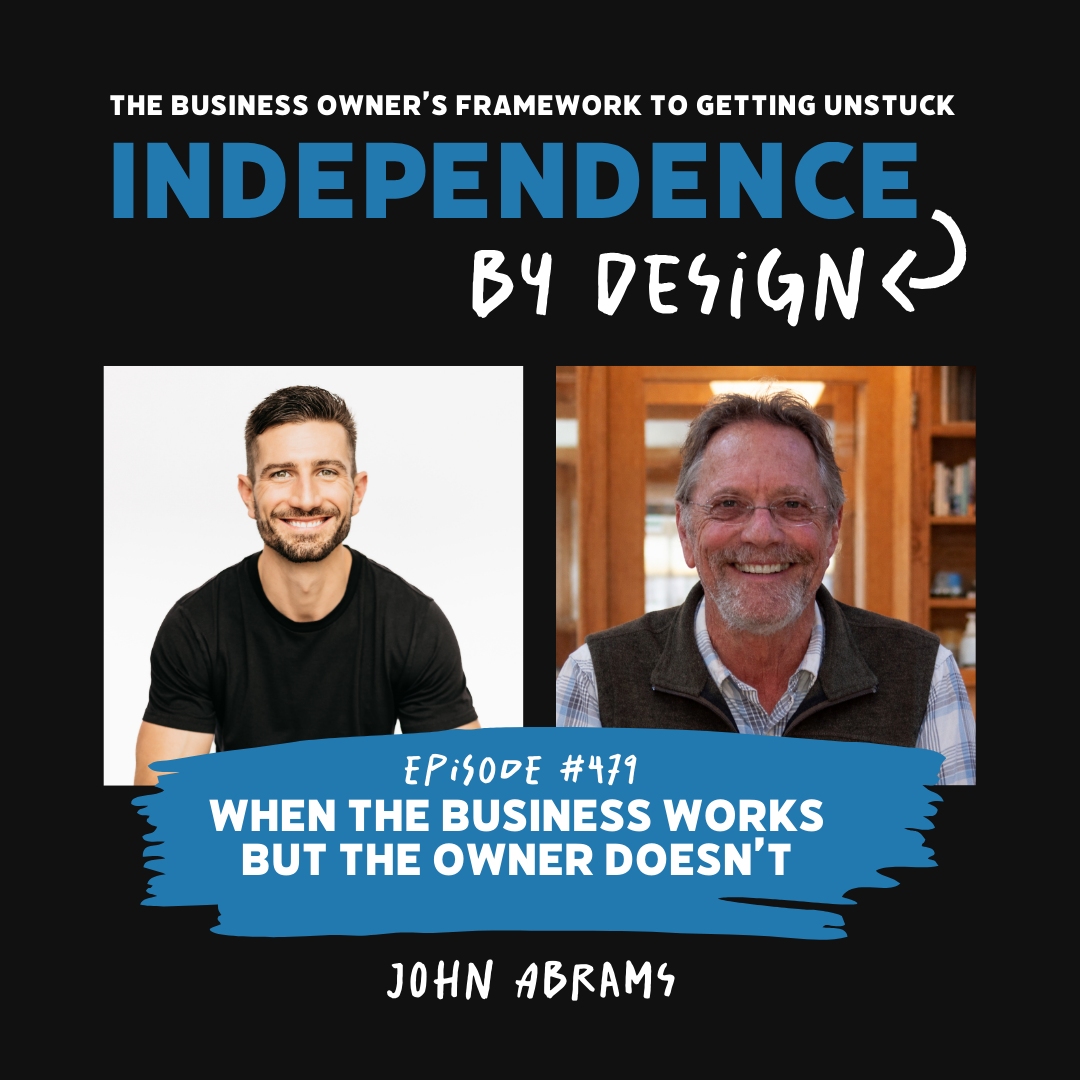
One thing that fascinates me, and I get a lot of enjoyment out of, is talking to people that really understand the operator role and the ownership role. And I love understanding how people go through their decision making process of what their goals are for their operator role as well as their ownership role, and then why they made the decisions that they did. I have John Abrams on the show today. He wrote a book called From Founder to Future. He's a huge advocate of employee ownership and we have a very thoughtful conversation around how he made his choices to turn his company into a workers cooperative, which is super fascinating to me. I had not heard a lot about that type of structure, so I was learning a lot. And John was super thoughtful and reflective of why he chose the workers cooperative, how that reconciled with his ownership goals as well as his operator role. And he walks us through his entire journey, why he did what he did and why he's such a huge fan of employee ownership. I know you're going to absolutely love this episode. So without further ado, here's my episode with John Abrams.
John, we were just saying we have a lot of common connections, our dear friends over at the Small Giants. And I was telling you that I get a lot of people that reach out like Ryan, we should have so and so on the podcast. I just kind of swipe and delete and I was like, huh? It's something in the universe is like, you should check out this. John, I went to your website or your LinkedIn. I'm like, oh my God, Bo Paul. All these common connections. I'm like, all these people with a heart and a soul. And then I got your little snippet and I was like, this is going to be a fun conversation. So here we are.
[00:01:49] Speaker B: Well, Ryan, thank you so much for having me. I'm honored to be here. I love what you do on your podcast, so I'm happy to be part of it.
[00:01:57] Speaker A: And you have, you know what, what caught my eye, John, was your employee focus, you know, the, the. The B corporation, employee ownership. I mean it was just all the stuff that checks a lot of the boxes. The, the companies with soul, which, not surprising, then the. The Small Giants connections. Where do you want to start, man? Like, I got so many questions, but maybe give, like give us the story arc, you know, kind of in a nutshell and Then we can figure out how we want to unpack various parts of the journey.
[00:02:25] Speaker B: Well, so Ryan, in 1973, after spending years in remote parts of Northern California, Oregon, British Columbia, Vermont, where my partner and I gained this kind of seat of the pants passion for design and building by fixing dilapidated old buildings and making new ones out of old barn parts. And we inadvertently founded a business in 1975. We were on Martha's Vineyard. We had this opportunity to build a house. And we figured we'd get this house built in six months or so, head back to Vermont with a pocket full of money.
A year later, we were still toiling away on this handcrafted house. The money was all gone.
But somebody else asked us to build a house. And so we stayed. And we had little experience.
We had rudimentary skills at best and zero business knowledge. So we kind of stirred all these random ingredients into a crude soup of business practices. And it would be decades, I mean, decades before we began to understand the recipe in any way.
So it turned out to be the story of my career.
Learning new things in a half baked way just well enough to know how to hire people who do those things better than I could do them.
[00:03:50] Speaker A: Such a good way to put it, isn't it?
[00:03:52] Speaker B: I love it. Well, you know, and it was really the arc of this company.
It was very exciting. In 1986, the company was 12 years old. My partner had moved on to farming. And two close friends who had been my employees since the very beginning said to me, hey, hey, John, we've been talking.
We don't want to take the usual route and go off and start our own business. We want to stay here for our careers, but we need more of a stake. We need more than a wage. And I was touched and I could have made them partners, but I thought if we do our jobs well, this will happen over and over.
Maybe we can imagine a structure that would welcome committed employees to ownership over time.
We didn't have to imagine. We luckily stumbled on the worker cooperative. And at that time there were barely a dozen in the U.S.
by the way, nearly all of those, like Equal Exchange, the Rainbow Grocery Cooperative, Home Care Associate, nearly all of them are thriving today, 40 years later. And I love that longevity and that record of success.
But anyway, this conversion was scary because as the founder and the most deeply invested, I had the most to lose financially and emotionally with distributed ownership. And the fear was simply this.
What if this thing that I loved with shared policy decision making became something that I love no longer?
[00:05:36] Speaker A: Like, oh, so good what did that happen? But I think that's the deep rooted fear of so many people, regardless of what the next chapter is, they haven't thought through that ripple effect. So how did that fear manifest and how did you handle it?
[00:05:52] Speaker B: I mean, momentum carried us and I mean, at times it felt like tugging on the reins of a runaway horse, but ultimately it felt to me like a hinge point in the company's young history, an exciting path forward to the unknown. So I just did it. And in 1987, South Mountain became an employee owned worker cooperative. All the employees were either owners or on a path to ownership. And over time, it became clear to me that my fears were completely unfounded. I came to love it way, way more.
[00:06:28] Speaker A: That's so many questions. So I, I do want to get into co. The co op model. Compared to like, you know, I talk a lot about ESOPs and employee ownership. Trusts have become more of a, of a discussion point these days.
Before going on to that, John, my question is like, where did you get comfortable? Or what was your process to understanding how valuations work? Because, like, one of the things that I see is such a challenge, as you heard with me and Paul Spiegelman talking about, like, ownership versus operator. We got this job, but then we also have this asset.
And how did. Because what's fair value?
And I think one of the things about the small giant community, why so many people lean towards ESOPs or EOTs or CO OPS, is because of the soul and the care that they have about the employees, longevity, et cetera. But then there's this tension between what did I create and what's that worth? How do we then transition it in a way that's equitable and fair for both parties? I mean, where did you and how did you understand?
[00:07:29] Speaker B: I've become a little bit more sophisticated about this in the last 50 years, but at the time we were just a bunch of hippie carpenters having the time of our life, loving it. I couldn't care less about money. I cared about camaraderie and community and craft.
And so the valuation of South Mountain at the time and figuring out. So we were really lucky, there was nobody in the country doing these co op conversions except one. The ICA group in Cambridge.
And an attorney there helped us through the process.
And I just remember the main thing I remember about the valuation is the company wasn't worth much at all.
And so I got these preferred shares and they paid me off over five years.
And it was very simple. I do this now. This is my work now is helping companies convert to worker co ops.
And as companies have much more value, it's more complicated, but we can get into that a little bit later.
[00:08:35] Speaker A: Okay, yeah. Well, why don't you. Let's start with the co op model and how that differs to maybe some of the other models that are out there. And I've got a.
I've got. And I'm out of my own curiosity too, John. I've got a friend that works for N C I S. Are you familiar with them? I don't.
[00:08:53] Speaker B: What is that?
[00:08:55] Speaker A: I don't even have a single clue. But they do. They do the software implementation for municipalities, for energy. Municipalities.
[00:09:03] Speaker B: Okay.
[00:09:03] Speaker A: But you know, so like the co op that I'm familiar with is like the rei the. And I don't know, Patagonia is a B corp. Right. They're not a co op or they're.
[00:09:12] Speaker B: Not a co op.
[00:09:13] Speaker A: Yeah. So why don't you. Would you mind just kind of giving the, give us the landscape of the kind of the different options and then how the co op model that you're talking about fits in.
[00:09:22] Speaker B: So that is such, that is such a big and great question.
So there are many kinds of cooperatives, and one kind of cooperative is the worker co op where the workers own.
[00:09:41] Speaker A: The company and versus like, versus the customers. Like I think in NCIS or the area.
[00:09:46] Speaker B: Okay, exactly. So I mean the cooperative economy worldwide is huge and there are all kinds of co ops that we don't even know about. So about half the country area wise is served by electric co ops.
Munis they're called.
And most people don't even know that they get their power from a co op. Agricultural co ops, purchasing co ops like Organic Valley and Ocean Spray and all of the. So there are, there are purchasing co ops, there are consumer co ops, they're owned by the people that shop there, food co ops. So there are all these co ops. But when it comes to employee ownership, there are really three main kinds.
And the one that everybody knows is the esop, the Employee Stock Ownership Plan.
And the book that I just released from founder to future talks about all the different forms and people ask me, well, what do you think of the different kind of.
I think they all have tremendous value and each appeals to different people and different types of businesses.
The ESOP is the most. The chapter in my book about ESOPs is called the ESOP Conundrum.
And it is a conundrum. There are exemplary ESOPs, many of them.
But ESOPs are highly regulated, which is a strength, good tax Benefits and a weakness. They're expensive, they're complicated, they're the least able to protect mission and protect from unwanted acquisition.
So ESOPs have all kinds of parts and they really don't apply to very small businesses because they're so expensive.
But there are 6000 of them in the country.
There are 1300 worker co ops.
Then there is this new model, it's not really new, but it's new to the US called employee ownership trusts. Very big in the UK for the last hundred years. Most employee owned businesses in the UK are employee ownership trusts. But the EOT is rapidly gaining traction and it's very interesting because employee ownership trusts are not really employee owned. The trust owns the company for the benefit of the employees. So there are endless versions of this.
So There are exemplary ESOPs, they're exemplary EOTs.
But my own passion is for the worker co op because baked into the DNA of the worker co op is dependent democracy, true workplace democracy.
And in my book, I do not.
What I really want is for business people to read this book and one of the methods or one of the stories will make them say, oh my God, that sounds like me. That sounds who we want to be. And I don't care which one it is as long as it's one of them. But I do, I have a bias to the worker co op and I make that clear.
[00:13:21] Speaker A: And hopefully your own experience, no, hopefully.
[00:13:24] Speaker B: I'll be forgiven for that.
[00:13:27] Speaker A: You know what, I, it's, it's been a personal journey of mine, John, where like we all come with our biases of our own experience and it is what it is. But I think you framed it up in a, in a, in a, an appropriate way, which is like there's a lot of options and all we're trying to do is educate people on options so that way they're not flying blind. And I want, I want to maybe frame up what are the conundrums I've seen about the ESOPs because I'm curious if the workers co op could figure out a way to solve part of this conundrum. So in the esap, because I've spent a lot of time breaking down and for the listeners I'll put the links to the ESAP miniseries and we're like really mechanical, John, where I've gotten into the valuations, the deal structures, the vesting, the tax benefits, all that kind of stuff on eSabs. So without getting into all that, we can kind of just assume that people can go down that rabbit hole if they want the conundrum that I've found recently, John, is that when I started talking about this stuff and becoming passionate about it, call it like seven years ago, million dollars in normalized EBITDA ish, with a five multiple $5 million valuation, 2 to 300 grand in fees was like, hey, it's kind of like a no brainer. 20 employees.
I've watched inflation hit the ESOP community where no one is interested unless you're like at like 3 million and 3 to 5 million in normalized EBITDA and even like the people that were going downstream. So there's a, there's a challenge with expertise because like if you go, if you go to 5 million in normalized EBITDA, which I've got a couple clients at that, but you're sitting at the like the single digit, like 1%, if not to the right of the decimal point.
[00:15:02] Speaker B: I think you're really right about that.
[00:15:03] Speaker A: Which then goes like, okay, shit. Like you have all of the expertise hovering at the highest concentration of the cash flow. And then you got the real backbone of America, a million to 5 million in normalized EBITDA going like, what are they supposed to do? This is a good business.
And the inflation has hit the interest, but also the fees.
But then all of a sudden you start to go, shit, okay, well, seller's note. And then you start to. I just, I've spent so much time on the mechanics, John, just trying to think through, like, what's the options for these people in the middle?
[00:15:37] Speaker B: This is really interesting.
Let me tell you a story. Do you know who Lauren Feldman is? 20 steps. Yeah, yeah, yeah.
[00:15:43] Speaker A: Shout out to Lauren.
[00:15:44] Speaker B: Yeah, yeah. So, Lauren, there's a guy that is on many of his podcasts called. His name is Jay Goltz and he owns a great business in Chicago and he's wondering what to do with it. And Lauren wanted me to have a conversation with two people that he knows well, Jay and a guy named Mel Gravely, both of whom had looked deeply into employee ownership and decided not to do it.
And he wanted to hear the three of us talk about it.
So we did. And Jay is telling me all about just what you were talking about. Then this deep dive into it. At the end, he said, this is crazy.
This is not what I want to do.
And I said, did you ever, during that inquiry, did you look at the worker co op? And he said, no worker co ops. To me, that's Birkenstocks and baristas.
I want hot dogs. And I said, jay, you can have Birkenstocks. And Hot Dogs at once.
[00:16:53] Speaker A: I think there's the title of the podcast right there.
[00:16:59] Speaker B: So we started talking about the worker co op and he got very interested. And now tomorrow I'm having another talk with Jay and Lauren because Jay wants to hear more about it and he wants to hear what would it mean for him to actually do that with this very straight laced but super progressive great culture company that he's developed over many years. So it'll be interesting to see what the outcome of that is and what I find.
So when I look at ESOPs like revision energy in Maine and Hypotherm in New Hampshire, and once again, nut butter, the ones that, the ones that seem exemplary to me and seem like everything that an ESOP ought to be are the ones that behave like co ops.
So this is an interesting kind of finding that I found in the research for my book.
[00:18:09] Speaker A: I'm curious to hear why before you go into that.
What I've always said, John, is like becoming an ESAP doesn't turn you into an ESAP culture. And like it's, it's like because. And then it's all the, like, you know, one of the things I've been doing, it's just myth busting, you know, for years, which is like, well, I need stop whatever their narrative is. And I'm like, well, whether you're an E or whether you're an S corp, LLC or C Corp, does that change the operations? No, I'm like an ESOP is just a corporate structure.
[00:18:41] Speaker B: Yeah, well, and you know, any form of employee ownership, if you take a, if you take a crappy business that, and you turn it into an employee owned business, you're going to have a crappy employee.
[00:18:54] Speaker A: That's what I always say.
[00:18:55] Speaker B: And if you hate, if you hate.
[00:18:56] Speaker A: Your industry, hate your employees, hate everything.
[00:18:58] Speaker B: You don't do it.
So the culture building, the ownership culture is just so essential and so critical and, and yeah, and we both know that some companies really have this. They're driven by values. They make decisions based on values. And some companies do not have that.
[00:19:18] Speaker A: So before we get into the mechanics of, or the tangible things that would make a workers co op culture and what your definition of that is, what are the mechanics on the co op, the workers co op and how that actually gets built, what is the actual structure of it? Because I think that will, that if I'm listening, that would be interesting before going, because I think the culture thing is a great thing, but I think it fits inside of like how does the structure work?
[00:19:44] Speaker B: So most, most worker co ops are C corps, some are S Corps, it doesn't really matter.
But the, but the work.
Many states have worker co op statutes and if you comply with those statutes, what a worker co op is, The basic structure is that after a certain vetting period that is set, it can be anything, whatever, any co op sets it. Sometimes it's one year, sometimes it's three years.
In extreme cases, like my company, South Mountain Company, it was five years.
And then you pay a fee to buy one share.
Everybody pays the same thing, everybody gets one share.
And everybody who owns a piece of the company has one vote.
But the key distinction is that one vote is on matters of policy.
So you have a decision making matrix that distinguishes between what's management, what's, what's operations and what's policy.
And you don't have people drawing straws for who builds the stairway.
You know, people have this misconception about co ops that they don't have leadership or don't need leadership. Co ops need the best leadership in the world.
[00:21:13] Speaker A: Same org structure, same strategic planning, same C level executives, all that.
[00:21:18] Speaker B: Yeah, yeah.
So that's it. It's just that behind it all is this one share, one vote democracy. And the owners all share dividends based on hours worked.
[00:21:35] Speaker A: Oh, interesting.
[00:21:37] Speaker B: So you have a hierarchical wage scale just like in any business, in most co ops the ratio between top and bottom is smaller than usual.
But the profits are shared with the recognition that everybody is a part of this team and a part of the success.
[00:21:59] Speaker A: Do the employees actually have to buy that share at like a certain valuation or something like that?
[00:22:04] Speaker B: And it's usually, it's usually quite low because you don't want it to be an obstacle to entry.
And, and, and the share can be financed.
For example, when we did it, we thought you want people to have skin in this game, but you don't want to make it impossible. So we thought if your car breaks down, everybody can figure out a way to buy a good used car. And at the time a good used car cost about 3,500 bucks. That's what we made, the entrance fee and it rose over time to about 15,000.
And it's common that buy ins for a worker co op run five to $15,000.
[00:22:50] Speaker A: So then are they able to buy more over like is it open market or is it just one share that.
[00:22:58] Speaker B: Everybody gets one person, one share.
Yeah.
[00:23:01] Speaker A: Interesting. So then, so then do you take like a pie chart and say, okay, well there's this many people, there's this many Shares. So at what point did John no longer own the company? Like how does that actual. So do you convert to a C Corp and then that C Corp has a certain amount of shares and well.
[00:23:20] Speaker B: Our company was a C Corp and but then it became a worker co op C Corp and there, there's, there are no there the number of shares there are is the number of employees who have met those two requirements.
Actually it's three.
It's three requirements Ryan. Number one, you serve the time. Number two, you pay the fee. Number three, you are accepted by the existing owners.
[00:23:57] Speaker A: Okay.
[00:23:58] Speaker B: They have to approve your entrance.
[00:24:01] Speaker A: Okay so this is super fascinating and you're gonna have to bear with me because my mind has got both the left and the right brain like hyper focused and sensitive. So like I'm both and, and so I do want to get to like the intangibles and the culture on stuff. I think it's just the reason I think this is so important John and like maybe if I frame up where I'm coming at this perspective is that the, the issue that I'm seeing in the marketplace and can and it continues to become more hyper focused for me is these people in the lower to middle market can't figure out how to actually go through this transaction. The problem is the valuation that they need doesn't equal the retirement. And I've got this time cash flow and wealth Venn diagram where people, what I see is most people want more time back and they need to hit their cash flow for their lifestyle whether it's a couple hundred grand, 500 grand or whatever the hell it is. And then there's this wealth component and the wealth has got a lot of, lot of, a lot of times that wealth is locked up in their company and they're just trying to balance what's the trade offs over. If I step back do I, you know, can I keep me getting my cash flow needs as I reinvest in the company, what's my wealth target going to be? How am I going to retire? And I think what a lot of people miss in the middle market because the advisors and all these people are just guessing on all this shit because they don't have clean financials that the owner wants to do a lot of this stuff but they don't know can they actually do this and be fine. So there's that huge sense of anxiety around it. And you know if there are people I've worked with general where if they've got wealth outside the business it becomes a no brainer, you Know, it's like if, if the, if the intrinsic value to do this becomes the no brainer is because they got options. And so here to.
To slide into home on this I.
[00:25:53] Speaker B: You are speaking to my whole purpose.
[00:25:55] Speaker A: Okay, well why don't you speak to that? Because like, and maybe we can go back and forth on this because I.
[00:25:59] Speaker B: Think for this book the reason I'm going to get this will take a minute. But. But I want to make two points to give context.
So first, from the 1930s to the 1970s, US labor unions helped create the prosperous middle class that we had by negotiating higher wages and a host of benefits for working people. And during that time, wealth inequality declined.
And at the end of that era, the typical corporate CEO made roughly 20 times the typical worker as that has climbed to 250 and 300 times.
If workers wages had climbed at the same rate as corporate CEOs, the minimum wage today would be more than $100 an hour.
[00:26:49] Speaker A: You ever looked at the website?
[00:26:51] Speaker B: What's that?
[00:26:51] Speaker A: You ever looked at the website, what the f happened in 1971?
[00:26:55] Speaker B: No, I haven't.
[00:26:56] Speaker A: It's literally that dot com.
August 15th, 1971. Nixon decoupled from gold.
[00:27:03] Speaker B: Yeah. Yeah.
So in the 50 years that I spent at South Mountain, both political parties were left workers far behind. And I think American workers are desperate for those who will fight for them and level the playing field. And my view is that they might be able to find that right inside the companies they work for and in which they've invested their future. So meanwhile, the second thing, There are about 3 million American small businesses with employees, with founders over 55 years old right now.
During the next 15 to 20 years, something is going to happen to each of those businesses and trillions of dollars will change hands.
Some of them will be passed down in families, and many will unceremoniously close their doors, find no buyer leaving holes on Main street, losing jobs.
But many are going to be targeted by strategic buyers and rapacious private equ. Equity.
They may be absorbed, bundled, relocated, carved up, sold for parts, their mission and culture undone.
And while many founders wish to preserve the values with which they began their business, like you say, their advisors, their financial planners, their succession consultants, their business brokers, their accountants, attorney, none of them know about the employee ownership options available that can accomplish that.
And nor do those founders or the 32 million people who work in those business.
So employee ownership can reward founders for their time and investment and simultaneously reward the working people who have helped to build these companies.
So the book is intended to inspire a different way of doing business that preserves mission and promises impact, longevity and prosperity at once. So that's the purpose and the message. Essentially, it's an ode to the America to come, the one where we all share the bounty.
And that's why I wrote this book, to spread that message. And in some modest way, and it remains to be seen how widely that can happen.
[00:29:16] Speaker A: I subscribe to the mission. This is where I think.
So let's dive a little bit deeper on the mechanics because, like, what I'll agree with you on everything that you said about, like, those 3 million people, their people are older. And here's like, legitimately, what I'm seeing, John, is that. So let's say someone's between 500 grand and like even a million and a half in normalized ebitda, that's not free cash flow. And that's why I had to learn how the financials work to go like, well, there's an actual constraint here because you could be doing a million in normalized EBITDA and the free cash was 500 grand.
So there's this huge golf ball of reality that I'm watching people swallow, which is my company's not worth what it needs to be.
And I don't know, like, you mean.
[00:30:02] Speaker B: Ryan not worth what it needs to be to serve my needs.
[00:30:06] Speaker A: Correct there. Because, because. Because, John, what I, what I learned is like, there was. There's been such a lack of understanding and education how valuations work. And I think it's insane. My father and I did it too. You just wake up and you just do every day, not, not having any idea how the valuation, like, if I'm going to reinvest back into this company, what should be my return? And we just don't think like that. We think about revenue, gross profit, net income, K1, how much did I pay in taxes? And it's like this. In. We have to invert that situation.
So here's where I'm going with this and why I'm fascinated in the mechanics is, okay, so what I see with those 3 million people is the biggest risk to them is their energy.
And so, like, because someone could come to me and if they're more on my age of the spectrum, it's like, hey, by the way, all you have to do is maintain your lifestyle. So, like, get your 200 grand locked in and then everything else can be reinvested and we should be able to see that return so you know what your efforts were. But if someone comes to me and they're 55, 60, 65. And I'm like, hey, John, all you have to do is forego all your distributions, put in a new ERP system, hire a bunch of executives, do us.
[00:31:11] Speaker B: And they're like, oh, I'm so tired.
[00:31:14] Speaker A: And so like there's, that's what I mean about the golf ball of reality being swallowed, which it takes some time, but then it's like, well, what are my alternatives? And if I go through the whole spectrum, it's like, well, seller finance, because I can't do an esop, because I would need another three, four years.
[00:31:29] Speaker B: So it's interesting too, Ryan, that ownership and leadership are different.
And speaking my language, brother, I advocate for disentangling the two.
Do the ownership thing mid career. It's easy.
Well, that's bullshit. It's not, but it's easier and it's more transactional. It's less emotional. Get that done and get everybody on board so that everybody's. All the wood is behind a single arrow going forward and then with a long Runway ahead to develop the internal leadership capacity that you need.
So I don't think of that. It's so great.
What's happening a lot is that people get ready to retire and then they think about this.
[00:32:26] Speaker A: They should be when their energy is the least.
[00:32:29] Speaker B: Exactly. And they should be doing it when they're 40, 45, 50. And, and that's the kind of companies that I am working with. And they're getting this ownership thing done. And then they are, then they have.
[00:32:43] Speaker A: All that putting their energy behind it.
[00:32:45] Speaker B: Putting their energy behind it, building that ownership culture, building the leadership capacity. So I think it's a, so is.
[00:32:54] Speaker A: It for the state to be.
[00:32:56] Speaker B: Yeah, it's a different way of looking at it. And people, people say like, so when should I start succession planning? I say now.
I don't care if you're 25 years old now.
So you want to be looking at where you're going early on.
And I think if you do, that makes a difference and you still have time in your own career as the person, if you're the CEO, the person who's making the most money in that business, you still have time to put money away.
And if you self finance, you're getting paid off and you are there as, as a risk deterrent. You are there, the person that built.
[00:33:44] Speaker A: This bill while you have the energy.
[00:33:45] Speaker B: Right. So you're there to ensure its success.
[00:33:49] Speaker A: So is there based on the people that you're targeting and like, are we looking at this 3 million people.
And every day I get less and less.
I get more and more realistic of, like, what's actually possible. So because of their lack of energy, potentially with their. With their arc of time, is there less and less options for them, even on this co op side, is what you're saying?
[00:34:15] Speaker B: I mean, I mean, I think so. The longer you wait, I think the sooner you start, the sooner you get to work at it, the better it is. And these days, when people really do retain their energy until you're 70, 75, so get started and you can do this.
[00:34:34] Speaker A: And I think that as people get some of. As people get more help and they're leveling up more people, that burden of being the sole person as actually allows them to have a longer timeline.
[00:34:46] Speaker B: So, like, and also the other thing is that. That a lot of people in their 60s are going, yeah, I've had enough of this. I want to get out of here.
But if they had, they could have this new lease on life by engaging the people who have helped them build the. The business and bringing them in all the way.
And then their job becomes different. It becomes stewarding this new entity.
And that may be their final chapter. And what a great chapter it is. I went through it, and I could not have been more energized.
So when I was 65, we started thinking about.
We were already a worker co op, we'd already done the ownership thing, but we started thinking about the leadership in a serious way. And then in 2019, when I was 70, whatever one, we decided that I would retire in December of 2022, and we would spend the next three years deeply engaged in building internal leadership capacity to take it for the next 50 years.
And that could not have been more fun.
Everything on the table. You know, a friend of mine says, how's it go? The health of an organization is inversely proportional to the number of undiscussables.
[00:36:21] Speaker A: Ooh.
[00:36:23] Speaker B: We got rid of all discussables.
Everything was on the table, and it was very exciting. And, you know, six months before my retirement date, we kind of looked around the room. We had this very aligned leadership team, and we went, hey, we're there. We've done this job. And we now have six months to just polish the mirror. And it was really. It was an incredibly exciting thing. And now, Ryan, two and a half years later, I get to watch. It's thrilling to watch. You know, this is a younger group with tools and resources that would have been unthinkable 25 years ago. And I think they're going to take this business to places that my casual style of leadership may never have been able to.
And it's thrilling to watch them be so deeply engaged.
[00:37:19] Speaker A: So I, I want to unpack the leadership, the culture and all this stuff. And I'm sorry if I'm being such a stickler on this because I want to get to that because like here, what I'm, what I'm from working with.
[00:37:29] Speaker B: I'm sorry, I'm taking you astray.
[00:37:31] Speaker A: No, no, no, no, no, no, you're not, you're not at all. It's just, I, I want to, I'm just acknowledging the fact that I'm going to go back for a second because sure, I, I, I have a tendency and a gravitational pull to, I want to jump into the leadership and like hiring the culture and getting that all like, because I think what that experience is like that you just described is what I want for everybody, which is like I ran the 4x4 in, in high school and like when you run your ass off for your leg and you just hand off that baton, you get to watch something, you know, that you did everything possible but you're still part of a team, is I think what people want for what they've built, especially with the community of people that you and I are talking to. But what I see, the biggest hang up is someone can't meet their ends, meet financially, which is what deters them from doing something like we're talking about, which is what then forces them to a third party sale that does all the things that we don't want.
[00:38:25] Speaker B: Yes.
[00:38:26] Speaker A: And so we're going back to just the couple mechanics. So then if someone, so if you have 50 employees and you say the buyout's 10 grand, does that mean that the whole purchase price is five hundred thousand bucks then?
Or like how does that seller find it? How does the actual funds flow? And then how does that, if you have the energy, how does that income and the financial waterfall flow?
[00:38:47] Speaker B: So you take, so you get a standard valuation done.
[00:38:51] Speaker A: Okay. So based on the just normal, like normalized EBITDA times a multiple or whatever the market valuation is. Okay.
[00:38:56] Speaker B: And then, but then you take that with a grain of salt, and this is the grain of salt that the three things have to be satisfied. The valuation has to meet in some way the founder's expectations and aspirations.
So that has to be factored in.
Is this close to what you want it to take away from the business. If it's not, you're going to have to build it better.
[00:39:31] Speaker A: And that's incentive for any, any situation.
[00:39:34] Speaker B: Right. Don't do that, don't do this when you're 70 years old. But then what can the business afford without it being crippled by the payments to the owner? So you balance these, which is, then.
[00:39:47] Speaker A: The constraint is the taxes, the reinvestment, all that stuff. And that's, I'm a big proponent of explaining how to see that future cash flow. So the affordability is just the ability to service the sellers.
[00:39:56] Speaker B: No, exactly.
[00:39:58] Speaker A: Okay.
Yeah.
[00:40:00] Speaker B: And you know, it's a small data set, but the ones that I have seen and the ones that I've talked to others about, usually you can find that, that happy place, you can find that sweet spot that works. And once again, the longer you have left in your working life, the more opportunity you will have to influence that.
[00:40:32] Speaker A: So, okay, this is where I do really get excited because I think that these technical things is what is a disproportional hurdle. And they're actually maybe not as big as most people think. Because like, like where you and I both want to go with this conversations where I think everybody wants to live, but there's this huge mountain in front of it that or trying to put perspective is it, is it really just a hill? So if, if it's a seller's note, we're like, so let's think about like if someone said as a decision tree, John, they're like, okay, esop. I don't want to wait that long to, to grow, to get there too complicated. Doesn't fit for me. For some reason I want to spend all that money. Whatever their reasons are. Yep, yep. And they're like, you know what? Private equity and third party sale doesn't meet my legacy goals or my, my. So then therefore really it is than the seller financing, internal buyer, whether it's the management team, the you know, a couple key leaders or workers co op. So then I've worked with a couple clients recently where it's like we're trying to get this deal done and the challenge is it's like, okay, well here's a, here's very specifically what happened about a million dollars in normalized EBITDA. The free cash flows, call it 5. It's actually about 600 grand a year free cash flow after taxes, reinvestment and working capital.
So we have 600 grand in free cash flow and the executive can't get SBA approved. And the SBA is being an because of all their new regulations and banks aren't. Then there's all the banking issues. So like there's all These mechanical issues of why that, that executive who's been there for 15 years obviously doesn't have $5 million, because otherwise, like. So there's this, there's this gap of the fundability, the personal guarantees. So who is that? So is that, is it the Orion? That's another. Yeah, yeah.
[00:42:21] Speaker B: First of all, the two options you gave, I would add a third one, which is the employee ownership trust, because for some, for some owners, the worker co op, it's just too democratic or something.
It just doesn't hit and the EOT does.
So that's a really good option too. But the other thing, in the worker co op world, there are a number of loan funds, CDFIs, that loan only to co ops, and they loan at low rates. They give great financial advice. And so, for example, getting rid of your personal guarantees, what happens when you sell the company to a bunch of owners? What happens to the personal guarantees? You go to the cooperative fund of the Northeast to do some of your financing, so it's only duck financing. And then they'll give you a line of credit. No personal.
[00:43:24] Speaker A: You're now really diving into what I think are the biggest constraints. Because if you, in that situation of the executive who can't get funding from the SBA loan where, where it all, where it ends up is you gotta sell or finance and go, what the hell? Well, why, like, and then, well, now I've got all the risks and I got all the, the contract liability and the personal guarantees. So, like, it becomes this stupid hamster wheel. Like it never makes sense to sell. Yeah, but like, and that's where, like, why getting into the mechanics, like, so in this situation, you have the executives, so not just one person that's personally guaranteeing their entire life, but you have distributed ownership and the ability to fund some of that financing or help some of that to at least get, at least get rid of the risk of the, of the, of the entity outside of.
[00:44:11] Speaker B: Does that make sense kind of financing that a conventional bank would never do?
Right. I mean, in some. So, you know, we live in a small community and we know our bankers very, very well, and we have for 40 years. And at a certain point they were willing to get rid of the personal guarantees. That doesn't happen that much. So that's where in the co op world other funders have sprung up to serve this need. That's exactly the need that you're identifying, Ryan.
[00:44:47] Speaker A: Because that is now popping into light.
Why would I do this versus just seller financing to executive A and B?
Because, like, because Usually A and B.
[00:45:01] Speaker B: First of all, can A and B afford it?
[00:45:04] Speaker A: Well that, that's what I was getting at where like they can't afford it, which then it ends up being seller financing to A and B with all the personal guarantees and all the rest still. So then there's and, and then you're still not getting the buy in for the, the, the, the lift from the rest of the culture that all the stuff that I want to get.
[00:45:20] Speaker B: Exactly.
[00:45:21] Speaker A: I'm tracking it.
Super fascinating.
[00:45:23] Speaker B: Wow.
[00:45:24] Speaker A: Okay, that was very helpful for me.
[00:45:26] Speaker B: With all that being said, Ryan, I have no illusion that the worker co op is going to appeal to every founder, but what I know is that it is going to appeal to far more founders than know about it now.
[00:45:45] Speaker A: And so totally fair statement.
[00:45:48] Speaker B: This information needs to be out there. And what I see, it's kind of like, you know, in, at South Mountain we had a, have a solar business and when we first went into the solar business, we would lay these proposals out in front of people and with the paybacks and with the benefits and they would go, well, wait a minute, why wouldn't I do this?
This just makes too much sense.
And that's what I think as the information gets more widespread, many bankers are going to think about the worker cohort.
And I think that's especially the ones in their 40s and 50s.
[00:46:31] Speaker A: Yeah, fair. And I think it's the relativity of comparing it to the other things that we were just talking about going.
Because really, John, that's what my mission is with this, this podcast. My education is what is the trade offs of the level of effort I have to put in over the next, call it five years. And so the trade offs of retirement, back cash flow, back wealth, and then with my, what I call the noble aim of my goals. Yeah, exactly.
[00:46:58] Speaker B: Because there is an easy way out and the easy way out is private equity. And one of my favorite quotes in the book is from somebody that I think you know, Eric Rieger. Oh yeah.
So Eric said, he says, I have all these friends who sold good businesses to private equity and he says they took their seven figure or eight figure paychecks and to a person, they're all miserable. They sold their souls, their employees got the shaft. And this is what is happening. I call this the fat wallets and broken heart syndrome, you know, and so we need to provide a better answer.
[00:47:41] Speaker A: Well, and it's that relativity, like I was saying, where it's just none of these are right or wrong. And I would never begrudge someone for taking it for, you know, whatever they choose to do, we're just providing more puzzle pieces to show more relativity. And that's why I wanted to cover some of the bigger hurdles of, like, mechanically, financially, what does this mean?
But then when I think moving on to then the culture lift and the leadership and like, what the. Like how that ongoing arrangement looks like, I. I've got back there, John. I'm a huge proponent of conscious capitalism and then small giants. And like, I. It came from my personal experience where, like, I went from a very, very toxic, disgusting culture in our family business to after I turned it around, I had, like, dear friends, right? Like, like, these were, like, people in the trenches with me that were my employees, and I consider them team members.
And when we sold that, we gutted the whole thing. So I had to fire all those people.
And the understanding the op. Like, the options, I think is so helpful because the. The. The culture, what I experienced with those people is my job got easier every day, and it was more fun and we were winning more. So I call it this. Like, there's, like. With culture, it's this infinite spiral upward or the infinite spiral downward. There's no static. And it's like. And it's all about. What was that? The invert, the inverse of the undisclosables.
[00:49:14] Speaker B: It was. The health of an organization is inversely proportional to. To the number of undiscussables.
[00:49:22] Speaker A: Undiscussable, meaning?
[00:49:23] Speaker B: Meaning the number of things that nobody will talk about, right?
[00:49:27] Speaker A: And this.
[00:49:28] Speaker B: And everybody's thinking, but they won't talk about it.
[00:49:30] Speaker A: And, like. And we're all adults, right? And so, like, that's where, like, I have. I've personally experienced the elixir of what that looks like. Because we were in such a dire situation, John, where I was just like, I need help from everybody. And, like, I don't want to do any of this work, by the way. So, like, my desire to not want to do the work, have no ego and discuss everything.
I personally watched this come out of a shitstorm of losing a million bucks to, like, a very good company because everyone was rowing in the same direction to help. And so I say that because I do have this belief and that's why I want to talk about what does this culture look like? How do you build one?
Because of what I've experienced personally of the magic that can happen, but it's hard work, and it doesn't happen overnight. So, like, what. How would you describe what that culture looks like? And like, what it. What the power of it is?
[00:50:22] Speaker B: Well, first of all, I would say that it comes from kindness and straight talk, a combination of the two.
And it's not kind to keep somebody who's doing a shitty job and is tanking the morale of the company. It's not kind to keep them around. You got to make the hard decisions and let people go.
But being present with the people in the company and engaging them, Open book management is a huge tool for building a culture of involvement and engagement.
[00:51:09] Speaker A: And John, just a note on that. When I, when I had Jack Stack in the podcast, like, I think one of my favorite things today to, to date is we build all these dashboards and all these KPIs and all this shit and everybody's trying to hide some of that stuff. So that's the undiscussables, right? Which is the owner's making a bunch of money or we're disproportionately solving for the owner's K1 and we're suffocating reinvestment. I mean, like, we have to call it what it is. Like, that is what it is. And like, because at the. John, when I say like in a.
[00:51:38] Speaker B: Worker co op, it's all right there on the table, right?
Yeah.
[00:51:44] Speaker A: Yeah. Well, and how that ties into open book management, like you're saying is like, because like at the, in the cash flow statement after cash flow provided by operating activities, that's all where we'd make the decisions for ownership of our constraints of cash. And like people aren't sharing that stuff because they're, they're afraid of their decisions. Either they don't have visibility or they're, they know they're being selfish and they shouldn't be or they're just hoping for growth because they don't have visibility. But what I think back to Jack Stack, when we have that open book management, Jack goes, why do we make all these dashboards for KPIs when the freaking income statement is sitting right there?
He's like, he's like you literally, he puts like a face like John's face next to the GL code that you're responsible for. Because we understand how it fits into the whole. And we're sharing the whole with everybody. And if we don't share the whole, then you have no context, John, for how your work impacts the whole.
[00:52:38] Speaker B: Yeah, yeah.
You know who else is really good at this at the cultured part is Zingermans.
[00:52:46] Speaker A: Yeah.
The small Giants community just constantly talks about Zingerman's.
[00:52:51] Speaker B: They're fantastic. Ari Weinswig is the co founder is a good friend of mine and he just is so expressive about this stuff and he does such a good job of it. And people just, you know, and that's even grown.
So one of the things about Zingerman's and this is a thing.
So another thing that maybe I disagree with the tugboat concepts.
There's also this obsession with growth.
Small companies that haven't grown are considered to be failures. And that is strictly a Wall street mentality. You can grow in all kinds of ways. You don't have to get bigger.
We decided early on, we decided that we're a local company and that's where our strength lies, is in this community and staying in this community. And we got all kinds of demands to do things in different locales, to open offices in different places. And at a certain point we said instead of that, we're just going to share our learning widely. And we started to put our company documents on our. You know, people would ask us, how do you do this? How did you set this up?
And we would just put those documents on our website. And it was just all there for anybody to see and do whatever they want. It still is. And nothing negative has ever come from that. Only positive opportunities for greater collaborations than we otherwise would have had. And it reminds me of this thing that the economist Herman Daly once said. He said the Danes make sugar cookies and they ship them to the United States and the United States makes sugar cookies and ships them to Denmark. Why don't they just exchange recipes?
And I think that is when you talk about growing something, scaling a good thing, that's one way to do it is just by sharing information rather than becoming a bigger and bigger company.
[00:55:08] Speaker A: And I have landed on this top or this concept where I call the ownership structure. So instead of necessarily talking about exits, because I think it's such a convoluted word, like you talk about succession, which is jobs. And then there's the ownership is understanding the ownership structure. So privately held family office, employee owned, private equity, venture capital and public.
The reason I break these down, John, is because each one of those ownership structures will have a different mandate for cash flow and equity valuation within a specific timeline. So those are rules of their various flavors of the rules of capitalism.
[00:55:48] Speaker B: Yeah.
[00:55:48] Speaker A: And then we, and then I think what, what helped me with that concept is to say, okay, here's like as a privately held owner or as a workers co op, what we have to determine that because no institution is determining for us. So then that gives us the liberty, I think, to then say we don't want to burn all of our cash flow for growth because growth is expensive and chaotic. It can be very valuable if you get there. But what if that's not the game you want to subscribe to and it's okay.
[00:56:19] Speaker B: That's right. And you know, and private equity can makes its own choices too. They have complete freedom to make their own choices. The only thing is they make in my view the wrong choices.
[00:56:29] Speaker A: Well I the only. I would slightly disagree with that because they have to deliver an internal rate of return that they promise their investors within a specific timeline. So like I so it is. And when I learned so make a.
[00:56:42] Speaker B: Good promise instead of a.
That's going to make you do this thing that is not such a good thing.
[00:56:49] Speaker A: So okay.
[00:56:50] Speaker B: Yeah.
[00:56:50] Speaker A: Yeah, I like that. Yep.
[00:56:51] Speaker B: Yeah.
[00:56:52] Speaker A: Yeah. Well and a better promise and to a shout out to Brent. Be sure. Sonny Vanderbeck. These are private equity firms that have forever hold periods and they get. They give the investment back through a hurdle rate of cash flow. So there are different people to your exact point that are making better promises which I think is very fascinating.
[00:57:09] Speaker B: I think that is so true. Ryan. And there are in the employee ownership world there are a number of. So there's a company called APIs and Heritage and they are buying using patient private equity. They are buying companies and making them into ESOPs and giving them the support.
Mostly these are mostly black and brown owned companies, underserved in general and making them into great companies and giving them the business support they need because it's a better promise. There's another one called Oberon and they're, they're like a conglomerate of cooperatives. Another one in Cleveland. Evergreen. So the employee ownership world is like a petri dish right now of experimentation and innovation.
And some of the models come from other parts of the world like the, the, the province of Emilia Romagna in northern Italy, which is the area around the city of Bologna, is one of the most prosperous places in the world. And it's a combination of good business and good government working together.
But the basis of that economy is thousands of worker co ops that work together and they do super high tech manufacturing that none of these old co ops could ever do on their own. And they do it by collaborating with each other.
[00:58:41] Speaker A: So.
[00:58:42] Speaker B: So there are models out there.
[00:58:44] Speaker A: Yeah. And I think it goes back to then to your point of we just get to choose what kind of company want to be, whether it's local or whatever and we don't have to grow for growth's sake. I think it's what we're trying to promote is choose the game you want to play. And I mean it's so silly and play it well.
[00:59:03] Speaker B: Right?
[00:59:03] Speaker A: And like I've got, I've got twin daughters and they years ago we had this because as, as twins it's like all about competition. Especially because they're my daughter. My daughters are my. From my wife who's insane and for.
[00:59:15] Speaker B: How does it work out with them? Are they good friends?
[00:59:18] Speaker A: They are best friends. 90% of the time, 10% they're mortal enemies. But I have to be the fair cop. And they're almost nine.
And so the book that we got them to help them better think about themselves as an individual and twins was run your own race. It's like quit comparing yourself to your sister and and I think that's where the small giants and what you're talking about is like what do you want to be? And like who gives a what anybody else thinks?
[00:59:50] Speaker B: And I'm writing that down. Ryan. My daughter has four year old twins and oh no way. And pretty soon, pretty soon they'll be ready for run your own race.
[00:59:59] Speaker A: Yeah, run your own race. And thank you for that and fill your bucket first and like and, and that really just. And I think that does align with the founders that we're talking to which is we want independence. Which is the name of what I'm doing is.
But that means quit listening to everybody else's goals for you. And then you come up with your own goals. But then make sure you have to clarify your goals and then understand how then this worker co op model fits into it. And I think that you know, it's, it talk about the, the experience that you had in the culture. Like you just, I mean I, I just, I heard you when you said like the last as you were looking at your retirement and like you know, mentoring it. Like I think that that's what we all eventually want to do is be that mentor without the doing and how you're like that baton handoff. Like how, how did the culture, how did you get it to the point?
Like what was the conversations. How did you get to that opening book?
[01:00:56] Speaker B: I, I feel, I feel like I was doing that for my whole career because I was learning, I kept learning. I never knew what I was doing. I kept learning new stuff but as I said in a half baked way and, and just well enough to recognize and attract people. People who could do it better. So the handoff was happening for 30 years already.
[01:01:25] Speaker A: Yeah, yeah.
[01:01:27] Speaker B: To some degree. And I kept learning embarrassingly slowly, what it really meant to be a servant leader.
And in fact, I have to say that I really didn't learn the lesson of that until 2008 when the crash came and the cascading cancellations crushed us. And we were so used to. We had gotten so used to prosperity, and now it was staring us in the face the unthinkable possibility that we would not have enough work, good, productive work for everybody to do. And I always thought my job was to protect others from stress.
And that's where I learned.
No, that is not. My job is to engage them in helping to solve whatever is causing the stress.
And that was the most. I now say that the crash of 2008 was the second best thing that ever happened to South Mountain Company because we. We really looked ourselves in the face and relentlessly tried figure out how to rebuild without laying people off.
And I will never forget the day that at a company meeting, I said, so we are going to. With no idea when it's going to be restored.
We are going to cut everybody's salaries and wages by 20% across the board. And afterwards, people came up and thanked me and I said, what are you thanking me for?
They said, you're losing more than I am.
And they were thanking me for a culture that has everybody all in it together.
That was big learning for me.
[01:03:30] Speaker A: No, and that. I think that answers part of the question, most of the question in.
As in that you were naturally doing this.
And do you think that this is an intrinsic thing to leaders or it can be learned? Because I'm just thinking about the. You've probably met a lot of business owners too, and like, you could probably spot the people that do this like. Like this compared to that.
[01:03:56] Speaker B: But. But I do think that that leadership.
Anybody can learn. Leadership can be learned. Leadership is like drawing.
Anybody can learn to draw.
Yes, some people are. Are great native drawers. They just are. And other people actually have to learn. Same with leadership. So I don't think this is something that.
[01:04:23] Speaker A: I agree with you. I agree with you.
[01:04:25] Speaker B: We're some special breed of people that can do this. Yeah, I agree.
[01:04:32] Speaker A: I do agree with you because I've watched the transformations of people in my life where they have gone from the egomaniac or chaotic to a servant leader, to use your words. And I really love that book.
The conundrum I've seen that's at play. Is it? You ever heard of. Her name is Allie Taylor from Orange Kiwi.
I met her through Allie Taylor from Orange Kiwi. And she was around about A decade ago when I was starting to get involved with like Bo reading Bo's book and stuff like that. But here's why I'm bringing her up. She wrote her dissertation on the role identity infusion of the identity of the business owner with their company. And what I've learned and this is very deep into like psychology on but so many business owners start their company for independence and the root behind that is not always healthy.
[01:05:28] Speaker B: Yeah.
[01:05:29] Speaker A: Like I want to prove to the world something. You give the middle finger to the man or the woman or the system or the job.
[01:05:35] Speaker B: I don't want anybody telling me what to do.
[01:05:36] Speaker A: That's exactly. That's what I say all the time. And so that that sheer insanity to take risks to manage our own life. A lot of times it's. It's.
And speaking from my own personal journey to ego driven.
Yeah and this so what plus you don't.
[01:05:57] Speaker B: You don't really get to do it. You know it turns out that that you are that you have to be responsive to all the demands of others.
You don't have that independence.
[01:06:08] Speaker A: I will not sit in this jail. I'm going to choose my own jail cell.
So but in the at some point there's that awareness that that happens. It's the cage and I call it the owner operator chat. But I where. Where I'm going with this is the things that got us to having something of value or a company is that that tenacity the burning through you know burning the bridges and the boats that behind us or whatever it is because of the level of risk because we're trying to A lot of times that independence isn't always driven off of like I want to be sovereign and be a selfless leader. It's usually internal which is fed by the ego. So the business becomes And I think why both talks about in his book in the finish big three fourths of the people are miserable is because their identity is so trapped up into it that we are actually getting dopamine releases from being the person that answers all the questions question or getting addicted to the risk. So what what I've noticed is that there's this deep psychological process that has to happen for that leader to go from like. Like to go from. I'm holding it all together to letting go. John and I were just talking recently in the podcast Just letting go. It's a son of a. But like it's this weird process though the moment I I posted this on LinkedIn recently like the moment like the the world's Been telling me this, and it's been very painful. Cause I haven't listened. But then I. Then I start to listen. But instead of trying to hold on to everything, like, just, like just the death grip, the moment I actually have faith and let go, I actually get what I want. And if I don't, I get the exact opposite of what I want. And so I learned that through, like you said, sheer embarrassment of how long it took me. It took me some serious painful events in my life for that to be like, okay, I get it.
[01:08:00] Speaker B: You just reminded me of a great little book. Have you ever heard of a book? It's called Managing Transitions by William Bridges.
[01:08:09] Speaker A: I have not.
[01:08:10] Speaker B: It's a little tiny book, and it is brilliant about the different stages of transitions, about leaving the past behind, about the psychological difficulty of being in the neutral zone when you haven't invented the new yet, but you haven't really let go of the old and then build it. It's just a wonderful.
It helped us so much. We would go back to it often.
[01:08:41] Speaker A: That's super helpful, very practical. Because I think that I agreed with you that. And I do agree with you that it can be learned.
I do agree with you that, like, the power that you see from the uplift of the culture, the people you know, ownership, thinking is so worth it. Even if you're the greediest person on the planet, it's still worth it.
But then there's this ego thing that has to be overcome too, in order to let go, to actually experience. And that's why, like I asked you, if. If you.
How. How that came to be, and you said that I've done it this my whole life. Because there was something inherent. Like what. What was it about you?
Was it the hippie dippy generation of just building houses? Or like, what was it about the you back then where you.
[01:09:22] Speaker B: I mean, it was about. Not about the. It was about the back to the land movement where people were trying to. Where we were living communally and trying to make that work and failing miserably all the time. But, but. But knowing that there was something there. There was something there if we could only learn it. And so it just became a lifelong pursuit to kind of learn, like, how can we live together better? And this stuff is. It's so important in this, you know, in the madness of today.
And. But there is so much amazing stuff in this regard going on. And you don't hear it on Morning Joe and you don't.
The Trump cacophony kind of takes over everything.
But Meanwhile, you know, Paul Hawking once said this thing, he said, you know, if you look at all the data and you're not pessimistic, man, you do not understand the data.
But if you look at all of the amazing things that, that millions of people are doing randomly, worldwide to restore the planet and to bring people out of poverty and you're not optimistic, well, then you don't have a pulse.
[01:10:47] Speaker A: He said there's a cool, there's a cool book called Factfulness. You ever heard of that?
[01:10:50] Speaker B: What's it called?
[01:10:51] Speaker A: Factfulness.
[01:10:52] Speaker B: No.
[01:10:53] Speaker A: Yeah, I read it years ago, but it was about the prosperity that we've all gained.
[01:10:59] Speaker B: We.
[01:10:59] Speaker A: Where does the. Ben, how, how does the benefit show up for the employees on the economic side? So, like how, like they, so they've got a percent for their vote and their share. You said they share in the dividends. Because I, I.
[01:11:12] Speaker B: What I think does well, they do.
[01:11:14] Speaker A: Well, and that's through dividends. So that they're getting annual annual income. So they're increasing their owner, their, their income.
[01:11:23] Speaker B: Yep.
[01:11:24] Speaker A: So they're not sharing in the equity per se of the, the future asset. They're sharing in the distributions of the cash flow.
[01:11:31] Speaker B: Yes, but the distributions can be all in cash if there is enough cash to do that, or they can be partly distributions of equity that go into their internal capital account and then with them when they leave.
So, yeah, there are different ways of doing it, but yes, they are sharing in the prosperity of the company. And one of the kind of strange things about co ops is that if you and I are both owners and then a third person becomes an owner, then our share is diluted and we're going to get less of those dividends. So presumably the owners are making decisions about growth that are based on, well, we're all going to do better enough that it's worth more people sharing.
[01:12:29] Speaker A: The pie will be bigger because John's involved in the pie.
[01:12:32] Speaker B: Yeah, yeah.
[01:12:34] Speaker A: So in, in. Is it like an easy.
[01:12:37] Speaker B: And that's the whole idea of, of power. That power is not a pie that if I give some power to you, then I have less.
If, if we share that power, then there's just more power.
[01:12:51] Speaker A: Yeah, there's. There's a. The pie is abundant and the pie is growing. Yeah, yeah. Is it similar to an ESOP or like you said, that they share in the economic. So there's the equity and the distribute. So they're either sharing in cash today or they're growing. I mean, it's the same charit off more cash Today or more equity. They have to get bought out like, like an esop. So you have to buy their shares out if they leave or something?
[01:13:13] Speaker B: Yes, it's. Yes, their share. You have to be an employee to have a share. When you leave the company, your share returns to the company and your internal capital account becomes yours. Never. The payout scheme is whether you get paid out in four years or six years or it is and the company has to have that money. So once again remember that the only owners are responsible for the governance. So if I'm a 25 year old person at South Mountain that's expecting to work there for my career, I want to know where my dividends are going to come from. So everybody's sure that there's money to back that up in an equity fund.
Yeah, it's a self reinforcing system.
[01:14:05] Speaker A: So I mean back to then it's just the fair market valuation. You're figuring out the payout to make sure that the cash flow is not drained.
[01:14:12] Speaker B: Yeah, it's what you've accumulated and the company keeps an equity fund. It's like Social Security.
You're looking with assumptions at the next 25 years and making sure there's enough money there to satisfy all the departing owners as they.
[01:14:28] Speaker A: So I'm going to get really geeky here for a second John, but I'm curious on your thoughts. So where. I just heard that one of the differences are between an ESOP and a workers co op. So because I have some people, I work dear people close to me that work at an esop.
[01:14:47] Speaker B: Yeah.
[01:14:47] Speaker A: So here, here's the issue that I'm seeing with the mechanics of an ESOP potential and I don't want to blame it all in esop. So let me, let me walk you through this situation and see how the worker co op compares. So in an esop, because the employee ownership trust owns it, the employee is getting vested and then they have to get bought out, just like you just said. So it's the same kind of mechanics, but the employees are not sharing in dividends.
And so with inflation and the debasement of the dollar, I mean there's a huge, I mean because wages are always lagging by 18 to 24 months, we printed $5 trillion out of nothing in 2020. So now we are sitting where like what was 75 or 80 grand is a good wage is now 120 and people have not swallowed that golf. But I'm watching, you know, clients where their, their people are getting pulled. I mean it's here so what happens is, even though I know I had this person that I'm thinking of like, oh, you know, their ESOP is the, the capital is pooling at the top still of that esop, so they can go put it into growth revenue while everybody's not having a great living wage.
And it's just like. And it's the same problem if it was privately held or private equity backed or anything like that. But in the esop, they're not just. I mean, what should happen and how an ESOP I think should overcome that is they, well, can we look into the future and afford the pay increases that are actually real?
And then the. But so you'd have to do it through the W2 or, you know, enhancement of benefits, but you're not sharing the dis. The dividends, as in like a workers co op where you could say, okay, well, John makes 120, but with dividends he's making 200 because. And then, and how this ties into what you said about we're going to stay local.
What a company could in theory say is we want to make sure everybody has a good living wage and a good lifestyle and we're not going to burn all of our cash for equity growth in 10 years. So that way everybody can have a good lifestyle today and save for retirement and have a modest income. But we're not going to strive for this arbitrary growth because we want to have good lives today.
[01:16:53] Speaker B: Yeah. And in a worker co op, there are a group of people looking after the company's interests and their own interests because they're the owners.
[01:17:05] Speaker A: Right.
[01:17:06] Speaker B: And so they want to make that good living wage that you're talking about and so that, so everybody's taking care of themselves and each other.
[01:17:15] Speaker A: What are some of the struggles with, of getting everybody to understand the ownership decision tree of like more cash today versus more growth tomorrow and getting consensus around that.
[01:17:27] Speaker B: There are a lot of them. And I think that it's all based on good leadership that really understands how to communicate, how to listen well and how to conduct great meetings so that people and decision making, consensus decision making should not be such a hard thing to do.
But we don't learn this stuff in schools. You know, we spend our life in meetings. Have you ever heard of a school teaching meeting facilitation?
[01:18:02] Speaker A: Oh my God. I mean, you don't get me started. You just said like, you just poke the, poke the bear on that. Well, I don't know, like the real.
[01:18:08] Speaker B: Memory, it's so essential in organizations to teach meeting facilitation because not only do you then have people who know how to facilitate meetings well, but learning about meeting facilitation makes better meeting participants too.
[01:18:25] Speaker A: Well, and I think the foundational layer of that is the undiscussables. Yeah, I mean like, because again like.
[01:18:32] Speaker B: And also just like, like making utterly productive meetings rather than meetings that people are like falling asleep.
[01:18:40] Speaker A: I agree with you. But I think what happens is, and where I see the wheels fall off of most companies is the ownership group, one person, partners, whatever, have not clarified their target valuation of their cash flow goals. So they don't understand the constraints. So then everyone's going into meetings in a, in a fear or fight or flight mode, which is like I'm protecting myself without information.
[01:19:05] Speaker B: Right, right, right, right, right.
[01:19:06] Speaker A: Because it's either and without fuller information because it's either A, not known and everybody's guessing or B, it's because there's self interest modes at, at play and people are trying not to make those disclose. Either way, people are having the same reaction, which is I'm going to fight for myself because I don't understand how I fit into the hole if that is. I think that's why you're such a powerful impact on me.
[01:19:31] Speaker B: But in terms of your question about what, what are the barriers to it working, I don't want to minimize in any way the difficult of running any good business, worker co op or not, you know.
[01:19:46] Speaker A: Right.
[01:19:47] Speaker B: It's hard. And yeah, so.
[01:19:50] Speaker A: So good meetings. Good straight. Would you say you said straight talk and what was it?
[01:19:58] Speaker B: Yeah, and straight talk and utterly productive meetings.
Yeah, all of these things are critically important in people's lives. And the thing that I love about it is that you get, you know, it has been demonstrated that when people own are owners you get greater productivity. But I think the other thing you get when people spend their days in collaboration with others doing joyous, meaningful work that spills into other parts of your life with better civic participation, better parenting.
So I just think that there are such huge benefits to this.
[01:20:43] Speaker A: I agree with you wholeheartedly. This has been a blast.
I have absolutely enjoyed this conversation.
[01:20:51] Speaker B: Me too, Ryan. I really appreciate it.
[01:20:54] Speaker A: You've got a couple books. Where should people be finding you? LinkedIn. You want to drop the website? I mean we'll put all the links in the show notes too.
[01:21:02] Speaker B: So yeah, I mean the best place to go is just go to Abrams angel. Angel has two L's abramsangel.com and there's all about the books there and. But what I recommend to people is. Is they say, well, where do I go from here? I mean, I say, you know, with a little marketing here. I'm sorry, it's.
[01:21:24] Speaker A: That's what you're here for.
[01:21:25] Speaker B: Shameless, shameless marketing. I say read this book, just read the book and see if one of the stories or one of the approaches connects with you.
And you may find that you come out of it with a path.
And that's my hope.
[01:21:50] Speaker A: Yeah, I think it's. You're, you're supporting and enhancing the education and I think that's what the biggest gap is that I found. John, is this like, it's non.
I'm trying to. I don't even know what the word is. It's non threatening education. Where like so many other times before this podcast or like the, the.
By the way, everybody should go check out my newsletter too. It's just live and it's just like free education without someone sitting across the table from you who needs to get a commission or something. It's just like, hey, go educate yourself. And that's why it's super fun hearing what you're doing and giving back.
Thank you so much.
[01:22:26] Speaker B: Here. The name of the book is From Founder to Future Business Roadmap to Impact Longevity and Employee Ownership. So again, Ryan, thank you so much. I love what you're doing.
[01:22:40] Speaker A: That's fun.
Well, thank you, John.
[01:22:43] Speaker B: All right, onward.