Episode Transcript
[00:00:00] Speaker A: Welcome to the Independence by Design podcast where we discuss what it means to be a business owner and ways to get unstuck from the day to day so we can design a business that gives us a life of independence.
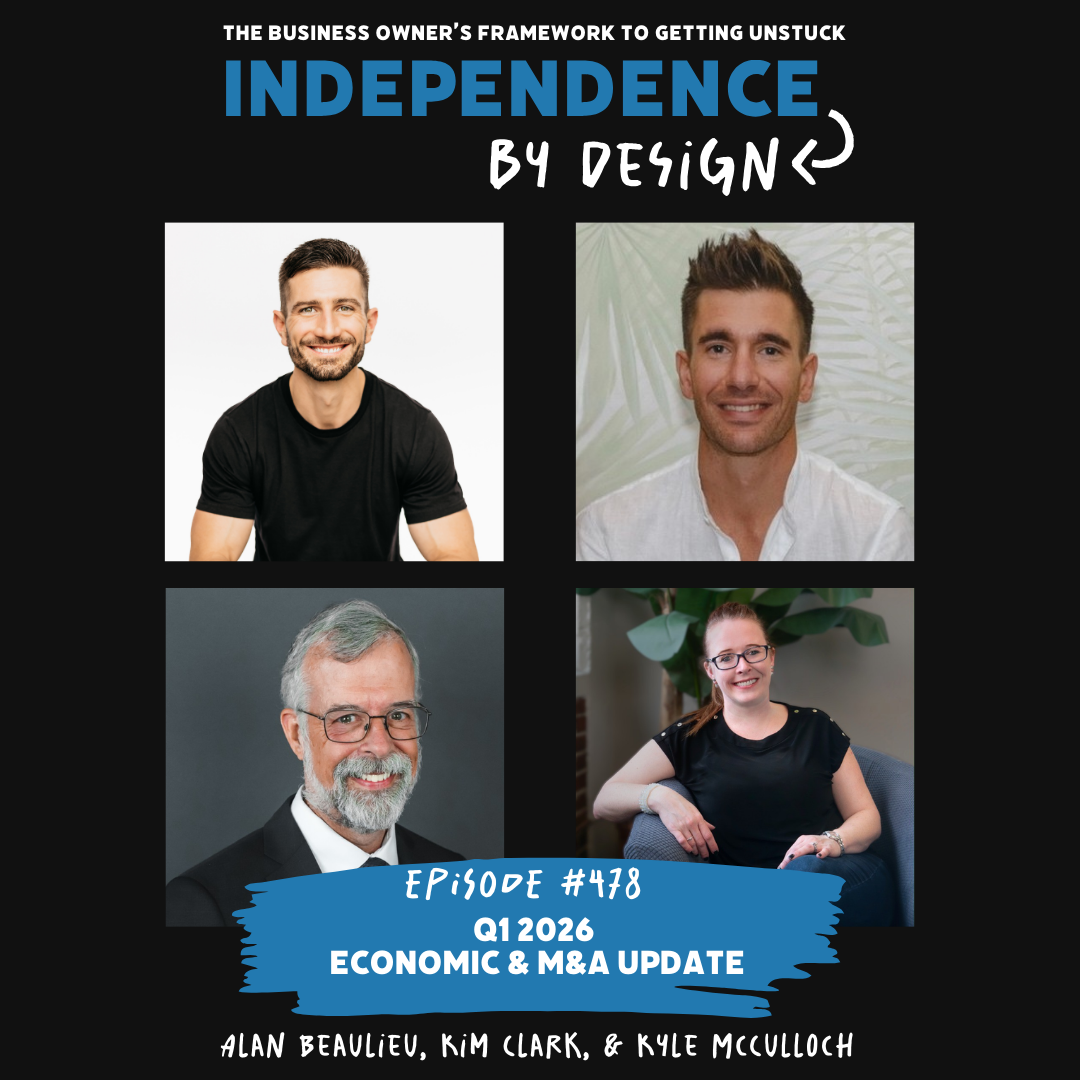
What's up, everybody? Today's episode is broken into two parts. The first part is with Alan Beaulio and Kim Clark. We are doing an economic update. And then the second part is with Kyle McCulloch, who is from Bizval Evaluation Company where he just launched their Q1 2026 valuation and merger and acquisition update report. You can find that report in the link below. The entire episode came to be because I saw the report that came out from Kyle and Kim reached out because her dad Alan is extremely concerned about the Department of Justice's inquiry into the Federal Reserve and how that could impact markets, valuations, lending, the business climate, et cetera.
So the first episode is all. Or the first segment is all about what's going on. Does how is this going to impact business, our financial system? And then the second segment is all about what's going on with valuations and how the cost of capital could be impacting valuations. What are the geopolitical risks? So I think it's a great episode that starts high level and then also gets into the nitty gritty of like, what does this mean to you? And how valuations work and how deal structures work and where the volume of deals are coming from from the different types of buyers.
So I think you're going to enjoy this conversation. Don't forget to check out Kim's Growth Playbook podcast in the link below, as well as Kyle's BIS valuation report in the link below. Hope you enjoyed the episode.
[00:01:38] Speaker B: Hello, everyone. Today is not a podcast for Ryan or for my dad or for myself. This is going to be just a raw footage of Alan Beaulio and Ryan Tansom on unbridled on a very important topic. There is a danger confronting the economy that we need to share and felt compelled to walk through the different thought processes of what's going on with you. So without further ado, dad, if you want to kick us off, because you're the one that emailed me and said, I'm grateful we don't have a recording for the Growth Playbook this week because of everything that was going on. And I said, ha. Well, sounds like people need to. Yeah, exactly. People need. The people need to know.
[00:02:25] Speaker C: I think, I think you're right. They do need to know, Kim, because I. And I'm really looking forward to hearing what you have to Say Ryan too. I'm very, very concerned. I think this move to put the Federal Reserve Board, especially the FOMC, but through the Federal Reserve Board system under political control is an ex. Is very dangerous. Very, very dangerous to everyday people.
Just so everybody knows, the Federal Reserve Board has three goals. Promote sustainable growth, keep inflation low, and to keep employment up or unemployment low, depending on how you put it. And they have two very important tools for that, which is interest rates and the money supply.
The Fed uses a very methodical, thoughtful, statistical approach to doing this. Do I always agree with them? No.
But what numbs my brain, Kim, is that politicians, a politician who is whimsical, a politician who is driven by, you know, wanting their approval rating to go up or to prove something is very dangerous because it upsets that, that stability that the FOMC provides. I don't always agree, but I do appreciate what they do. And I'm not just talking about President Trump here. I don't want people to think I'm piling on Donald Trump.
Other presidents have exerted pressure. Not like this. I mean, this is mind boggling. 14 other fed chairs and secretary officials and stuff have said this is destabilizing to the economy. If it happens, we're going to find a weaker economy, slower growth. We're going to find ourselves in a position that we don't want to be in with recession or stagflation, with millions of Americans wondering how they're going to afford food, medical care and employers that are not going to be able to grow because of inflation. I mean, it's just while the President says that we are in a growth economy, as a matter of fact, he has said that the economy is booming and he still wants interest rates to go lower. And that only creates inflation. If it's true. Which means he either doesn't understand or he actually knows it's not true, but he's covering it up or he's really just lost. I don't really know what it is, and that may sound harsh, but a booming economy, drastically lowering interest rates is somebody's idea of a. Well, it's, it's a dumb idea. It's, it's as dumb as it comes. Okay. It's just, it just is.
I'm going to take a little volume now.
[00:04:52] Speaker A: Fantastic.
It's so interesting to me, Alan, because like I, I know we have a time frame for this and you've always said like, okay, where do I start? After my responses. It's such a nuanced thing because I agree everything you're saying like. And I think about where I come at the challenge and what is the problem. So I try to usually like how I, I think the best way Allen is like, because I truly am in the explor, exploratory phase of like, how do I think about this? And like, what is. How do I actually. Where are my opinions? And when I think about when I started, the first principle is of I believe that the US Is bankrupt.
So when you have a company that's bankruptcy, it's like a raccoon in the corner and everybody's trying to claw at different things. And I look at all of the political instability and the way I think about our country is if you have a wealthy family and all the kids are leeches on the family estate, everybody's fine as long as there's money. And if there's no money, everyone fights. And I think that's where I see just the US the political instability. And when I think about the challenge, I don't want any politician in control of my money. So I agree with. That's where parts of the stuff that I'm agreeing with, it's like, okay, I don't want Biden, I don't want Trump responsible for my money, which is why I'm a bitcoiner and an Austrian economics. I want sound money that you can't print. But here we are and there's a mathematical doom loop here that I see ourselves in where the only way to get out of this is to inflate the money supply.
And like when you say like you got the Fed has these mandates understood. But they, you know, on December was it, I can't remember what date it was. You know, the repo market is now controlling everything. Like they're like their political or like the financial stability of the system is part of their deal. And if it's 80% of the economy is debt refinancing treasuries as the bottom of that pyramid has to stay stable. And what so maybe the way I'm kind of thinking was I don't want politicians in control of my money regardless of the party, if they have control. I don't like the risk of property rights that I see as a way of means of like figuring out a way to get out of this debt doom loop, which I don't want that as a byproduct. But then you go, okay, like how do the hell you get out of this when the Fed's already, you know, it's 40 billion. Is it a 40 billion a week or a month now that it's, it's not qe. Qe.
And then like where the government spends their money with fiscal dominance. So I don't know. So I look at this and I go, yeah, I agree with you all on that. And like, I don't think the Fed should be around, but here we are, you know, it's 120 years around, you know, after Woodrow Wilson approved that while everybody's on vacation.
So we're here. I don't want instability and I don't want someone covering my money, you know, controlling my money. But I don't know.
I don't know. That's my, like, as I'm thinking through it, like, I don't know.
[00:07:47] Speaker C: And you know, I appreciate your Austrian roots. I'm Austrian leaning. But I think as far as this whole the market forces will decide interest rates and you know, and all the rest of that, I think that ship has sailed. I think.
[00:07:58] Speaker A: Agreed. And that because we're not in that, we're not in that timeline of the simulation. Right. It's different.
[00:08:03] Speaker C: Let it go, Ryan. Just breathe deeply and let it go. Just.
[00:08:06] Speaker A: But then when you go, okay, well, there is a mathematical debt doom loop here where we have to keep printing money, which is the repo market that is going to continue inflate, otherwise everything's redlining.
[00:08:16] Speaker C: But this thing does reset all on its own.
So if you want, you know, you ask a question in your, in your talk about how does this thing correct itself? It corrects itself in the depression and when bond markets around the world are in trouble, the world rejects the US financial position and we find ourselves in a where we have to be fiscally responsible. And what's going to enable that all to work is the death of the baby boomers like we've talked about before.
So when I die, you two are good. I mean, well, three of me have to die for every two of you, but that'll work and we got enough people that can die. So with the pressure of the depression and the death of the baby boomers, we're going to find that there is that ability to reset and maybe then some Austrian like thinking can come about some fiscal responsibility.
[00:09:07] Speaker A: I track you on that and I honestly, that's my hope.
Honest. Other than your death, Alan, because then our beautiful times together would not be able to continue.
Maybe I think where I struggle with like the mathematics of finance and economics as a, you know, like when people are rational automatons. Okay, what world is that?
Like there's people that do random Stupid shit. Predictably Irrational is like the name of a book, and behavioral economics is a thing. So when I just don't. When I look at the recorded history that I've gone through, every single time a global currency has gotten to this point where they've inflated themselves, the political discourse is so dysfunctional that. That, like, if it was just this perfect melting away and then you guys drop off in over 10 years, that's fine. But, like, we have states now that are involved in activism and property rights, and are the younger people okay, or the people that are not doing well? Okay, enough watching all of this go on for the next 2028 election and 2032 election, where all of a sudden people are trying to blame someone because they don't understand what you and I are talking about. They're going. They're blaming the different nationalities, the different genders, the different ages, and they're trying to find the boogeyman to. To. To argue with and then vote someone else in that is going to pander to whatever side that they want.
And that just. That's what scares me, is like, oh, my God, like, all. Like, it's either fascism or communism, and I don't like either option.
[00:10:53] Speaker C: Wow. All right, let me take out from what you said, one, go to my funeral. And what I want you to do is say, Alan predicted this. This was going to happen.
[00:11:03] Speaker A: He predicted he was going to die. Like. Like, look at that. 100% accuracy in forecasting on that one.
[00:11:08] Speaker D: That's right.
[00:11:09] Speaker C: You got the win.
All right. That'll be your job. Okay, Ryan.
[00:11:16] Speaker A: All right, Kim, you got to make sure I get the invite.
[00:11:21] Speaker C: All right? I'm gonna.
You range far and wide, and you bring up some really deep stuff. And if we have a half hour sometime, I'd love to go through some of that with you. But I want to bring it back today to the political pressure on the Fed, as opposed to a lot of the things that you talked about.
And what I want to just raise today was that this is not healthy for the U.S. economy or for the U.S. people to have this political pressure. I don't care if it's Democrat or Republican.
Ben Bernanke and Greenspan and Janet Yellen and all those others, they served under Democrats and Republicans. I mean, this is not one party's fault if any party decides to exert that influence.
[00:12:05] Speaker A: Yep.
[00:12:06] Speaker C: I think it's. It's a mistake.
[00:12:07] Speaker A: Can you explain why to me and the listeners, why that political pressure makes things unstable? Because I do agree with you, and I don't think I've got a way of articulating it like you would, because.
[00:12:18] Speaker C: They have a tendency to do what is politically expedient as opposed to what is best. For the longer view, they. It's like the election cycle. It's a two year election cycle. Nobody in Washington thinks beyond two years. But in, but if you're the Fed, you have to think about the slower. This takes time. We can't just rush into this because it builds momentum and, and politicians don't ever think that way anymore. I mean, maybe they used to, but they don't anymore.
And they, there's no methodical approach to politics. It's just all my hair's on fire and off they go. And that's the danger.
I don't think they can. Well, I'm going to say it. I don't think they can be trusted, period.
[00:12:56] Speaker A: You just stop.
[00:12:57] Speaker C: No. With that powerful a tool. Okay, to your point, there shouldn't be a Fed. What I've told audiences over the years is that's fine. I understand the Austrian point of view and I understand market forces and they're a beautiful thing.
But where we are in history, if it's not the Federal Reserve Board or central banks, but our central banks called Federal Reserve Board, then it would go back to Congress and I would say, do you really trust Congress to get this right?
[00:13:21] Speaker A: Yeah.
And that's where it is. Like, it is such a, it really breaks my brain, Alan, because like there's the whole. It's a false choice that it feels like, but then it's like, okay, but I, you know, I am also a practical person going, okay, we are here. And I think when one of our previous conversations is like, yes, and, but we're here and we don't want to flip the whole currency system globally because we would have anarchy everywhere. And that's not good. And so let me see if I can regurgitate part of what you said back is because this is what I do believe too is if the global financial system is an inverted pyramid of leverage, the bottom is U.S. treasuries.
If that is destabilized, the whole thing is at risk for pricing, for like. And like everything becomes shaky from the bottom up.
And regardless of what political party exerting pressure on the Fed makes that whole inverted pyramid of money destabilized, which is kind of back to the whole anarchy. Like, yeah, we might not like this, but like, we still don't want the whole thing to break at once. Is that a fair way to put it?
[00:14:31] Speaker C: Agreed. And I like how you use the word regurgitated, because what went through my brain is great. I just made him want to throw up. But.
[00:14:41] Speaker A: We'Re like a bird. You throw up in my mouth. And that's not food.
It's food. It's nourishment.
[00:14:52] Speaker C: That's my morning. To people that want to know, is this good, bad, or that's a moral value? This is dangerous. This is just economically dangerous territory. And if you can talk to your congressmen, your senators, or to whomever you want to talk to say, the Fed must remain independent.
And while there are lots of virtues to the market theory and to the Austrian way of thinking, the reality of the moment is they must remain independent and be able to say to Washington, buzz off.
[00:15:27] Speaker A: What are the ramifications if the Trump administration does hijack the board of Governors and some of the mandates? Like, how do they do? Like, what is the process of, like, the imp. And what are the implications of that? And I'm very curious, Alan, like, when all of a sudden there's another party, and so let's say you got blue and red here that have opposing views of how to handle.
Spread it around.
So anybody listening in, regardless of their political affiliation, what would be the ramifications if this actually goes down?
[00:16:06] Speaker B: Good job. That's exactly where my brain went. All right, now we know it's dangerous.
What are we. What does that mean?
[00:16:14] Speaker C: A world that becomes less dependable? Right now, you can count on mortgage rates not moving erratically. And so the building industry needs that, the automobile industry needs that, the banking industry needs that, and credit card industry and all the rest. You know, you need to know it's not erratic. You have to know that there's money available. And if there's a tightening in the money supply, it's not erratic and it's not by leaps and bounds. It's a slow tightening so that people can adjust to it, so there's less borrowing that can go on.
But when things happen quickly, it's like, oh, my gosh, the world's falling apart. And if all of a sudden there's this flood of cash and there's all this crazy buying going on and creates inflation. And for the moment, it seems like great consumerism, factories can't keep up. And that's where the problem is, because as they can't keep up, prices go up. And, I mean, it just creates anarchy in people's lives. And how do businesses. How do your clients. Ryan, Plan in. In that kind of environment? And, Kim, I mean, even it's just.
[00:17:08] Speaker A: On, even on the personal level, Alan, like I'm looking at like building an outbuilding in my backyard and like I'm like, I don't know our rate's going to go down three times this year. But if they go down, does the 10 year go up or down? I mean like it's impossible to plan to your point, like equipment financ or doing an acquisition or like it's, it's impossible. Yeah, that's right.
[00:17:27] Speaker C: And by the way, build a building. Don't worry about interest rates.
[00:17:30] Speaker A: It's, I'm not concerned about the interest rates, are concerned about my budget and my desire of like what I actually want and how much it actually costs. It's let us less about the interest rates.
[00:17:40] Speaker C: But you have stated it well with the uncertainty comes the inaction. And Kim, you and I have talked about this in prior podcasts, in writings. Uncertainty is the enemy of the economy.
And this just introduces another layer of uncertainty. Uncertainty is the enemy of business planning and human as retirement planning. The whole thing is like, oh well, you know, what's going on, you know, and how do I plan for that?
And it may sound like I'm exaggerating the case, but if you get political parties that are changing their mind every two years and you get this whipsaw action and in the meantime, in the two years you can create a lot of inflation or you can create such an austere environment that things come crashing down because I don't think a lot of the people in charge that would be making those types of decisions understand the ramifications of those decisions and that it takes time to weigh things out.
[00:18:32] Speaker A: Amen. And I want more certainty even if it's not fantastic over the next five to 10 years, given your forecast and it's the slow boil, but it's better than the frog that jumps into the boiling water, right? At least you get warm along the way and you can then get used to it.
[00:18:48] Speaker D: But.
[00:18:51] Speaker A: The way I think about, I mean this maybe gets into the mechanics too much and too geeky and you both can stop me. But the way I think about even so, the Fed interest rates is doing less now than it ever has. It's not as effective because the government spending and where they spend their money becomes that. So that's my, as I've learned, fiscal dominance versus what's the Fed dominance? Monetary policy. So where the government spends the money and the deficit spending is becoming, you know, my wife was asking me like what companies are succeeding? Like whoever's got the closest Money like wherever they're at in the money spigot like is the people that are winning. And so fiscal dominance.
And so the repo market has become this mechanism of stability where like I mean they're refinancing $550 billion a week at new higher level interest rates. It's like the snake eating its tail. I mean it's insane. And so the repo markets is like on the bottom of that pyramid is like we have to have those treasury markets. And the repo markets are at like, it's the whole bottom of the pyramid. They're like standing on the repo markets is what I've like gathered. And like the yen carry and all these hedge funds and all this leverage, it's like we can't screw things up so we have to print 40 billion a month to keep that stable, to keep the liquidity in the banks. So like the way my brain and kind of like the schizo of me is, I don't like that because it's inflation of the money and the basement of the dollar.
What's the alternative what you're saying? And I don't want that more. So then it's like, okay, well I can plan around a slow 7 to 8% debasement of the dollar. I can plan as long as then the 10 year treasury and borrowing costs are stable. I can plan around that even though it's a reality. I don't like versus if the repo market's not there or if the Fed is hijacked by a politician that makes everything unstable and completely impossible to plan around. Do you think that those two things are correlated from the mechanism of planning or how do you think I'm thinking about that?
[00:20:50] Speaker C: I think you're fine and you're thinking about that. And as far as your repo market, when you do this inverted pyramid, I'm thinking about this.
[00:21:00] Speaker A: It's the opposite of a pyramid.
[00:21:04] Speaker C: It's the debasement of the dollar is a phrase that I wanted to go back to political things, changes in the world, all of a sudden instability in the world can push people to the dollar which stabilizes the dollar and puts up its value. So while I understand money supply growth.
[00:21:19] Speaker A: I guess is my point, like money supply growth, inflation might be more on the outer edges of the third world economies that we export our inflation, but there is the increase of the US fiat money growth through like the, the bottom of that is like the spigot and the repo market is kind of the way they're doing it. Right now is how I've gathered.
[00:21:38] Speaker C: But so far the world's fine with it. I mean we've seen some devaluation of the dollar this year, but I wouldn't make this year the longer term trend at this point because things can change to disrupt that. And, and I think the process that you're talking about though with the longer term debasement of the dollar feeds and inflation that goes really feeds right into the long term forecast that Brian and I developed in 2011 or 12 before.
[00:22:04] Speaker D: We wrote the book.
[00:22:06] Speaker C: So it all feeds in really well. So I thank the world for participating in making our book so accurate. That's just really thoughtful of them.
[00:22:17] Speaker D: I love the.
[00:22:17] Speaker A: I love, I love it. And back to the purpose of all of us being on here. I'm looking at the clock because I think, Kim, you're the one with the heart cut off is it's the instability and the whipsaw of interest rates and who controls the money and all of that scares me for all the reasons that you mentioned. And honestly I haven't been able to figure out how to quantify the level of concern I should have of.
I don't want politicians controlling money just in general. I don't want them surveilling money. I don't want them determining who gets money and who doesn't get money. Like that's even a higher level of concern, heightened level of concern for me, like, because like regardless of the politician, I don't want them to have any say of like where and how people access money.
[00:23:06] Speaker C: I don't know.
[00:23:06] Speaker A: Does that like, does the current situation have an impact on their oversight of money in your perspective?
[00:23:14] Speaker C: No, I think it makes it more difficult for them to accomplish their tasks. They just don't realize it. You know, you made me think of those sometimes be fun to have a discussion about tax policy, flat tax versus consumption tax and that sort of thing. That would be a fun discussion because there are answers to the things you just mentioned by using an entirely different tax policy which is used in other parts of the world and could be used very effectively here. Flat tax and the one not unrealized.
[00:23:41] Speaker A: Capital gains tax where you have to rely on the politicians for valuations. That would be fun.
[00:23:45] Speaker C: Yeah, that would be fine. I mean, so there are answers to some of these problems, but it comes with the fairly dramatic change from what we have gotten used to because we think what we are doing is the only way, but it's not the only way and there can be much more stable ways that would be beneficial to all parts of the economy whether you're the lower quartile. And I was just talking about. It's not aimed to benefiting the higher quartile it's benefiting at aiming the whole. The whole and I mean and it's a lot less political. You just stop again the congress shut up about the loot holes. It's 15, it's a postcard. Just don't argue about it.
[00:24:26] Speaker A: Yeah, yeah it's Alan, what would be interesting and Kim maybe this is piggybacking off of Alan's idea about furthering discussion.
What I have found helpful is like as I've understand the whole of like the economy the way I think about it is a business and I think we could help people contextualize all of the noise. And the way that I like to think about it is when I have, when I look at a business you have the income statement, balance sheet and cash flow statement and the company either makes cash or it doesn't. It is a binary answer. Yes, no. And so everything in the operations is a part of that. How sales did, how Service did, how SG&A did and the capital structure. So like everything has a part of it. But when I think about a bankrupt company and who's at that board or the CEO they're the ones that supposed to look at the out for the whole and politicians just don't do that. So like there is no one human being or organization looking out for the whole of the comp of the company here which is and I think about when you have a bankrupt company and you had to if you were to sit every everybody down and be like who wants to cut their department? How's that going to go? Like it's like a group discussion. It is probably not going to be on board, you know like so every department and every facet of that company is going to be like that cornered raccoon that wants their pie part of the pie. And there's no one to say hey the cash has to be positive and we have to shave it off across all these places for the whole thing to survive.
And I think that's what we could maybe you know, because tax is a part of that and the revenue part, you know you have all these different components that help see the whole and I don't think a lot of people have that context.
[00:26:08] Speaker C: You just described a major part of the $0.01 solution.
So I'll send you the title in the author of the book. I'll have to look it up because I don't know, off top of my head. And then I think you're going to see a light bulb go on and you're going to go, wow, there is a path.
And there were at 1.66 Congressmen and women who were in favor of that legislation, which is not nearly enough, but does show that there were some people in Washington who understood there was a path out of this.
[00:26:39] Speaker A: What's it called?
[00:26:40] Speaker C: The $0.01 solution.
[00:26:42] Speaker A: $0.01. Okay, I got that.
[00:26:44] Speaker C: I think the congressman's name is from Georgia. Republican, I believe. George Linder, that's the author.
[00:26:52] Speaker A: Love it. Kim, are you over on your time?
[00:26:55] Speaker B: Oh, I'm good. Engaging conversation. I did have a question, though. So, dad, when you were talking back to the instability, the unpredictability, the potential for greater swings in decisions than we see right now, so just the lack of stability and then the impact that would have on the supply chain, consumer, so on and so forth, does it have a great enough impact to have some form of an impact on what we've always looked at in the business cycles? Like we say, everything goes in cycles and you can use rates of change and there's a predictability and there's like a X amount of year cycle and everything else that we have been able to use in helping to determine a possible forward view.
Does this have a significant enough disruption to hinder some of that?
[00:27:50] Speaker C: I think what it has the potential to do is to exacerbate the swings as opposed to anything else.
More, what it has the potential to do is make it difficult on the micro instead of the macro level for the family, for the individuals, as opposed to the larger economic cycles that have occurred. Ryan, one of the things that the school of thought, the Austrian school of thought, says business cycles really started when the fed started in 1913.
If they really mean that, and if I read that correctly, that's patently not true. We actually have proof that it goes back centuries.
So the price cycles as well as industrial cycles. And I'm not going to get into more because it's proprietary, just. But it's not hard for people to see that cycles have occurred before that.
[00:28:39] Speaker A: Read the book the Fourth Turning.
[00:28:41] Speaker C: Oh, part of it.
I heard Neil Howe talk about it and I found that much more enjoyable than reading the book.
[00:28:48] Speaker B: Me too.
[00:28:50] Speaker A: I got like an hour into the book and I was like, because I listened to it, I was like, are we just saying this? Is this on, like loop? Like we're, we're in cycles just saying.
[00:28:59] Speaker D: The same thing over and over again.
[00:29:00] Speaker A: I get it.
No, it's interesting. And I think that what my favorite money book that I read was the US The History of Money and Banking in the United States to the Colonia era to now by Rothbard because it was 450 years of politicians fighting over who inflates the money and then like the gold versus the silver pricing and all that kind of stuff. So like I said, I. I've learned the most out of that book as far as a kind of a thought process because it's not clean and simple. That's what I gathered.
[00:29:28] Speaker C: No, and you know what? That proves the point about the business cycle, which is wonderful. And the other thought that came to my mind is, Ryan, you really got to get life.
[00:29:39] Speaker A: I'm pretty sure I sent that book to Kim because I was in Mexico and I sent her a picture of a book like, this is what I'm doing on vacation. She goes, you remind me of my dad. And I was like, yay, I've made it in my life.
[00:29:53] Speaker B: Oh, well, that I have for you really quick. Like when you say greater swings, what pops into my head is again, going back to predictability because if we were working with companies that have big swings, it's much harder obviously to predict. And so is it is my logic going in the right or the wrong way with my thinking that again, kind of like the ocean or the storm, if you will, bigger companies maybe will handle it better than the smaller companies. So I'm just thinking like the small to medium sized businesses in the US if all of a sudden these swings become that much greater, what kind of impact may that have on the man, like the leadership team of these small to medium sized businesses? And then the predictability of how do they plan for the next one to five years with any bit of confidence with that kind of swing happening around them?
[00:30:47] Speaker C: That's a tricky question. And that you're welcome. That could take a little bit. So give me a moment here. A smaller company can be much more agile and therefore adjust to the changes quicker, while a big company could become monolithic, so stuck in their ways that they can see their bowel swamped with water, to use your metaphor, or and be unable to respond in time their course so that they're facing into the wave, into the wind, as opposed to saying, I won't, you know, it's fine, everything's fine.
So I think it depends on the company and the leadership. Kim, if you have a small company with a leader who thinks that there's no need to change, you're dead. If you have this big Company that's led by a fairly agile leadership team you can overcome. So I'm not going to give it a size preference, I'm going to give it a leadership preference.
[00:31:35] Speaker B: No, I like it.
[00:31:37] Speaker A: Kim, how I would answer that based on like the work that you and I are doing with the playbooks is if someone has a clear five year plan like with an original like hey, here's what I would like to do for revenue, for margins, for you know, normalized EBITDA and cash flow valuation and they've got a financial model that connects where they are to that point. It's a three statement model so they can see their cash flow, actual cash flow, working capital.
Then we can look at the revenue and the margins and I kind of think about that as the ship. So like I think about back to like when you know, my experience of like those volatile waves are like the whole world shut down, boom. And there was like everyone 5 trillion and boom. And it was just like wham, wham. Like you know, the floor, the ceiling and people way overbuilt their infrastructure and then all of a sudden 20, 22 and 3 hit and they didn't have any way to right size that or like so it was just managing that revenue and that margins and that cash in proportion to the demand.
And then to Alan, I think your point of like being nimble whether it's big or small, like doing the hard and quit denying the fact that you're overstaffed now that the pipeline drew up. You know, like, I mean I watched an H. There was this H Vac company I used to work with that was like Fiat. It was trailing 12 months of normalized EBITDA went from like 4 to 4.5 to 6.7 and then back down to 4.8. And everybody we're doing so bad. I'm like, you're literally still up 15%. If you would have kept that whole thing and that see where the free money came in, it was like this big huge bump. But like they were looking in the rearview mirror versus just acknowledging what was going on.
[00:33:15] Speaker C: Yeah, I saw that happen a lot with companies too, that they felt that they were doing so poorly or things were way off and then just normalize it, folks. You feel a lot better about life and understand that was, that was not life.
[00:33:27] Speaker A: But Helen, Now I've got 50 more people on staff and they have nothing to do go back to normal.
[00:33:36] Speaker D: Exactly.
[00:33:37] Speaker C: Yeah. Well, truck driving is a good option. But that's another discussion, a follow up.
[00:33:42] Speaker B: Question that I have to all of this then. So to summarize, still manageable.
Don't run and hide in a cat in a cave somewhere. Just be more agile, be more alert and more communicative I would think with your leadership team and innovative and all of that.
What about folks that are on the fence about selling before the depression? I mean if this goes through and becomes a thing and people are already bought into the 2000s economic depression and are asking themselves do I wait until 2028, 2029, like maybe they've already started things in the works and they're like but maybe I'll just delay that a little bit to see which how much more Runway I can get out of this. Like does this impact or should it impact their thinking somehow if they're convinced considering selling the business.
[00:34:29] Speaker C: What we've discussed today in my opinion does not change the timeline of when they if you're going to do it for purely financial reasons at 28, 29 now you both know there are lots of other reasons why people sell their businesses but if you just want to do a purely financial projection that still be where I would choose and then make sure you sell it to somebody you don't like because it's going to go bad real quickly.
[00:34:53] Speaker B: Perfect.
So not to your child or I.
[00:34:57] Speaker A: I do think at some point point we should unpack that because I find there could be a very, very interesting opportunity to use privately held cash flowing companies to manage this storm as far as like maintaining your equity and going through and growing equity, growing cash flow as other people in your industry are either too leveraged too et cetera because otherwise you're going to have to find there's a whole strategy on the asset protection side that becomes like I don't know, I don't know which one's more work depending on your age and depending on your income needs.
[00:35:33] Speaker C: Well, I'm with you on that Ryan. It's just I was thinking what I have in mind with those people who want to sell. I'm all in favor of hold and use it to your advantage and the long evergreen and all the rest of that. But if you have the mindset I'm going to sell this thing, when is the best time?
[00:35:51] Speaker A: Yeah, I like that. Good clarification.
[00:35:53] Speaker C: Thank you for allowing me to regurgitate.
[00:35:57] Speaker D: I'm just.
[00:36:00] Speaker B: And on that note, nourishment.
[00:36:02] Speaker A: It's just my nourishment.
[00:36:06] Speaker B: Anything else that unbridled Handsome or Molio would like to add to this raw footage that will just be throwing out there on social media so that way people can know that this is a true danger to our economy. I'm just summarizing things in my mind. Dad, you had given some advice like speak to your congressman or woman and like, are there other pieces of advice that you would give? Just how do you want to. What are your closing thoughts, both of you, and how you want to wrap this up?
[00:36:33] Speaker C: Don't panic because of this, but take that nimble discussion. We had to make sure that that's in your mind, that what you think might be stable may not be. So just have the plans in place in case. In case. In case. That way you're not going to be surprised, unduly surprised and in a bad place.
[00:36:54] Speaker A: Pay attention and build a good business so you can do whatever you want.
Kyle, I was reading your report. I know you and I know how much time you put into this.
Super excited to get your backdrop on the research that you did, the insets that you got. Because you know, one of the interesting things, Kyle, I was talking to one of the other investment bankers that I sent you that GF data report on like the valuations and the deal structures and they, they, they aggregate that data from like 380 private equity firms, but the smallest they go is like 10 million in enterprise value.
And so this whole Mike Finger podcast that you and I and Graham did, it's like we're trying to speak to the relevant business owners who are in the middle to lower market. And I think you have just got a heart mission for those people. So why don't you walk us through like kind of the, the inputs that went into this report and then we're gonna. I, I've got the notes and I got the report up and we can unpack it, but I just wanted to kind of get your two cents on like why did you do it? Inputs that went into it.
[00:37:59] Speaker D: Yeah, so a couple of things and maybe, maybe just touching on my background first, my place in good context with this. You know, I moved to the states as, as a commodity derivatives trader and you know, really moved to New York to pursue that full time. I came over when I was pretty young, didn't know anybody, and I thought I was going to get a job being. Being a trader pretty quickly and pretty easily, which ended up being a lot more difficult than I thought it was for a number of reasons, I think. Firstly, obviously not having a network here and not having, you know, one of the things that came up fairly, fairly frequently is I didn't have U S experience.
So in short, I mean, no One was really prepared to hire me. And so I thought, you know, how do I, how do I turn this into an opportunity? And I, I thought maybe I could go into buildings and you know, like walk behind someone and go and find hr, which I tried to do. And then I nearly got arrested, which would have been green card right away. So I had to, I had to pivot pretty aggressively. And what I ended up doing was writing macro reports.
Big focus on macroeconomics, big focus on, on company selection, so basically investment pieces and then, you know, with a risk management lens as well. Those are, those are pretty much where my three core areas of expertise. So I started writing these things and you know, started my own, you know, my own company. And it was really, it was really a front actually to try get somebody just to listen to me. So you get a job. Yeah, Like I wrote this, I wrote this interesting report for my company. Take a read, see what you think. Long story short, that is how I got my first job.
And then throughout the years I ended up, ended up working like writing reports for funds, for hedge funds, you know, for banks and any firms basically that would take them from me. Worked across the nonprofit sectors as well, started a cybersecurity data nonprofit and then ended up finding myself in geopolitical cyber risk, which really pulled me all the way back into the macroeconomic side of things. The risk side of things.
[00:40:04] Speaker A: Can you walk the listeners through what that actually means? Because when you and I were driving to dinner and you were explaining your perception of risk, geopolitical, geopolitical events and then cyber risk, like how do you think about macro events and risk and like what, what is your definition of those things?
[00:40:22] Speaker D: It is tough to define.
[00:40:24] Speaker A: What were you trying to solve for? Like, like, like when you were looking at events, what were, like, what were you trying to anticipate and solve for?
[00:40:31] Speaker D: I'll give you a good example that I normally give to people is hedge fund A wants to buy an oil field in the Saudi Gulf, right? Like, obviously there's, there's a geopolitical aspect to that. If you look at like Israel, Iran, like they, they absolute enemy, there's going to be incentives for them to commit espionage against each other, potentially shut down, you know, shut down operations, etc. So what we do is, we'd say to that, we'd say that fund, okay, you guys are going to put in a billion dollar acquisition of, you know, the soil field.
This is your critical infrastructure. Like what sort of, what sort of attacks have occurred on these, infra. On this type of infrastructure, what is your defensive capability?
What are, who are your likely enemies and at what probabilities, what are their offensive capabilities? And then you know, just given the overall macro landscape and you know, trade policies, etc. Like how do we then concatenate all of that data and then come up with a risk score so it's probability.
[00:41:35] Speaker A: So freaking awesome.
When you and I met a year ago, it was like immediately like I just love how you think because as we get into the report and talking about valuations and discounted cash flow and like, because what you said, you know, macro, what's going on in the world and like how valuations work, which is what is the risk of the future cash flow. And the reason that I like love, you know, talking to economists and especially with your background finance and understanding, like we're trying to predict what's the stability of the current situation happening. And so what you just said is though, what I heard is inputs that could impact the cash flow of an oil, whether it's an oil field or whatever it might be. You're just saying, okay, all of these things are risk factors. It's not just like on the business side when you and I talk about business, it's you know, key leadership and there's the, you know, ERP system. But you're talking about like Israel and Iran attacking each other on top of the normal sort of risk profiles in a company.
[00:42:35] Speaker D: Yeah. And there's also like you've got proxies, so you've got state actors, non state actors, you know, like who is Iran funding for instance? You know, like what are their capabilities? Like are they actually funding potentially cyber offensive efforts which in 20, I think 16, and I've been out of that world for quite a while, but they were.
And you know, so you, you take those sort of, those sort of inputs and then you got to think, okay, well like how do we quantify these? Because if you look at it from a big bank, you know, big bank point of view, I mean you've got the chief technical officer side of things, you've got, you've got the macro teams there and then you've got the overall risk teams. Macro kind of feeds into risk, but they all kind of talk to each other like that. But no one has that one version of truth. So I was quite fortunate to come.
[00:43:18] Speaker A: Up under one version of truth that score. I mean it has to do with like if this asset has to cash flow, all of those factors have to be put in to the risk profile. I mean that's What I find is so fascinating about valuing assets is like you're trying to anticipate the future and understand the risk of the future. That's all we're trying to do.
[00:43:39] Speaker D: And I think like, what's really important too is that when people, when people are looking overall at the economy, you know, and listening to these policy decisions, first of all, like it's actually a tiny complex. So you know, what we tend to do is we tend to zoom in on one piece of the puzzle. But there's like, you know, call it 5,000 pieces that you can see and there's another 20,000 pieces that you don't even know are going on in the background.
So I think to be able to really synthesize those data points and then come up with an objective view on things, it's, you know, it's a, I think a learned, a learned skill in some ways. I think some people also do have a bit more of an appetite for it than others.
[00:44:20] Speaker A: But why have loved all of Ray Dalio's stuff that he's put out over the last five plus years? Because it's like that's where I really understood what objective thinking really is. And I know he's not totally objective like his. In order to get the seller financing buyout of Bridgewater, Bridgewater has to exist and they do a lot of business with China. And so you started to just like follow the thread and say okay, but like the framework that Dalio came up with, which is objectively he's trying to anticipate the future of cash flow. So is it's as close to objective truth as we can get or objective thinking. Which is why I just found it so fascinating that as your background, that is what's lending the insight into your like valuations understanding the discounted cash flow, which what When I met you I was like, oh my God, like it makes a ton of sense because you understand macroeconomics and finance.
Why the valuation methodology that you and Bisval and Graham have come at it from is cash flow risk, not the typical, you know, there is the value of multiples and normalized EBITDA as a proxy, but the real truth is the cash flow and the risk of the cash flow.
[00:45:26] Speaker D: So Graham has a good, has a good way of explaining this because a lot of people, you know, we've, we still cover the full spectrum of the mid market, I mean even from pre revenue companies. But you know, when on the lower mid market side of things there's a real obsession with earnings multiples and where I think earnings multiples run into trouble. And I like Graham's explanation with this is he said, you know, you take, you take five people, they're all 6 foot 5 and 250 pounds. You know, some guys are 250 pounds because they eat McDonald's all day and other guys are 250 pounds because they work out and lift weights all day. So it doesn't mean that everything's going to be not all created equal.
So where the discount of cash flow really benefits, that is that we're actually looking at things like client concentration. We're looking at the owner dependency side of things.
Do these companies have internal operating documents? What happens if the whole management team is on a private jet and the jet falls on guy?
Have you still got a company or not? And I think that's without understanding the risk profile of things. I mean you've, you basically just looking at, looking at things wishfully in my opinion.
[00:46:34] Speaker A: Yeah. And there's been, I agree with you and I think there has been this tendency leaning towards risk profiles of that multiple. But like it still is so much a rule of thumb of like based on your size and based on your industry. Here's like the, here's the range but.
[00:46:49] Speaker D: Like it's way of looking at it very soon.
[00:46:52] Speaker A: And that's why I like it.
And the three lenses of value that I have created, like there is a value to looking at value that way. I call it the Zillow lens. You have to look at market comparables to get a baseline of value. But then what we're trying to do is really understand like, you know, in the housing example, what's the price per square footage? Because what's the finishes? What's the like, you know, like what are the actual internal guts of that house look like?
So you have spent so much time looking at valuations and looking at. So maybe talk like again back to the inputs of this report.
So do you want to cover anything about like how you think about value and like how you think about valuations before we jump into the inputs of the report and the findings?
[00:47:34] Speaker D: Yes, I mean what we, what we primarily look at is discount cash flow. Overall we think that's the most important kind of measure of valuation. Then we blend that with an earnings multiple and net asset value as well. The net asset value is, you know, particularly useful in asset heavy businesses. I think it's going to become potentially even more relevant in the coming years with manufacturing coming, coming back to the US the way it, the way it's poised to so I think there's going to be a lot of manufacturing plants, obviously they're heavy and assets. So I think that there'll be, there'll be a little more of a focus on that. But ultimately it does come down to that, to that risk profile of cash flow. And you know, what is, what is your forward looking thesis on it?
But I think on, on the valuation side, I mean Stephen, who runs our valuations desk is definitely a lot more in the weeds with that sort of stuff than I am. I think where I, where I come in is, is more on the kind of big picture macro lens on the valuation side.
[00:48:31] Speaker A: Let me do like a couple minute or less. I can try of like, for the listeners just to like level set the valuations using my three lenses and then will have context for the conversation. Because again this is a new lens that I, an approach that I'm taking with all the material I've been creating Kyle, and I actually honestly want your, your reaction to it. So the discounted cash flow for the listeners listening who without all the technicalities, we say okay, we have five years of cash flow of owner's distributions, distributions to owners after working capital debt and taxes, say okay, the company goes from 150 to 150 to 200, 400, 600. You're pulling all of that forward based on the discount rate based on the risk profile of that cash flow. And then in year five, what would be the normalized EBITDA and the multiple which they call it the terminal value and you pull that forward say okay, because the case study guy that I created, it's like those distribution cash flows that I just mentioned. And then the valuation multiple which is 3 million, the normalized EBITDA times 6.6, they pull that forward. It's like a 5.9 million dollar equity valuation based on 30% discount rate.
So I'm just saying that because that discount rate is coming from the risk buildup of Treasuries S&P 500, the private markets industry and the company.
What's the risk of that operating entity?
The way I think about this Kyle, is so that's your internal rate of return as an investor that you're trying to target based on the risk that you have.
Lens two is the multiple times normalized ebitda. I call it the Zillow lens. So the first one is the keep it lens, second one is the Zillow lens. Like okay, according to all the other people, what could I be worth?
Hopefully those are two pretty similar if it's done appropriately Then the third lens cow that I created was the transaction value, which is if you transacted, how much cash at closing would you have based on the deal structure?
What I landed on as I was doing these case studies was the transaction value of the deal structure, that cash at closing should equal the discounted cash flow because you get your enterprise value in the multiple. But you're like, wait a second, your cash at closing needs to equal your discounted cash flow. Otherwise don't sell it.
Because otherwise all the risk of the earn out the rolled equity, all that risk is still there even though you don't have complete ownership of it. So the hurdle rate for the transaction should be the cash at closing equals the discounted cash flow. That might be a mouthful for everybody listening in, but I think the takeaway I wanted to give. So that way we jump into this, Kyle, is how to think about value. It's like, okay, there's keeping the company, which is the risk of the cash flow that you have as an investor. Then there's a what's it compared to all the other houses on the market, all the other companies. And then what's. If I got cash at closing, does it equal my keep it lens?
And you guys have focused a lot. And that's why when I met you and Graham, it's like, oh my God, you guys truly understand the discounted cash flow. Because your macroeconomic background, your understanding of risk.
So I think all the context you gave just lends some instead of like why I appreciate what you guys have done. And then you're out doing research, trying to figure out what's everybody paying for companies and why.
So the middle market can actually get some insight of what the hell's getting paid out there.
[00:52:01] Speaker D: Yeah, certainly. And one of the other things we can just touch on it, going back to what you just said is the way we typically look at it is that buyers will often try come in on the earnings multiple so they'll start their negotiations.
Hey, you know, like six of the previous transactions happened around about here.
And that's where we, you know, it's a typical offer, but you know, the buyer definitely wants, wants to pay a little less than the seller wants to get. The seller is going to extract, try to extract to your point also of like, you know, dcf. And then transaction value should be aligning. The seller is going to try to transact at the dcf.
So that's what we typically finding and where, where blended approach is actually quite useful is we'll give a targeted range, but we'll say this is sort of the midpoint that we, where we think it's going to actually transact.
And Steve and the team are busy probably every three to six months actually updating a lot of the data in the back end just based on transactions as well.
[00:53:01] Speaker A: So with that context for the listeners, if we didn't lose them already, which I'm hoping. No, I love it because the more and more we just want to bring people along this journey as they learn.
You went on a hunt and as scouring the the world for. And you did the UK version, I believe. And then there's the US version of the. What's the, yeah, the 22 or Q1, 26M and a report. So maybe walk us through the methodology and like the components of it because I, I, I wanted to jump right in, but I wanted to give everybody the chance to catch up. Like deal volume, deal structure, what's impacting valuations. That's what I think you got a lot of insight on. So, but anything to say about the inputs and how you went about creating the report?
[00:53:45] Speaker D: Yeah, so I thought kind of, kind of long and hard about this. From the position of a capital allocator, I thought, okay, if I'm, if I've got, if I'm sitting on a heap of cash which the world is sitting at the moment on, the global dry powder is sitting at about. Estimated that I think it was between 2.19 and $2.5 trillion. So there's a lot of undeployed capital at this point. So I thought if I was sitting on this heap cash, like what would I want to know about. So looking at it through a capital allocator, a legal framework and a policy lens. So I think if you can bring those three, those three lenses together and understand the legal, sorry, rather understand the macroeconomic side of things as well, it'll give you a good.
[00:54:28] Speaker A: Let me see if I got that so capital allocator into. When you say legal, do you mean macro? Is that what you meant?
[00:54:33] Speaker D: So, no, actually legal. So you'll see and I probably shouldn't touch on this because no one should take my legal advice, but one of our contributors was, he's an M and A attorney. So understanding some of the legal, the legal levers that are happening in M and A I think is very important as well because it informs, obviously informs the way deals are structured.
[00:54:52] Speaker C: I love it.
[00:54:54] Speaker A: Okay, so we got the capital allocator lens, legal lens, macroeconomic lens.
You're trying to understand what's going on what price is getting paid and for what reasons using those three lenses. What kind of research did you do to gather this information and what was the outcome that you were striving for?
[00:55:12] Speaker D: Yeah, and also one of the important things is just looking at policies. So like, what policy changes have affected this? So this, I think this ended up affecting the UK report a little, a little more. But we can also touch on some of the UK sorry the US Especially on the fiscal policy side of things.
[00:55:27] Speaker A: Well, let's, let's jump right into that because I'm actually going to be piggybacking this episode off of Alan Bolio where we talked. He went on a rant about Trump administration suing Jay Powell. So he is extremely upset about that from an economist perspective because he thinks it's going to blow up.
Now I, I don't know if he said those words. That might have been my words. But like there's a serious, you know, warning that he's having for investors because of how uneasy that makes everybody. But anything you want to comment on that?
[00:56:00] Speaker D: Yeah, I mean, I don't know the, the full ins and outs of of him suing Powell. I have heard, I have heard and obviously read a little bit of that sort of stuff. Look, I mean I don't think from a, it sets a good precedent, but I also do think that the Fed has been, has been a little slow to react to things. I think if we actually had slightly lower rates. I mean we're in a loaded, a loaded coil at this point. You know, especially with, with some of the changes in OB3 that are so. OB3. I learned this the other day. I think it's a way better way to say one big beautiful bill. But some of the, the tax changes in that are really favorable actually to our markets, especially, especially on the manufacturing side of things.
So you know, I'm gonna, I'm gonna have to look at like some of the, some of the data in this because it is quite extensive in this. But you know, the one thing that really jumps out to me is the depreciation for manufacturing companies. It's going to be 100% written off, which changes from the traditional 30 to 40 year write off period. So you can Write the full 100% off in the first year that the facility is in service.
And it also applies retroactively to facilities and construction starting in January 2025.
[00:57:13] Speaker A: Insane actually.
[00:57:15] Speaker D: Yeah. So if you think about that. So like effectively what this is also doing is it's bringing down your, your effective, your effective corporate tax rate. From like 21% down to about 10%.
It's freeing up a lot of capital which allows these corporations to reinvest the capital into the business.
So more capex, there's more expansion, more hiring that's going to boost wages.
It's potentially, this is a big question mark at this point but it also helps us to cut prices to gain competitiveness globally as well and then also strengthens the balance sheet and just the bottom line of the company. But if you think about this just in the full relation of everything else that's going on in the world, America is the hottest economy to invest in it just as all these other economies, their GDP growth is like 1%, 1.6%. I mean yeah, you can look at China's, China's believe is about 4.8%, India is like 6.6. And then I think Indonesia is, Indonesia is also pretty hot. But like would you want to park your money over there?
Guessing probably not on tracking.
[00:58:20] Speaker A: Yeah.
[00:58:20] Speaker D: So I mean I think there's, I think there's a lot of, a lot of very positive momentum coming into 2026. I think it's just a matter of matter of interest rates coming down a little bit. I don't think they're going to drop them in the first meeting but maybe by mid year I think they might drop another 25 basis points.
[00:58:38] Speaker A: So looking at this from a capital allocator, legal macroeconomics with a kind of wrapper of policy change, you went out and where did you get the information? What information were you looking for and what answers were you on the hunt for?
[00:58:55] Speaker D: Yeah, so I wanted to basically look at, look at dry powder and figure out okay, like what are the levels, where have they been tracking over the last, the last couple of years?
And then what is that relationship kind of between rates and dry powder and why. And then basically looking forward, how do we think that this is going to change especially with like the dollar weakening as well, you know, is there going to be for the foreign direct investment into the US which I think we've seen 17 or 18 trillion dollars so far. I think that's still going to continue. And then yeah, basically using that to inform some of the risk profiles and understand like how the, how family offices, private equity and search funds are actually conducting business based on that.
[00:59:39] Speaker A: So for the listeners connecting some dots here, where you've got a pool of money, two to three trillion dollars that needs to be put into things and that's where for anybody listening in the discounted cash flow that build up methodology we say, okay, it starts with US treasuries, so the 4.25 or whatever the hell it is, then S&P 500, roughly the equities, then smaller companies, then the industry, and then there's the company specific risk. So that money has to be put somewhere based on the risk return that it needs for the investors.
So you're looking at it from the entire global side to be the visual that I always get Kyle with when I think about money, because it's with my kids. You know those play DOH things where you put it and then you smush it and it comes out like the hair. That's what money does. It goes. It's like water. It finds the lowest spot based on the risk adjusted rate of return. Right. And so that buildup is kind of like that smooshing thing. It goes. And then the Play DOH goes out.
And so you're looking at private equity firms, pension funds, family offices who have that money. Where are they putting it and what's their appetite based on the stuff going on? Is that a fair.
[01:00:53] Speaker D: What is the catalyst that's going to get them to start deploying at a foster age?
[01:00:58] Speaker A: Okay. Which will impact valuations, right?
[01:01:01] Speaker D: Absolutely.
[01:01:02] Speaker A: Okay.
[01:01:02] Speaker D: Yeah. So, so one of the things also, just to kind of set some sort of context also is that general partners of the fund will go and raise money from limited partners. It's typically a three to five year term for them to deploy this capital.
A lot of, because of the market conditions in the last couple of years, people, these funds, basically these general partners have been sitting on these funds. So come the end of the year, this is why Q4 also sees a big boost in M and A activity is come Q4, you've got limited partners kind of on the, on the phone going like, hey, you know, either you're going to give our money back or we're going to do something. There's obviously an opportunity cost to just sitting on cash. I mean, we've seen the dollars been weakening, which has helped our foreign direct investment. But if you're just sitting on a wad of cash and it's not doing anything. I know you've got a lot of energy on this as well. Like, it's not good.
So. Yeah, like what are those catalyst points that are actually going to get people to act and how are they acting as well?
Love it.
[01:02:02] Speaker A: So I love this because we're going from zooming out and we're just going to keep double clicking in all the way into transactions transaction volume. So like okay, now you started gathering this information, you know, just to read the. And we'll make sure we put a link in the show notes, Kyle, but you've got like deal activity and financing trends, buyer profiles and cap. I'll just put this up for anybody watching. So here's the table of contents. We got the macroeconomic policy, which we've talked about.
We've got deal activity and financing trends. I'm super curious on what's going on. Debt, equity, deal structures, you've got some sector deep dive technology and healthcare buyer profiles and capital trends, private equity, family office, corporate search funds. And then you've got some contributors, you get some case studies.
We don't have to go through all this. So I'm not throwing this up there to make anybody like, oh my God, I'm nauseous. I don't want to stay in for this. What I want to do is we put the link in below people go, you know, grab this. Kyle, as you're talking, I can pull up a chart or two if you say, hey, go here, look at this because I think you got some great material just to kind of give everybody a sneak peek. You got a lot of stuff in here that's awesome. And we want people to download it. I'm going to follow your lead and how you want to guide us through the insights. Because the things that I think I care about, the listeners care about, is who's buying what, what are they paying and why?
What does it mean to me? So like that's what we're trying to answer here with the context of like we're looking at that report. You've done a lot of this research, so I'll follow your lead and I can guide us too. But like, where would you like to start with some of the insights that were interesting to you or what you think the listeners would want to listen to?
[01:03:48] Speaker D: Yes, I mean, I think, I think one of the other things that's important to talk about is just the regulatory scrutiny around antitrust. Some of the HSR thresholds as well.
[01:03:59] Speaker A: Would that be. Is there anything you want me to pull up on this or.
[01:04:03] Speaker D: Yeah, so on antitrust, for anyone listening, it's a word that is, I think spoken about a lot, but. But isn't necessarily known about it. It's basically anti competition. So yeah, this is a good heat map to show. So the antitrust scrutiny on tech firms. We've got this heat map that we've done is sitting at maximum level, at level five.
So you could imagine if, you know, if Google just went out and started acquiring Yahoo and you know, Bing and DuckDuckGo and basically every, every type of search engine out there, you know, they monopolize it. There's obviously risk that comes in with that is that Google can say that the sky is pink tonight and even if it's blue, it's going to be pink because that's what Google says. So that's obviously a very, very trivial way of explaining it. But what they are trying to do is, is just limit the amount of that that is going on. What we've also found in the US is that the, is that, yeah, there's a lot of, there's been a lot of states Attorney general activism and that's been particularly high in New York, California, Colorado and Massachusetts.
So what basically happens is that there's something called the HSR threshold. This is a federal law that companies that are planning significant mergers, which is typically, you know, it's on the higher end of things. So it's not really your smaller companies that get affected every year. They, every year they reassess what the transaction floor is for that. This year it's at 133.9 million. But basically you have to notify the Department of Justice and the Federal Trade Commission ahead of a merger or anticipated merger activity. Those four states that I mentioned have been showing possibly about, they've been asked for a lot of second requests and this has been actually extending transaction times at least by four to six months on the short end.
So there's, that has been a little bit of a delay. And then the committee on Foreign Investments in US which is just shortened to CFI us There's been a lot of intensity and scrutiny on tech and healthcare companies.
So that's where, where we're pointing again to the antitrust side on, on tech being 5 and then on energy companies and ESG that's also been like scrutinized quite heavily in transactions. So that has been, that has been affecting things a little bit. So beyond that sector, plan ahead. You want to, you want to make sure that all of that stuff is buttoned up. I think very often people think like, oh what if I can get past this? And you know, it's, we're on the line, but we might, we might actually just be able to skate by like just do your homework, get this stuff done right. It'll make your transaction process a lot easier.
But also again that this, this affects primarily the upper end of the market, the mid market. So 133.9 million to trigger HSL thresholds.
[01:06:58] Speaker A: Well, I think what, you know, the takeaway that I have for listeners are the. Where's the deals getting done? And it's. Everything's based on risk. Right. So like the big funds, the private equity funds who end up like backing even like strategic buyers. I, I always try to challenge people, Kyle, like thinking about where the buyers in your market, even if it's a competitor or vertical, like integration of suppliers or manufacturers, like who owns the freaking companies and what's being driven like this, you know, that's why I think it's so important you're starting from the big picture. All in, zooming in because then we can say, okay, well here's what's going on and here's how people think about risk. So the buyers that might be knocking on your door or where the private equity firms are looking, I mean because like people can be working as a supplier or a company working in these industries where they have a. And this is where Kim Clark and ITR's, you know, business cycles and understanding people's industries and stuff are so important. We're just stacking all these different lenses together to say okay, where's the activity going and why.
[01:08:03] Speaker D: Yeah, certainly. And yeah, I mean that, that also then leads probably quite nicely into what you wanted to talk about which was the deal activity and financing trends. So just looking at that, I mean we are looking primarily from like sub one, call it sub 100 million. If I, if I was to break.
[01:08:19] Speaker A: Down into enterprise value when you're saying.
[01:08:21] Speaker D: That or enterprise value. So if you just want to pull up the chart on page 11, look.
[01:08:28] Speaker A: At that, that you made it easier, man.
[01:08:29] Speaker D: Make it a little, a little more sense. Yep, that one. Cool.
Yeah. So at the bottom we've got this, this light gray section is sub 100, sub $100 million companies and enterprise value. Then we've got the blue band is between 100 and 500 million. And then anything above the blue band or I guess the charcoal band is basically greater than 500 million.
What we've noticed is that there's been a, there's been a modest decline in dry powder, but that's really been concentrated in that blue band. In the 100, 500 million range, the slightly bigger and the slightly smaller hasn't moved that much. It's remained fairly flat and I can tell you why.
[01:09:11] Speaker A: So that's where I was going.
[01:09:13] Speaker D: Yeah. So if you look at mid market debt, it's down from 55% in Q1 of 2022 down to a projected 35% by Q4 of 2026, while equity and credit is up to 65%.
So what we think's happened here is that banks have actually retreated from the mid market lending which has mainly been driven by regulatory pressures and capital requirements based on like Basel rules and like post gfc which is left a void. So what, what that basically means is that now you've got private credits and direct lenders that have come in to fill that gap.
So if you think back to you know, five, 10 years ago, probably more like 10 years ago, you didn't really get as much from private, private equity and family offices.
But now that's pretty much what you hear about every day is like private equity snapping up. All of, you know, all of these companies.
So they've been filling that void. And then on the megadeals, Debt's gone from 65% to 45%.
Equity credit has gone to 55%. And that's reflected higher rates favoring the more resilient capital stocks. So the higher interest rates and elevated debt costs has kind of sparked a little bit more lender caution. So if you think about like the syndicated loan market, so tradition, like a traditional leveraged buyout type deals, if you look back to 2022, I think we were sitting at almost 9% on an inflate. Yeah, almost 9% on inflation and really, really high interest rates as well. So I mean if you're gonna, if you're gonna take out a loan with those interest rates gonna cost you. So there has been a shift slightly, slightly away from that as well.
[01:10:57] Speaker A: So I find this so fascinating. Again, I love trends because then you can see the context. And a couple takeaways I have from this for the listeners is because of the bank regulations and some of the, you know, that Basel 3 and just the different liquidity ratios and the cost of capital and interest rate, I mean it's just all of this stuff compiled together, the end result is less bank financing and somehow that gap has to be filled. So like let's, let's break maybe this down for the listeners and then kind of an easy way to think about it and you let me know if I'm on track or off track or correct me, let's say you have a $10 million enterprise value.
Okay, well someone has to buy that. You're probably not going to get the 10 million that cash at closing.
So let's say you get six.
How does the buyer deliver that cash? They're bringing their own cash and their own debt just like you would Buy a house, you go okay, well the 6 million, maybe they bring 2 million of their own cash and 4 million in debt. That debt has expenses to it and they need the banks to lend that to them. And so when I say what does this mean? It's well the private equity firms or the buyers are either going to the banks.
It depends on how the cost of that. The more expensive that debt is, the less cash you might be getting at closing.
Or they go to the private debt markets which I just have found fascinating. The private debt markets are just the shadow banks that have grown since 2008 and 9 when the banks kind of puckered up. So now you have family offices and other wealthy people that are lending to people and as a, as another bank. So there's a way that yeah, like this gap right here is getting filled through only a couple things. It's either private lenders instead of banks or it's a lower purchase price. So instead of 10 million it's now 8 or it's in making the seller roll equity or do an earn out. So there's like this is math is what I'm trying to get across. And so like somehow the math still has to work out and it's either like this gap is going to be filled somehow.
What would you like to correct me add to or I'm just trying to.
[01:13:17] Speaker D: See if I can, if I can pull this stat really quickly. But I think it was 40%.
I believe it was 40% of deals are now being funded in the mid market through private equity and family offices.
[01:13:32] Speaker A: When you say funding is that the cash or equity or is that the debt?
[01:13:36] Speaker D: That's a dead side of it.
Okay, if I try to read this.
[01:13:40] Speaker A: I, I think I saw that somewhere.
[01:13:43] Speaker D: Yeah, yeah. Lots of, lots of numbers to try to remember in this. But, but yeah, so, so basically yeah, just to kind of tie that, tie that all together. I mean if you're a true mid market company, I mean that's, that's where you can probably expect your transaction to happen. You know we've obviously also still got corporate and search funds as well that we can, that we can talk to. The corporates are much kind of pena deals. They just come in and basically what's.
[01:14:10] Speaker A: Your definition of those for the listeners and what's the implications?
[01:14:13] Speaker D: But just you know true mid market like big mid market companies that can come in and basically pluck out any competition or say blackouts. I mean they, they roll it into their, their company but they competition essentially strategic buyer.
[01:14:26] Speaker A: But what I think is so fascinating. But how many times now are those strategic buyers actually backed by private equity? And it's just a bolt on, I mean it's probably significant amount from what I've seen.
[01:14:37] Speaker D: Yeah, we talking, we're talking to someone just the other day who was you know, also kind of operating like a bit of a search fund and doing very similar thing on a much smaller scale as well. So I mean this is, there's definitely more activity in the market, you know, in that regard than, than there has been historically.
[01:14:56] Speaker A: So where do you want to go next with this for like is it volume? Like what are some of the other. Like what, what shocked you? Like what, like what's. I mean we can talk about deal structures. Is it volume? Is it. Yeah, like what was.
[01:15:10] Speaker D: Yeah, you know, something that actually was surprising to me didn't include this in, in the report, but I tried something like a, you know, like a real 2026 person nowadays is I, I keep a big Excel spreadsheet with a lot of macro indicators that I follow which, which go all the way from like CPI to employment data, you know, deal volume, dry powder, et cetera. And I put into 8 in into large language model. And I also just to look at some of the key trends we actually found when inflation goes up, deal activity starts actually accelerating.
And I think that, that there is, that there's also speaking to the whole time value of money and cost capital, dollar erosion for instance.
So I mean I do think inflation is going to continue to come down, but I think there's an interesting kind of inflection point with inflation coming down. So maybe that's going to you know, quote unquote, slow deal activity. But then we've got these fiscal and monetary changes that are more favorable to deal activities. So I think we're at a, at an inflection point and ready for the markets to actually take off pretty aggressively.
[01:16:20] Speaker A: Okay. So I want to piggyback off that. And so here's some of the dynamics that I'm seeing because I, I am hearing from like Scott Besson the, the Treasury Secretary and then Lutnick and I'm so like there's what people say and then what people do. And even like David Sacks, you're like, oh, we're going to have the biggest M and A bull run ever this year.
And then you get the dynamics of the Fed and the propaganda of like oh, CPI is only this. And it's just a bunch of bullshit. Like CPI is a bunch of bullshit. Like they, they, they mix and match all what goes into that basket and it doesn't include borrowing costs, it doesn't include houses, and the whole thing is just a joke. So understood that we need to track it. This is Ryan's opinion here for everybody. Like, it's not financial advice. But what I think is a useful lens, Kyle, that I've taken on is there's the CPI inflation of goods and services.
So there's the inflation in CPI of goods and services, and then there's asset price inflation, which are different. So Michael Howell is this guy that I follow. He wrote a book called Capital wars and he completely distinguishes the two.
Asset price inflation is related to the debasement of the dollar and the growth of money supply.
So the reason that I'm seeing and what I'm hearing and what I'm going to be watching for is as the they refinance $9 trillion of treasuries this year, you're going to have to print a shitload of money.
And so then people are going to have to push their money. That 2 to 3 trillion dollars has to go somewhere where it doesn't get eroded. So then you push that into like the play doh, into assets.
And then as the assets, as you have that 2 to 3 trillion dollars, trying to push it into a fixed amount of companies or gold or silver or real estate, those asset prices go up even though eggs is still $4.
So I just thought it was a useful framework to think about because inflation is not one thing. It's like because you got gas now at the lowest, it's been a long time, so they can pull down the cpi.
So it's just like. I guess I say that because I.
What I do know is that they have to refinance $9 trillion at higher rates, which means they have to print money because the repo market's broke. Okay, so then we're going to print more money, which means asset prices and people that are holding dollars are going to be like. So it makes sense to me why even. What you saw was that correlation of as inflation goes up, M and A goes up because they can't just keep it in the money market anymore. They have to do something else with it, otherwise they're getting their money stolen from them.
[01:19:04] Speaker D: Yeah, yeah. And it also, you know, not to, not to get too political on this, but I mean that's, that's when you look at like someone like Mandani getting elected. I mean, that's one of the reasons why a guy like that gets elected is because people coming into college or Coming just out of college, do feel disenfranchised. I mean, I still think it's an absolutely terrible idea. But you know, if people can't buy a house and they're going to be renting for the rest of their life and you know, they've been told, oh, you know, go to school, go to college, work hard, you know, by 30 you'll have the white picket fence, the family and the Labrador.
[01:19:40] Speaker A: It's a bunch of bullshit. I mean, like, I know and it's. You and I will have to have another conversation maybe at a later date about this topic because I think what I've always appreciated about you is we can have nuanced conversations.
And like this requires nuance. And my, my quick comment on that is because I can understand why you have a Nick Fuentes and Amandani I don't support. Like it's like, no thank you, you mean? But like why are they out there? It's because we're printing money, in my opinion. And it's like we're stealing this in like, dude, I was out in Vail with my family this last week, stayed in this condo. I don't know, it's two bedroom condo. It's like nothing fancy. Like cupboards were okay. I mean like it was an okay condo, $900,000 in 2017 it was 350,000. And you know, as a 39 year old, almost 4 year old, I go, fuck that.
Like, I want one, I want a condo. But like I can't. Like, you know, just buying a $900,000 condo doesn't make any mathematical sense for me, right? And then I literally sat in the sauna with this guy and he's like, yeah man, I just bought my fourth one. I'm like, the guy was doing margin loans on his margin loans on the equity. So whoever has the, the assets, as the money printer goes up can take more margin loans out because their equity is growing constantly. So it's this self reinforcing and I don't blame that guy for it. I don't blame any. Like it's the, it's the debasement that's driving all of this. But like what I find fascinating how that, how that relates to us as owners of companies go, how do we manage our company and the choice to keep the company and grow the cash flow and grow the value or sell the company, it is part of our decision making framework. And how many times have I pushed against you saying like, as you're making decisions, we have to understand how valuations Will work in five years.
And the true base layer of the math. Like what are your thoughts about it?
[01:21:33] Speaker D: No, I mean certainly, I mean the last conversation we had was, you know, don't have to get into all the details of it, but was. Was really eye opening actually. I mean especially.
And I think we can even tie that back to the podcast that in some ways there's a link to the podcast that we had with Mike Finger and you and it's like okay, you sell a company for $2 million and call it 10 years time. What is the actual real rate of return versus the normal rate of return? That 10 million, what did I say? $2 million. Sorry. That $2 million is probably worth called 1.4, 1.6. After you pay all the deal fees, the taxes, all of the stuff that you have to pay when you transact, you left holding an empty, an empty cup with what maybe like 600k on that, not going to retire on that.
[01:22:24] Speaker A: And then you add an 8% debasement a year.
[01:22:26] Speaker D: Yeah, if you've got good cash flow in a company like that, it does make more sense to then take that cash flow reinvest into and into assets that have a higher rate of return than the debasement and inflation and all of these other you know, basically factors that you've got to consider when you, when you are looking at, when you are looking at these options.
[01:22:50] Speaker A: Which is why I think the $2 to $3 trillion of dry powder from private equity firms, family offices and funds are going into cash flowing companies of like I call my client and my client base and the people. Isn't it real companies for real people selling real to the real economy.
Like you're doing real stuff. It's not moving money around or financial engineers like no, you, I sell you services or products and I get something in return because you need cleaning or low voltage insulation or like you got boilers or you have moving or you have whatever surface that you have. And but I think what's fascinating and you know I'm looking at the report here, it's like okay, you got the.
Trying to think of how to make this not go too far sideways for everybody because it is so freaking relevant of if we can reinvest back into our companies and understand how valuations are working and you're providing us with data for that we can understand how to use our money wisely to say I'm going to reinvest back into my company to get a higher return and generate more cash or I'm going to put it into some other investment.
I mean, silver hit a hundred dollars today. I bought it at 26.
[01:24:02] Speaker D: I saw such a great meme, meme video of, of like boomers buying silver for the price of raspberries.
[01:24:10] Speaker A: Yeah. And then they're all like dancing around. It's the same one with gold and their real estate. But so like, how do you, like, because you're a macroeconomist finance valuation, like, how when you looking at the data, like what are you, how are you making decisions? Or like when you're doing valuations with companies every day, how are you thinking about this and viewing the world and how to make decisions of where to reinvest and where the biggest bang for your buck is?
[01:24:38] Speaker D: So I think one of the important things just to know from, like, from our point of view is that we are completely independent. So we're not actually providing advice, but we giving, we're giving people an objective. It would be like a home appraisal.
So we come in, we tell you what you're worth and then we get out. Maybe, you know, maybe we might. If someone asks us like, oh, you know, where our biggest risks sitting, we can tell them, but we're not telling them what to do with their money necessarily. But, but yeah, I mean, I would certainly, if, if it was up to me and like my, my company was getting valued, you know, I was looking at like a five year, five year exit plan.
[01:25:15] Speaker C: Yeah.
[01:25:15] Speaker D: I mean those would be the things that I'd be looking at as like, can I grow the company at a rate that can exceed other assets that I could be investing in? You know, if I can't, like, if I'm growing a company at 5%. But I can invest in silver, which. What's silver's rate of return over the last five years?
Not entirely sure. But say silver's at 20. Makes more sense to take that cash flow and bomb it into silver.
Now because you've got that delta. I mean it's, it's a kind of common question. I mean people, people also look at like, do we pay our house often in full? Yes, it does take, it does help your cash flow, essentially. But if you find, if you finance in your house at 5%, say, or.
[01:25:56] Speaker A: Even call it at 2%, but anything under 8, essentially.
[01:26:00] Speaker D: Yeah, yeah. If you, if you can earn a higher rate of return somewhere else, like, you know, leverage, leverage that, leverage that and just deploy your capital smartly.
[01:26:10] Speaker A: Well, and that is why I have found it so helpful. Like, people need to go grab this M and A report and start Diving into this because the more we understand valuations, I don't know how anyone can make a rational decision without understanding valuations and using a framework like this to make a decision. CAL so like, like how you just framed it up and it was like breathing air for you because you're, you know, a finance and risk macroeconomic trader. Like, maybe they slow her down, slow it down a little bit and just walk through when you're making decisions. So let's say you, because you ran a company prior to working at Bismo, so I can't remember if it was 10 or 20 million bucks. It was a normal company operating business.
Like, what is your decision making framework? Like if you're, if you put your, you're like, imagine being, running, you know, imagine running a company that's 15 million in revenue right now or 20 million in revenue now going, okay, how are you thinking about the goal for five years, that destination? What does that mean for the value and how you making decisions?
[01:27:23] Speaker D: Yeah, so I mean, I think if I was to boil it down the most simple terms I look at, you know, if you just do like A, A minus B type of thing, if A is, if A is my rate of return and B is my cost of capital, if I end up with a positive number, like leverage that capital, get a higher.
[01:27:43] Speaker A: Can you walk through, Sorry to interrupt, but can you walk through the cost of capital? Again, I'm going to break this down for.
[01:27:48] Speaker D: Yeah, even if you're just looking at like a, let's just even keep it very simple like a traditional bank loan. Like if that again, just also for simplicity is they lend you, you know, $100,000 at 5%.
So you're going to be paying call 5, $5,000 a year in interest.
But what if off that $100,000, you can grow it at 15, 20%?
It makes more sense. It makes more sense because you've got that delta between your growth rate minus the cost of that capital that they lend you. You use that to reinvest that into your business. And you know, there's a, they call, it's the PR distribution. So I think they also call it the, the Moses principle or Matthew principle or something to those who have more sh.
But when you have, when you have a bigger pool of capital, like, the more you have, the easier it is to actually leverage and scale that cash.
So try to scale that cash as quickly as possible because that's also going to help you if you do end up needing, well, I shouldn't say needing to, but wanting to Transact in five years time. You know, you obviously want to optimize your cash flows as much as possible. You want to grow your business as quickly as possible.
You know, I certainly wouldn't, I wouldn't just sit on, sit on cash for the sake of sitting on cash. You know, I think, I think a lot of people.
[01:29:08] Speaker A: Because it's melting underneath you.
[01:29:09] Speaker D: It is at a rate of 8% here. Yeah, yeah, you're going to be swimming.
[01:29:15] Speaker A: And, and that's why I think understanding what creates value will help people understand how to use that money.
[01:29:25] Speaker D: Right.
[01:29:25] Speaker A: And so instead of just piling it into real estate or paying off their real estate debt or putting it like understanding how to deploy it in their operating business that they understand. That's why I just get so excited for people. It's like I was on a call this morning with one of my clients. He owns a moving company. He came here as an immigrant for the hundred dollars that he, that he borrowed from someone else. And now he's got a multimillion dollar business like Go America and go hard work. And we're trying to figure out how like, like he's working with me to figure out how do I grow the value of this. So instead of, you know, looking at revenue, he has a net worth target and we're trying to figure out how to get to the net worth.
And we have to understand the valuation and how the company is able to get him there as a value.
So that way it's like back to your capital allocation. So that framing helps him. But like it's understanding that valuation as he, because I, I'm convinced that he could figure out how to put that money back into his operations to create that rate of return. So you want to go ahead.
[01:30:27] Speaker D: Yeah, I mean that. But that goes back to that OB3 thing that I was talking about earlier. So 100% deductible on your, on machinery and equipment. Well now that allows you to reinvest back into your business and keep growing your operation. It's another way to look at it is like maybe you want to hire a sales, a sales professional. Like it's going to cost you a hundred thousand dollars. Like what are you gonna, what do you expect to make on that hundred thousand to justify that transaction. Obviously if that hundred thousand dollar investment yielded you $90,000, what should I say? That a hundred thousand dollar investment from the salesperson, sales guy brings in $90,000. Well now you're down $10,000 so it doesn't make sense. But if that a hundred thousand investment brings you 200,000, you've made a good call.
[01:31:14] Speaker A: So because we're going to get nuanced and geeky here, when you're, as the finance valuation investor mindset are looking at that $90,000 versus $200,000, where's it actually showing up in the financial. So are you talking revenue, gross profit, net income? I obviously have invested. I know, I'm trying to lead you because I want for the listeners, what does it actually mean to get that return? Where does it show up and then how do you calculate it?
[01:31:45] Speaker D: Yeah, I mean just for the basis of this conversation, I was just meaning just for simple terms like look, a guy cost you, cost you a hundred thousand.
Like you better get, you better get a good return on that. Like if he, if he ends up costing you money, bad investment, if he ends up making you money, good investment. And so there's that same delta, it's the same thing. You invest your money here like at a cost of X and then your return needs to exceed the cost otherwise, which I love.
[01:32:14] Speaker A: And maybe I can be a little bit more clear because I love that, I'm loving the frame.
But the way that you're making that choice from the capital allocator investor decision is the rate of return over the cost of the debt in that one example that you're saying. And so that's showing up in the cash flow statement from ownership distributions, not in the income statement. Yeah, right. And can you maybe kind of thread the needle here of how the ownership distributions and that cash ties into that rate of return and the discounted cash flow for, for everybody. So as you're looking at these valuations, you're understanding that like where is that actually showing up in the financials and then how are you seeing that and calculating that?
[01:32:59] Speaker D: Yeah, so I think, I think a lot of people, yeah. And I'm gonna, I'm gonna bring this back to something that I, I know you guys are doing really well.
A lot of people are especially like the smaller companies. But you'd be surprised at the, the kind of a, you know, 30, 40 million dollar companies too and enterprise value that get this wrong. A lot of these companies are only looking at their profit and loss or income statement.
I think it's, I think it's really important also to, to have that, that three statement model lens and actually look throughout, you know, look throughout the balance sheet, look at the cash flow statement as well. Because if your cash flow state, if you're not making a cash flow, you're going to be in trouble.
You're going to end up in big trouble. I know you guys, you guys have done quite a bit of work putting together a really good model. I know you showed it to me last, I think it was last week or the week before.
So just like with your clients, like, what are you typically seeing?
What are you seeing with that?
[01:33:57] Speaker A: Well, if we can see it, I would say that puts people in the 1%.
So like, you know, back to that salesperson. So let me see if I can kind of answer my own question, kind of lead the listeners here and get your reaction. So the way that I would answer the question hopefully of like, should you invest in the business and get the return is we hire the salesperson. That's a hundred, let's say they're 200 grand, which is 18,756 bucks a month. So you go, okay, you hire that person.
Well that's coming monthly, right? Or you don't pay the whole 200 grand today, the whole time value of money. So okay, well now I'm 18. Call it, round it to 19 grand a month.
I need to be able to see in 12 to 24 months that ownership distributions are higher.
And like it ain't that more complicated than that? Like, and how do we figure that out? Well, we sell more shit and higher margins, right? So that 18 and 19 grand every month in the income statement and SGNA should yield more revenue at some point. So we would have a build up revenue forecast to say in year or month 18 and then 19 and 20 and all the way out, 60 months, 60 columns.
We would go from the income statement through the balance sheet to the fricking cash flow statement to see ownership distributions. And then we would say, okay, well if there's 60 columns, let's say we do 12 columns for a whole year and then we do a higher level for years 2, 3, 4, 5. And we see the ownership distributions after working capital debt and taxes. It should be more.
If we can't see that we're making shit up. And then we take that distribution view and then we discount it today based on what you tell us the risk profile is.
So that's how I would answer it. And if that shit is not higher.
[01:35:48] Speaker D: Than the debt, you have a bad investment.
[01:35:51] Speaker A: You have a bad investment.
[01:35:53] Speaker D: Yeah, I mean, nothing more to add to that. That's yeah.
More clearly articulated than I think I could have done it.
[01:36:00] Speaker A: All I do is picture the freaking financial model and then I go, okay, well so one of my clients just hired a, a sales manager, sales director.
We need to sell more, otherwise we shouldn't have hired you. And how do we in. In, like. That's what I was trying to lead you. And I don't think my question was clear enough is it's not gross profit like that. Higher should yield more cash.
And the free cash flow from distributions is what you're measuring for the value of that asset. So it's all tied together. And if we can't get that rate of return for the risk that we're taking, go put the money somewhere else.
[01:36:35] Speaker D: Yeah.
[01:36:36] Speaker A: And like, in the amount of effort that it takes to Kyle to do this shit, it's like we get. Get a return for your effort.
[01:36:44] Speaker D: Yeah. And I think. I think it's also important, like, with different types of companies, you have to look at things a bit differently. I mean, one of our mutual contacts, Tracy and I were talking, I think, earlier last year, and she was saying her, like, aha moment was she was like, we're selling all this. All this stuff. But she's like, we still don't have. We still don't have cash. And she's like. Then she realized that all of her cash was sitting in inventory.
[01:37:08] Speaker A: Inventory.
[01:37:09] Speaker D: Yeah, I think she said she was like, sitting on the floor, looked up, and I'm like, oh, that's all my cash is on the wall.
And that's really it. It's like. I mean, you can tie your cash up in a million places, but if you're not actually getting a high enough return on your cash to generate free cash flow, that's.
Yeah, you've got some thinking to do.
[01:37:29] Speaker A: So when you have your M and A report, as we're kind of rounding home here, what, like, what other notable things.
I think this was a helpful kind of detour then kind of syncing us back up. Like, this is why it all matters. That's why, you know, for the listeners, that's why I'm trying to do this. Like, this is why all this stuff matters. Because without thinking like this, we're making shit up. So when you look at it, when I look at a report, like, what Kyle's got here is like, kind of like it should be helping us more clearly understand what's the return. Because here's how valuations are working, here's how deal structures, here's our buyers are. Anything else that we want to touch on other than just we can put the link, obviously in to the.
[01:38:05] Speaker D: Yeah, I think that's. That's pretty much like the. The broader lens that we were looking at. I think we've covered good ground with this. I mean I, I just say always look at the macro and fiscal changes that are, that are coming in, the policy changes because they, they can be levers that can either work really harshly against you already for you and you should always factor these things in to your decision making process along the way as well.
[01:38:35] Speaker A: And you know a couple of comments I would love your reaction to when I was talking to Alan Boyo, like his concern around Trump and the Fed is my reaction was well there shouldn't be a Fed. And he's like well we have a Fed, Ryan.
So I think, I mean, so I appreciate that that is any instability on the treasury market ripples through every single asset class. Because you know in you've got a section in your report about the 10 year treasury stabilizing. I think this would be an interesting place.
[01:39:09] Speaker D: I know where you're going with this.
[01:39:11] Speaker A: It's really. And actually maybe you don't because I'm curious like I might shock you here is because I was talking to Alan about this. The 10 year treasury prices all assets because it's technically the risk free rate and I say technically in massive air quotes because we're printing 8% a year. So therefore it's not risk free because you're diluting the people that are buying the risk free money.
That said stability in the treasury market, which is $300 trillion is what allows banks to lend private debt markets to lend and without that confidence that it's even though it's a f'd up shitty situation of melting away, it's predictable melting.
So like the suing of Jay Powell and the Federal Reserve makes foreign investors skittish, makes private debt markets skittish. Kind of like the Mandanis or whatever the state activism, any kind of geopolitical stuff just continues to impact the ability to say if I bought an apartment in New York it might be taken from me. Or like St. Paul in Minnesota has cap rates now so they're, the rent is capped at 3% and so all of the investors disappeared out of, out of St. Paul.
[01:40:25] Speaker C: Yeah.
[01:40:25] Speaker A: And they're, and now the apartments are shittier because people aren't investing in them because insurance still. So my point is, is like I, I'm kind of talking of both sides of my mouth because I don't want all of this but it is what it is and if we have this situation we might as well have stability in the effed up situation than instability. So like thoughts on the treasure, you know the 10 year and how maybe you can give some people some insight of the importance of that and just the stability that is necessary.
[01:40:54] Speaker D: Yeah. So we actually saw where I thought you were going with this was the blip in the tenure that we saw earlier this week. So I think it went to 4.3% as the highest I saw it go. But I was, I haven't been watching it super closely.
A lot of people thought that was to do with Europe's retaliation around Greenland. It actually wasn't. Was the bank of Japan. So the bank of Japan has got I think the largest holding of us for 10 years.
[01:41:19] Speaker A: It's such an effed up situation.
[01:41:22] Speaker D: Yeah. And they, they had a six standard deviation move in the last, earlier this week, the first two days of this week, the six standard deviation move. So they were, they were getting absolutely hammered.
[01:41:34] Speaker A: And so, so okay, let me. Because I, I'm, I'm, I appreciate you and I think this could help the listeners of being able to help me think through because I have to think out loud and sometimes I, I don't have an audience that's worth listening, that's willing to listen to me. So what does this mean for the listeners of the bank of Japan? And like there's this thing called the, the carry trade with these hedge funds in the Cayman Island. So let me see if I can explain to you what my interpretation of it is and you tell me if I'm on track or off track. So bank of Japan holds a shit pile of US Treasuries and then there's also all these hedge funds in the Cayman Islands that hold a shit pile. Like one, they came like it's like $1.8 trillion in treasuries for these hedge funds in the Cayman Islands.
[01:42:20] Speaker C: Kyle.
[01:42:21] Speaker A: And they're doing all, it's 50, I think it's a 50x leverage.
So they're borrowing up to 50 times on the, so the repo market. So the repo mark, the repo rates.
So that's where this re, you know, the repurchase, the overnight repurchase obligation or whatever the hell they're called.
So when the way I think about it and I kept doing this with Alan, this inverted triangle, I go when you have the bottom that gets effed up where the 10 year treasury is the bottom underpinning of all these assets.
When that goes up even a quarter point it's like it just ripples at an a magnification of 50x. And the way I like to think about it for the listeners is like if my valuation of my house goes down My HELOC gets effed up, or my margin loans against my stocks. If my stocks go from a million dollars down to 600 grand, you know, you might be able to borrow 500 grand against your million. But all of a sudden, if your stocks go down to 600, you have to sell shit. So I think that's the best way to think about this is like you have a stock portfolio of a million bucks. You have a $500, $500,000 margin loan against it. Your stocks go down to 600 grand. Now you can only have a $300,000 margin loan, so you need to sell 200 grand worth of shit. Well, if you are trying to sell 200 grand worth of shit the same time everyone else is, you have to sell more than 200 grand worth of.
And so what that does is the bank of Japan and the Cayman Islands are doing the exact same thing on a scale that is unprecedented to anybody listening to this.
[01:44:02] Speaker D: Yeah. And wrap our heads around it.
[01:44:05] Speaker A: But the thing is like, the worst part is I think I can and I just look at all of this stuff, go, oh my God, this is just a car crash that is guaranteed to happen. So, so what happens is you have the bank of Japan and the Cayman Islands that have that much treasury, that many Treasuries, and if their bottom foundation goes higher and val at higher cost, like the yen goes up in value or the, the treasury repo market goes up, they have to sell shit at the top. And if they start dumping Treasuries to generate cash to cover their margin call, it's a self reinficted, self reinforcing. So they sell Treasuries. That is what's already the problem. They sell yen. So then all of a sudden then the bottom continues to get more and more expensive.
So the only way out of this is more printing. Mathematically it's a guaranteed situation. So like, like why in like the 10 year underpins all valuations. So you go like, we mathematically cannot let the Cayman island hedge funds, the $1.8 trillion, the carry trade stop. And we cannot let the yen carry trade stop because if we do and let the rates go up, they sell more Treasuries and the rates go up even more. And they, and like, and like, and everything is.
[01:45:24] Speaker D: Yeah. I mean you even saw on, you even saw this like post 2022, I'm trying to call it up here, but post 2022, like we are at a new normal now, which is, you know, sitting at like 4 to 4.2%.
But if you look at even Q4 of 2021, we were at 1.52% pre pandemic. It was even lower than that.
[01:45:49] Speaker A: And I think to bring that home for everybody is because everything, I think everybody understands a heloc, which is if you took your heloc. So like here's what I like maybe I can really land this home for. Because this is all about money and all about valuations. That's why I care so much about this guy. I was like if we're going to make decisions for the next five years, we can't not think about this stuff. So if someone, let's say I took a hundred thousand dollars HELOC on my house and bought other assets with it.
So let's just go back to the margin loan because it's easier math. So it's a million dollars in stock portfolio. You borrow 500 grand and you buy real estate.
You, you like that 500 grand that you borrowed is probably sitting at like 2. It used to be like 2% but now it's 5.
Well you borrow that, you buy the house and like so everything needs to be mathematically in relationship so that whatever you borrowed to begin with to buy the next thing needs to be lower in cost than the next thing. So they could just as this Russian doll experiment experiment. But then when the house that is every, it's at the bottom of that pyramid and that or your, your stocks go from a million dollars down to 600, the whole thing unravels.
[01:47:04] Speaker D: Yeah, I mean it's, yeah. I mean it's like you can't build a house on a soft foundation, you know, and that's, that's really what we're doing is that the house is the foundation and when the house starts going, everything else goes with it.
[01:47:18] Speaker A: Which that, all that being said is what I think I'm paying attention to and what I think I, my takeaway is, is like watching the 10 year treasury is the thing to do because it's the, it's the baseline cost of capital and understanding whether it's Fed versus Powell or it's Greenland or it's Japan or it's. You name all the freaking bullshit that could impact the stability of that. So even though we're going to keep printing, if they can keep that stable, we can at least still invest and still play in a game that we can at least interpret going okay, I understand that there's the debasement going on.
A still needs to happen. The volume of acquisitions still needed to happen. So as I'm Looking at this year, to your point, we think that the M and A volume will go up.
Understanding this stuff is just so important because as an owner of a company we are asset allocators. Like we have capital allocators.
[01:48:14] Speaker D: Yeah, no, definitely. And I think also important thing, a way to frame it. It's certainly the way I try to look at it is like yeah, look at your tenure as, as like the, the macro indicator to watch and then you've got all these other actions that are going on but they ever changing. So it's like what is the probability of these things landing and then what is the outcome and the potential return given the probability here, you know, it's, it's probably mind numbing math for most people and you know, myself included now that I don't. You know, I think one thing that, that I learned putting this report together is like not having a team of analysts and you know, and 50 to $100,000 worth of subscriptions to Bloomberg and PitchBook and Stuff makes it considerably more difficult. So I think just for people that don't have access to all that data and all that information, like watch it but don't lose sleep over it. Like you're not going to be able to necessarily change it but just in your mind think like what is the probability of this happening if it does happen? Like what's best case. Do you know binomial tree modeling.
Like you've got like you've got the spot price over here and you've got like call it a 5% potential upside, a 5% potential downside or maybe it's a 10% potential potential downside then based on that next point, like there's an upside, a downside. So you.
[01:49:37] Speaker A: Okay, decision trees, right?
[01:49:38] Speaker D: Yeah, decision trees. Basically if you want to put it ends on it, like look at it that way, you know, into a rabbit hole.
[01:49:45] Speaker A: Though I, I agree and I think this is a good wrap up here. Is like what I have. The reason I've learned all this stuff is so I can forget it all.
So I can be very confident. Like what can I control?
I control my, I can control my business and I can control where I spend my time and my focus. And I think that if we understand that this shit is complicated and it's no longer the free markets and geopolitical and money printing and all this stuff that's going on. It's like well what, what can we control? Well if you have an extra 500 grand in cash or an extra couple million bucks, hiring sales teams, putting it Into Google Ads, into comp plans, putting into a CRM, building out a new accounting system, you know, increasing your margins through automation is very, very knowable stuff that you can do as long as your product or service is necessary.
Right. And you're not selling, you know, a flash in the frying pan product or service. And that's like, you know, your normal shit to real people in the real economy.
Yeah. Then. Then I guess my point is kind of like it becomes even more exciting to reinvest into a company that you own because you can control all of that stuff. And it's actually a lot less complicated than tracking back to if someone gets 5 million or 10 million bucks or whatever in cash now they're subject to all of this mental fatigue versus, like, hey, hire more salespeople, put in more, you know, systems in your ops.
I mean, I don't know, keep the company, sell the company. But this is the decision tree, I think.
[01:51:18] Speaker D: Yeah, yeah, no, certainly. I mean, I would agree with that completely.
[01:51:24] Speaker A: Dude, this is so fun. Chat with you. I will put the link to the M and A report in the show notes so people can fill all their.
All they need is their name and email address and they get the PDF or how does that.
[01:51:35] Speaker D: Yeah, and I think we might have even. We might have even pulled that. Pull that down. I think you can just download it directly now.
[01:51:40] Speaker A: Okay, I'll put the link in.
[01:51:43] Speaker D: And for anyone that's interested in the UK report as well, that is any relevance to that. If you go into the back cover page, there's a QR code if you're using your phone or you can just click the link, download it there, and.
[01:51:54] Speaker A: You guys do a fantastic, straightforward valuation on the DCF and the multiples of earnings. I mean, like, I've had a couple clients that have used it and one actually we use that behind some of the big decisions that we made by the end of the year. So they were very grateful for that. My recommendation would be reach out to you guys, you and your team, Stephen, to see if they can get some more insight on what the hell their company's worth and where they're going.
[01:52:17] Speaker D: Sounds good.
[01:52:18] Speaker A: Thank you so much, my friend. We'll keep doing this.
[01:52:21] Speaker D: Yeah, sounds good.
Thanks for chat soon.