Episode Transcript
[00:00:00] Speaker A: Welcome to the Independence by Design podcast where we discuss what it means to be a business owner and ways to get unstuck from the day to day so we can design a business that gives us a life of independence.
So, Greg, like I was saying, very excited. I am very grateful for Aaron for doing the introduction. I have heard so many good things about granite, which is why I think Aaron brought it up because you guys have values and morals and things that I think in the capital markets is not as common as it should be. And I'm excited as I continue to like pull the thread on your background.
As I just had said right before we hit record of David Horsager and the Trust Edge and he's been on the podcast. I actually was in a peer group with his brother Lauren.
And you were about to go into. I'm like, all right, let's just hit record. So yeah,
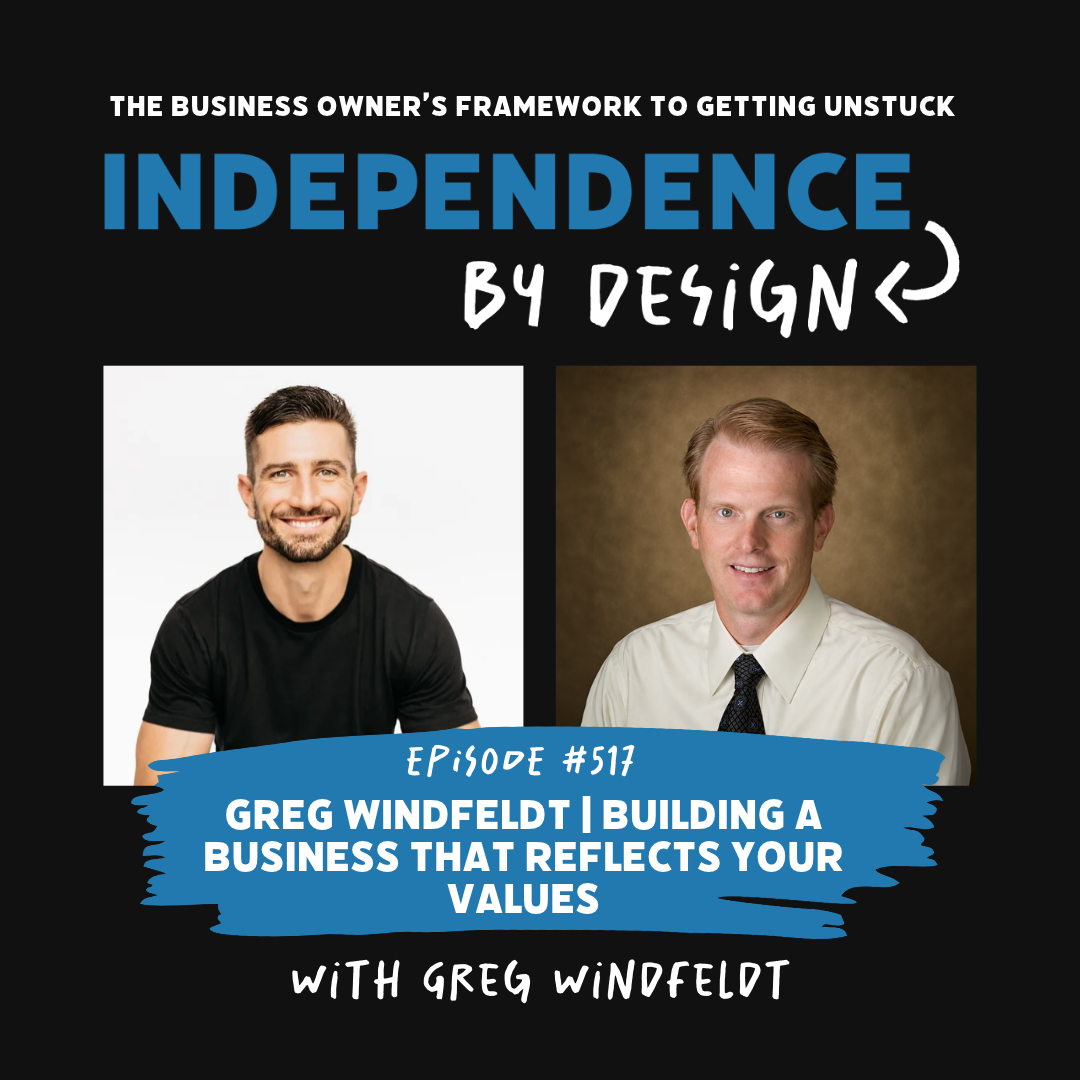
[00:00:54] Speaker B: so you know, kind of David Horsager, so kind of my career in senior leadership when I took over our family business being the. To become the CEO was in 2011 and, and most time you're taking over from a family member and maybe, you know, your, your values and things are pretty well kind of established and, and mine were, but I, we didn't have a family member running preferred at the time and we had a different viewpoint and we had, we had lost some credibility with our clients.
So preferred credit is what's called an indirect lender. So you go buy something from somebody, a water system, a vacuum, whatever, and you want to finance it, put it on payment plans or no interest plans. And we do that service. And so our clients are sellers of products around the country.
So we, we did not have a great, a lot of trust with our clients. We did not have a lot of trust with our employees.
And by happens chance, in the little chamber magazine of all places, there was a book review of the Trust Edge.
[00:02:08] Speaker A: No way.
[00:02:09] Speaker B: Yep. That's how I found David Hart Sager had no idea for many years that he was from Minnesota and lived in the Twin Cities. Read the book and long story short, read the book, start implementing the eight pillars of trust that is the foundation of preferred in pretty much everything I do today. So we have it postured all over our office.
[00:02:30] Speaker A: Cool.
[00:02:30] Speaker B: If you look at our mission, our mission vision, values, or as we call our values, mission vision. It is the eight pillars of trust that is our value system and we teach it to all our employees on a constant basis. But it started just reading the book and realizing here is a framework that we can use and Then a number of years later, I think it was 2015, we were awarded the Better Business Bureau of Minnesota North South Dakota's Torch Award for Ethics.
And David just happened to be on the board and at the award ceremony. So that was the first time. And since then we've done tremendously.
[00:03:14] Speaker A: That was the first time you met him at that award?
[00:03:17] Speaker B: Yeah, at that award
[00:03:18] Speaker A: was that.
[00:03:19] Speaker B: And so from that became a good working relationship first and then a friendship beyond that that he came fishing with us a couple years. He's come hunting with me a few times.
And so we just, we have a great relationship and, and it's just great having such a outstanding resource that happens to be local.
But I would say that is if you know the trust edge that is the foundation of my belief system both personally and, and in business. And it's, it's served myself personally well. It served all the organizations that I work with. So I do work with a number of organizations, either having ownership roles, board roles.
Family business obviously is the main one of preferred credit. So. Yeah, that's.
[00:04:08] Speaker A: Wow.
Well, and like what a beautiful way to start out of a conversation. Just going straight to the, the heart of it. And I'm.
There's so many different tentacles I want to.
Or how many. So many different threads I want to pull. Maybe I'll kind of throw a couple out there. Greg, we can figure out which. Which one you want to pull on first. Because I actually in my. One of my most recent podcasts talked about how there's just a trust recession. I know David's used that word too. And I think the trust recession is continuing to accelerate.
And I'm so curious because I took over a family business. I had a very similar experience to you. My dad was abs. More absentee owner and like I had a president that was not family and we had a very toxic culture. So I went through that own personal turnaround with my own family business with 115 employees.
I'm also interested to hear how you've taken that and then gotten into the long hold capital markets like Granite because there's such incentives for the quick wins and PE and like it.
You've, you've started the whole conversation off with a wonderful foundation of like how you're extrapolating that trust into all these different areas.
So like I said, a lot of different ways I want to go with this, but
[00:05:25] Speaker B: let's, let's go Granite. So Granite actually was not originally started with the mission that it has today. It was started as a typical private equity firm buy hold for a few years, sell.
It was actually designed to get SBA backing.
[00:05:44] Speaker A: Oh yeah,
[00:05:45] Speaker B: we did not get the SBA backing but we acquired a few companies. We had Fund one, Fund two.
We had a few we call add on funds or side funds where you know, investors got to invest alongside Granite in some of their investments. So
[00:06:02] Speaker A: doing like special purpose vehicles and just kind of like little,
[00:06:05] Speaker B: yeah, little
[00:06:06] Speaker A: things.
[00:06:07] Speaker B: You know, Granite could put in 10% of their capital, so they might only be able to put in $6 million, but you needed $9 million to get control. And so
[00:06:17] Speaker A: you
[00:06:18] Speaker B: went to the, went to the, you know, the members or shareholders of Grant and said hey, here's $3 million. You want to invest, you're investing in individual companies. So that's where it started.
Well, as our second, first first fund was in, was looking at the, and had started the divestiture period.
We had a couple of companies we just really liked. We just really liked. Dezuric is one here in Sartel, what is now Vector Windows up in Sauks, I know Fergus Falls.
And Then in Fund 2 microbiologics here in St. Cloud.
We just had these companies. You're like we can't get rid of these things.
[00:07:04] Speaker A: Right.
[00:07:04] Speaker B: So they're doing too well. Why would we sell them now? And so we converted from the traditional private equity to an Evergreen fund.
So I would say now Granite is a, as we call it, Granite Granite Partners is the management company. Granite Equity is the, is the equity side of it. And now we're in Evergreen. I would say we're a private holding or private.
[00:07:30] Speaker A: Did you get like the Evergreen from like the Tugboat Institute thought process?
[00:07:34] Speaker B: You
[00:07:34] Speaker A: know,
[00:07:35] Speaker B: Rick Bowerley is the CEO, founder and CEO of Granite Partners and he refers to it as a Evergreen fund. And so
[00:07:43] Speaker A: cool.
[00:07:44] Speaker B: I, I, I'm not overly involved in, in that in traditional private equity.
Most of my experiences in granite. So in 2012 we, we switched it to an Evergreen fund and then through the next couple of years we established our mission statement and
[00:08:03] Speaker A: did you guys have to buy, do you guys have to rebuy the businesses? Like do you set up like a.
No,
[00:08:09] Speaker B: we just, what we did is we had an, we had, you know, overwhelming support.
And so what we did is we did a tax free basically combine the two fund one, fund two and it was a tax free into ownership for so almost like a merger
[00:08:29] Speaker A: into
[00:08:29] Speaker B: Granite Equity LLC is what we did. And so it didn't, nobody sold, nobody had taxes due.
[00:08:36] Speaker A: Interesting. Interesting
[00:08:37] Speaker B: or anything. So that worked out pretty good.
But what we did is we came up with this mission or Rick came up with this mission of basically, you know, doing benefiting stakeholders. And so when we talk about stakeholders, most people think of shareholders. Well, shareholders aren't our number one priority always. So when we talk about stakeholders, we talk about the employees, the communities.
Granite originally was founded on the basis the. The 12 founding families. Now this is the first fund and this is kind of why it was easy to transition to Evergreen is the. These business owners in the area came together and said, hey, these companies are getting bought these outstate a lot around central Minnesota and by outside investors and they basically strip the companies.
The, you know, the leadership goes away. So there's not that, you know, higher salary, you know, the, the back office, you know, finance, accounting, maybe engineering, maybe, you know, hr. All of those functions go away. They might keep a plant here or something, but all of this employment base goes away. All of the community giving that local business owners have goes away for the
[00:10:03] Speaker A: spending of the money. The people in the community, I mean all of it,
[00:10:06] Speaker B: all that community support. And so we said, hey, we have to try and save these companies and keep them based locally or generally outstate Minnesota.
So from there then we said, you know, we want to serve all stakeholders. So the communities, the charitable organizations, the employees, obviously the shareholders still need to get a return. But it's not the main focus.
The other thing that Rick did is he established 100 year time horizon.
So when we look at companies, it is our plan to own them for 100 years. It doesn't always happen. We sometimes are not the best owner.
[00:10:45] Speaker A: Yeah,
[00:10:46] Speaker B: but our goal is always to when we acquire in a company that it stays local to support its local community and we're going to own it for the long haul. So we have a at granted we have a 100 year time horizon.
Not say, like I said, we don't. We don't guarantee we're going to keep it because sometimes
[00:11:05] Speaker A: you're not going to do it for stupid. You're not going to hold it on for stupid reasons. Like I mean like life and the world evolves but like a little bit of context. Greg.
So like you again, at any given point, if you want to double click on any of these components, I find it so fascinating because since selling our family business in 2014, this podcast has been around now for over 10 years.
[00:11:28] Speaker B: Yeah,
[00:11:28] Speaker A: because I just, it. It came from me and this is where it ties into the trust part. Where like my dad went to White Bear Lake High School, Reg. I mean he sold copiers.
[00:11:37] Speaker B: Yep.
[00:11:37] Speaker A: Just pretty straightforward. Right. And we had a family business, a lot of Johnny's. Yeah.
Maybe sometimes here and there would work with us and like what I learned because it was all about the, the soul of the business.
I mean I'm in violent agreement with everything that you're saying about the morals and the values and all this stuff. And I think a lot of people that are, that are people in the community that I work with want that. But what, what I learned, Greg, the hard way is I didn't understand the capital markets, valuations, deal structures, what's the discounted cash flow, the multiples. All this stuff that I learned over the last decade where the complexity confused everything to the point of the soul. And like the stakeholders, because I Conscious Capitalism, I don't know if that's where you're getting that stakeholder. Like, I mean that's, I've had this, the old CEO of Conscious Capitalism on the podcast. I don't know if I'm familiar with a small giants organization. I'm just, I'm showing, I just wanted to show you that like these agreements that we're have, I'm so on the same page. And what I found is like the complexities of all of the financial engineering try to, I, I saw like so many times the trust was dissipating because you just realized like once I learned how it all worked, I'm like, oh you're just a bad person.
And like I would be like this like all of these words and jargons, I'm like wait a second. No, you're just hoovering the money into your own pocket because of wrong incentive structures or whatever it might be.
[00:13:08] Speaker B: And people are the result of their actions, not their words usually. And it's how do you, how do you create your words that are backed by your actions?
You know, and these are all things. And the funny thing, you know, with the trust edge and the in and just they were all things that my father, who he started as a door to door vacuum cleaner salesman and that he instilled in my brothers and I, my younger brother was my partner. He's now the CEO of Preferred Credit or co CEO. But you know, these are all things. But the trust edge and David's writings brought it all together and put it in a format that you could teach other people
[00:13:53] Speaker A: and
[00:13:53] Speaker B: understand it.
And so by creating that common language and common understanding of the terms just allows organizations and across organizations to work so much more efficient and so much quicker and so much easier.
And once you have that reputation, you know it kind of sticks with you. So I'm also in the real estate business. I am a partner in GC Real Estate Partners here in central Minnesota.
And I'm in the process of selling some offices. And fortunately the seller is local.
And you know, we're, we're at the very final ages where there's just all these little ticky tack things and we both want to just get closed and the attorneys are going, no, no, no, you can't do that. You got to do this. And you know, we get these attorneys going back and forth and we're both like, you know what if grand more I'll pay for it, I don't care. And he's like, I know you will. I don't care. So he told his attorney, we're closing. We're just closing. Stop. Stop going through all this. The attorneys can get in the way a lot.
And so. But it's because he's local, he knows my reputation, he's local, his reputation.
And, and so we don't have to get into all the intricate minutia of a transaction to understand the outcome we both desire.
And
[00:15:23] Speaker A: Greg, what I find it's so refreshing because like when I, after I ended up learning how the whole machine of business and you know, the three statement model and all this stuff, and I know you grew up in finance and so you've gone through not only with your, with pce, but also the, the business PC. Sorry, pci. Right.
Is like when you look at the money, you kind of go down. Like when you're running a business, you're like, okay, if I only have so much cash, I have to actually use a decision tree of values of where I deploy it.
[00:16:01] Speaker B: Y.
[00:16:01] Speaker A: It really just lands there every single time. So the values are demonstrated to your point on the actions.
And then what I have found is so much confusion around all that is what actually like I'm hoping like, you know, with the middle market, with the people that you and I work with, like you hope that you're working with really good people. But then all that, all that, like you said, the minutia, the ticky tag, like that just. It gets all confusing to the spirit of the agreement.
[00:16:28] Speaker B: Yep, it does.
You know, and it's interesting. You bring up the money side of, of many things in business, you know, decisions you make.
And what I see is a lot, especially small business owners, is they let the money dictate their action.
Now there are times you might be in a position where you just don't have it and you cannot do what is, you know, whatever somebody's wanting you to do.
But if you are in a position to make the right decision, I mean, the right decision is one that you're not being greedy. You're not being, you're not pushing to the end detail of a, of a agreement. You're not trying to, you know, well, they kind of didn't see that coming. So I'm going to take advantage and benefit monetarily.
What happens is you find is, for one, your life gets a lot easier running it.
Because when you do things that are to serve your customers, serve your employees, serve the community, your vendors, whoever it may be, it comes back you. I have a story. We financed, we do a lot of financing of whole house water treatments, so softeners, filters, things.
We had a dealer down in Texas and he, he went out of business and, and we financed it. And the customer called, said, hey, you know, my water system doesn't work, it's leaking and the dealer's out of business.
So what we did is we said, okay, you know, Mr. And Mrs. Customer, we have another dealer in the area.
Would you be okay if we had them come install their system?
And we won't charge anything, but you just keep paying your bill, we'll cover the cost of that new system.
And so that's what we did. And it was a couple thousand dollars to have our. And our dealer very nicely gave us a good deal on the system, just a little bit over their cost for it.
And so we got this customer satisfied, they had a new system, everything was working.
That customer then went to the dealer who did the install for us and said, hey, I want to get this dealer did a bunch of other home improvement things and stuff. And she was like, I want this, but I only do it if preferred credit will finance it.
I
[00:19:04] Speaker A: don't know how many people do you think have been that determined to get the financing from a particular person, right?
[00:19:09] Speaker B: Yeah, never as much as we have our A rating with bb. Nobody says, hey, can I use that?
Doesn't, doesn't have that. But you know, you took a bad situation. We didn't let money get in the way. And now this customer did actually a 20 some thousand dollars bigger project versus a couple thousand dollars. And we got a loyal customer who paid both bills.
The dealer that put it in the second time, they got a loyal customer and the customer got what they paid for. And in the end of the day, if I would have only been thinking about money, I could have just said, no, I'm sorry. They went out of business, you know, we're still owe us, but. And that's what I see a lot in small, in a lot of business people is they let the money, the, the smaller dollars today get in the way of the bigger dollars in the future. And those bigger dollars come from creating trust, from creating goodwill, from being a good partner to whomever it is, your customers, your clients, you know, your, Your vendors, your employees.
And, and so that's where that, you know, that all kind of ties together.
[00:20:26] Speaker A: You know, I'm sure you just get reaffirmed every day as you start to see the dividends coming back from those goodwill actions that you've done. I'm really curious, Greg, as you stepped into, like, what was that like when your. Sounds like you learned a lot of these lessons from your dad and then you have this family business that's not a reflection of your family values.
How was
[00:20:52] Speaker B: that?
Well, before I took over, it was hard. And that was the hardest thing is you had employees coming to you and you could see what's going on. You're like, this isn't, this doesn't meet my family values.
And so that was very hard. In fact, I, I just about left the family business because I just couldn't, I could not stay and have our, you know, my, you know, last name, you know, attached to that kind of reputation. And so, but once I stepped in, it did take a while is a very hard process because very, very good people get indoctrinated into that culture, in
[00:21:39] Speaker A: that
[00:21:40] Speaker B: environment. They learn their leadership skills that way.
And what happens is, is it's very hard for people mid career to completely change their idea of what, you know, leadership and management is. And so we ended up having to roll over a lot of our leadership team just because people that wanted to change, they, they liked the new culture, they liked what we were doing.
They just had so many years of doing a certain way they couldn't change. And that was probably the hardest thing is when you had to let go of good people because they could not, they could not continue on the journey with you just from, you know, their personality and the way they were. They were
[00:22:29] Speaker A: habitual.
[00:22:30] Speaker B: Habitual. Their habits.
[00:22:31] Speaker A: Yeah.
That's really interesting of how you phrase that. That was helpful for me because I think that there are a lot, I think a lot of people have good intentions. Most people do.
[00:22:44] Speaker B: But
[00:22:44] Speaker A: then it's the repeat behavior that like, that becomes challenging. So how did you, you.
Was it the eight pillars? How. How did you see. If. I'm trying to formulate the question, Greg, where like, so many people in the community that I work with where, like, they feel like they're trying to always. I think they're trying to help people that they. They've got the conscious man or conscious capitalism kind of like soul of their companies are really feeling the people first. But then it becomes difficult where all of a sudden it's like there's this period where it's like there was no structure and accountability or clarity. Now there is. So there's kind of like this before and after, maybe the trust edge or before and after the eight pillars, where then all of a sudden you have to take these people that you've worked with forever and say, hey, there's this new thing that we're doing and now we have this new accountability.
Any thoughts about, like, what worked or didn't work as you kind of went about that journey?
[00:23:40] Speaker B: You know, you have to give people time. So if you look at the eight pillar structure, every pillar is weighted equally.
And so what you have to be very aware of is so compassion is one of the pillars, but compassion isn't more weighted now you can kind of weight it for a time differently. So you might wait heavier to compassion versus contribution, character, clarity, commitment, you know, the other pillars.
But eventually compassion can't outweigh contribution, character, you know, contribution or commitment and the others. And so what we did is we.
We set up, you know, 360 reviews, and then we started using the Trustedge Institute's 360 reviews.
And so that started showing those leaders where their, where their challenges are. And by the time, you know, we gave them, you know, a year or two years, by the time they kind of got through it, they. They saw that they just weren't able to make the change.
And so it wasn't usually a difficult. Some people, it was.
[00:25:02] Speaker A: It was more objective than subjective because of the framework and everything.
[00:25:06] Speaker B: Yeah, there was a few individuals that just thought, you know, I don't care. You know, that
[00:25:12] Speaker A: makes it a little bit easier, though,
[00:25:14] Speaker B: but that they're. That, you know, they weren't living by the eight pillars anyways. And so,
[00:25:19] Speaker A: yeah, yeah,
[00:25:21] Speaker B: it made it easier. So.
But it, it was a very difficult time because, you know, you worked with a lot of these people.
You, you know, I, I'd come up through the ring. So, you know, I worked at preferred credit for 20 years before I took over as CEO. So it wasn't like I just came in and took over. I was
[00:25:42] Speaker A: there 20
[00:25:42] Speaker B: years. I was the controller and CFO. And so I was in a senior leadership role for many years prior to becoming CEO.
[00:25:52] Speaker A: What was the dynamic with your dad? Like, what, what were his thoughts or how were the conversations between you? And maybe I'll give you my own experience for like, it. I, as my dad and I bumped into these challenges. Great. Because my dad's a wonderful person. And we got to a point where, like, this company was unrecognizable to the values of our family too. I mean, it was just like, I was just like grossed out, like by two thirds of the people.
But then every time I would like, talk about would be like, I was, I was like, criticizing my dad's character, his baby. So I had to work through all of these words and him and I had to have all these conversations around, like, I'm not trying to criticize you. I'm not trying to criticize. You've built like, you barely graduated high school. We're doing 20 million with 115 employees. Like, you obviously are successful. And so it was like, it was just this constant battle of communication.
So how, like, was there any of that? Or like, how, how did, how did you navigate that transition period?
[00:26:51] Speaker B: You know, he was more, it was more loyalty to him. The individual running the business had been with him for 30 some years, 38 years, maybe.
And, and so his thing was. Yeah, but look at how well, look at how well it's done. You know, look at what he's done for us. And of course, when he would speak to, to the, to the president at the time, he would get a completely different story. And it was just all this, oh, everything's wonderful and we're great and da, da, da, and I'm great and all that. And I would have to go back and say, yeah, but that's not true.
And so I, you know, so he believed me, but he, he just kind of, he didn't want to go out on that ledge and say, okay, I'm going to make the change. Until I put a little more pressure on him to say, you know, in the end, I essentially told him, well, it's him or me. So who do you want running the company for the next many years? You know, if you want me running it, then he's got to go, or you want him running it. And I just forced my father to, to make that decision where he kind of just, you know, it was one of these things. The, the prior president was going to retire. And then, you know, hey, I'm gonna retire in five years. Now I'm gonna retire in four years. Now I'm gonna retire in three years. And then he got to two years and it was, I'm gonna retire in two years and I'm gonna retire in two years. And I'm retiring to. And finally I'm like, no, no, no, the five years is up on this date.
So my father gave him one more year and. But he kept wanting to do that and then finally just my, my dad had to say, enough. You set your retirement date, that's when it is.
And so that's, that's what happened in the end. And, and so I took over actually really running everything about a year before his actual retirement date.
We just kind of took pieces of the company and ran it separately because you're right, you just, you, you kind of got this toxic environment. So I took two thirds the organization under me and he kept one third until, until his final retirement date. So but you know, you just sometimes you gotta force these things and you gotta do it respectfully. But at the end of the day, I had to get my father to like understand that it was going to be good. It was a good change. And you know, and that was 2012 and we're six times bigger than we were in 2012.
So
[00:29:24] Speaker A: that's fantastic.
[00:29:25] Speaker B: It's kind of worked out pretty good.
[00:29:30] Speaker A: I mean you could get, you could go double thumbs up for that, right?
And it kind of worked.
I am curious, Greg, on the part of the reason that I built this playbook and this ownership operating system that I worked on was so many topics and ideas got confused and like wrapped around the axle when my dad and I were going through that. One of them being the ownership role of like, hey, owning an asset is all about reinvestment versus distributions. And in light of the valuation target and a period of timeline, like that's what owning an asset is. And then the operator is you get a W2 paycheck plus compensation for the job that you do.
[00:30:11] Speaker B: Yep.
[00:30:12] Speaker A: And no one had ever sat my dad and I down and said that.
So it's like all the baggage and everything comes together of like what we value in massive air quotes. Right. And you know what's interesting is like what I have found, Greg, is like the ability to put labels to these actual first principles, then allow allowed me to then have conversations around them with different hats on. Because like back to then, the trust, it was like what I, what I struggled with, Greg. And I think a lot of people probably listening to this with family businesses or partnerships, it's like, I could trust you, Greg, like I really trust you. But then if we're using the wrong words for the wrong game.
I think there's this misperception of ill will when it's not really ill will, it's just lack of clarity, lack of education.
So any comments around, like, just those ideas in general and how that has transitioned or has that. How that's flowed into the family business or the, the Granite world?
[00:31:11] Speaker B: Yeah, so I had mentioned that my father had, you know, left preferred and he went and ran the Kirby Company. Kirby was owned by Berkshire Hathaway. And so he met with Warren Buffett every year.
[00:31:27] Speaker A: That's cool.
[00:31:28] Speaker B: And, or every other year. Warren Buffett made very, very clear.
Ownership decides. That's it. Ownership decides.
So ownership decides. Are you in a company that is there to produce cash flow back to the owner?
Ownership decides. Are you in going to create, you know, are you going to grow and reinvest the, the, the earnings and you know, going to rapid growth?
Ownership many times decides the, the type of organization is going to be somewhat. The culture. Leaders influence culture more. So you can have the same company run by different, you know, presidents and CEOs and they're going to have different cultures. But a lot of that does come down from ownership. And then you add this layer of family in there. So if you're non family, like, you know, the Granite companies are non family owned.
All the 10 companies that we own, you know, it's, they're owned by a collective amount of families, but not a family.
So but many of our business, like yours, like mine, you know, we are owned by the family. Might be three family members, might be six, might be 100, might be 300. You know, so as a family, especially when it's smaller, closer, tighter, you know, the first question is, what is our objective of this company? And I got this from, from a, a consultant that does more, you know, industrial psychology, you know, and he said there's the way he looked at, there's, there's two ends of the spectrum of what your organization is.
The, the one end of the spectrum is does the business exist to employ and provide financial resources to all family members?
The other. So that means, you know, cousin sue,
[00:33:26] Speaker A: cars and health care and to everybody,
[00:33:29] Speaker B: mainly salaries, health care, but you know, cousin, you know, Jeannie, sorry to Jeannie's out there, she gets a paycheck. She's not capable of doing much of the role, but she gets a paycheck. She has a role and the employees just live with it. Right.
They accept that she's really not good at what she does, but she's a family member. She's going to get a paycheck, she's going to get health insurance and she's not going to get fired. That is the one spectrum and as many family members as the company can sustain, that's, that's who's working there.
That usually does not end well in the end.
Usually companies can't survive long term that way. The other end of the spectrum is an NFL team. They're owned by a family.
There's one goal, it's to win. That's why you never see a family member as a head coach, as a gm, as anything. Because there is one objective.
Win.
[00:34:27] Speaker A: Get the ring.
[00:34:28] Speaker B: Get the ring. And that is the most companies fall somewhere, you know, one side or the other a family where the organization is there, provide some jobs to family members, provides income, provides livelihood.
Some of them at preferred. We've gone a little bit more to the performance where, hey, you can't work here unless you can do the job that you are in and you're going to get paid a salary commensurate with that. If I just hired anybody else, and you know, I've had that run in with some cousins that don't speak to me anymore because I didn't give them a job, but I do believe, and as my kids are getting working age, you know, I tell them, you are welcome to work for the company if you can get hired there by somebody not named me.
And, and you have to be able to do the role that they're hiring you for. And then I go to whoever's hiring him and I tell them, well, if you don't think they can do the job if you wouldn't hire them otherwise, don't hire them because it'll be a problem for you. And if it's a problem for you, it's going to be a bigger problem for me.
[00:35:44] Speaker A: And you're not in the business of making more problems for yourself
[00:35:46] Speaker B: and I'm not in the business.
But there are companies, you know, that, hey, that's, that's what they want, you know, provide family members.
Then comes down to, okay, so you provide a family member in a job, put them in a role.
The trick there is most roles in organizations have a need to get that role. Whatever that is you're trying to accomplish through that role has to get done, right?
What happens when you put a family member in a role that needs to get done and that family member can't do the role?
Nobody ever comes and tells you that they're not doing the role until you realize there's a breakdown.
And so that's usually what most family businesses miss is they put Joey in a role that has some significance because they want the title, they want to justify the higher pay, but they can't do that role, and nobody's going to do it for them because employees are afraid of family members. Right.
Human nature. You can say whatever you want.
Every employee, I. My employees love me. They are awful, deathly afraid of me.
[00:37:02] Speaker A: Yeah, well, because there's a. There's an authority hierarchy. I mean, it is what it is. Right.
[00:37:06] Speaker B: It's. It's the way that our world works.
[00:37:08] Speaker A: Yep.
[00:37:09] Speaker B: And so they're not going to say anything. They're not going to tell anybody that, you know, that Joey's not doing the job until one day, as the leader of the organization go, oh, I got a real problem over here. Joey's not doing the job. So now I got to deal with it. But it's a bigger problem.
And so I think that is the real trick is you can employ family members. You just got to be really careful where you put them, because if they're blocking somebody else from doing an essential role or essential work, nobody else is going to do it. And now the organization is not going to get to its potential. And you get. And then it just multiplies. Right. You get eight of those people in there, and pretty soon the. It's
[00:37:55] Speaker A: like. It's like a cancer, like
[00:37:57] Speaker B: family, just. Yep.
[00:37:58] Speaker A: Walk through, like, how, how you could use the eight pillars of trust to spot that. That's part, like part one of the question, Greg. And then I think maybe it's a comment or more of a comment or question of like. I think that also applies to non family members, like the sacred cow of the people that both of our parents or both of our fathers probably kept there for too long, where it's like kind of the same idea.
[00:38:22] Speaker B: The Untouchables,
[00:38:23] Speaker A: the inside, the sacred cow, Untouchables family, non family, whatever it might be. How that, how does that impact trust in the culture of an organization?
[00:38:32] Speaker B: So when you, when you have somebody and you're, you know, and they're usually the. Your staff, your employees know when somebody's not doing their job long before you ever do.
Nobody tells you anything when you're in a leadership role.
That is another thing I found.
They, they kind of leave it to you to figure out on your own.
[00:38:55] Speaker A: Even when you're, when you've fully embodied the trust.
[00:38:58] Speaker B: Yep. Even when you fully embodied it. It takes so much, especially for somebody that's in a, in a authoritary, you know, a role of authority.
You know, it takes, it takes a lot for people to jump that. Even though I would go on my all company means every year I did outcome means I said the tower employee, my door is open.
Come to see me. If your manager and your, you know, your supervisor, if they're not doing what you think they should be doing or treating you the way you think you should be treated, go go to some other manager. And then if that happens to be, you know, jump the hierarchy and let somebody know. It's hard to get people to do it. They just don't do it.
And so, you know, what you need to do is. And that's where anonymous surveys and reviews and, and things like that really come in because they kind of, they start, you know, you, you can see things, you know, about people and areas and be like, okay, I see there's something here, but I can't quite put my finger on it. And that's where 360 surveys and employment engagement surveys, they start connecting the dots for. You
[00:40:16] Speaker A: got it. I was going to ask you how you get the information. If you feel like there's even difficult in the fully rolled out a pillar trust organization, you're still trying to get that feedback loop.
[00:40:26] Speaker B: Yeah. So, you know, we do, we do our organizational trust index every other year. And so that, that gives us a lot of insight into that.
And, and so, you know, that's how you figure it out. But you, you know, when it comes back to when somebody's not doing the role, especially a family member, the eight pillars, you know, contribution is one of the main pill, you know, is one of the pillars.
So if you got contribution, a lot of times, if they're a family member that's skating along, they don't have commitment, they maybe don't have character.
They certainly probably don't have clarity of. Of what they should be doing, what versus what they're doing. You know, every, you know, there's all these pillars that can kind of come back to say, okay, this is what's not happening. And, and that's something we also found is, you know, every. If you were having an issue in your business with something or someone, it will almost.
If it's not, you know, external tariffs and costs and things like that, it will almost always come back to a very significant degradation of one of the eight tellers or one or two.
You can almost always trace it back to one or two of them that is very deficient.
[00:41:51] Speaker A: Did you have. I'm going to, I'm going to label this for the moment as emotional intelligence. Because, like, when I, when I.
The reason I'm using that word is like, I saw my company, family business too. I mean, I, and I think it'd be interesting. I don't know what sports you played or like, growing up, some of the activities of like, was this embodied into you as like a EQ radar and then this labeled it, or did you learn this? Like, how did, how did. What's your journey with it?
[00:42:19] Speaker B: You know, I think I didn't really grow up doing team sports.
I played some hockey, but I was never that good that I didn't stick with it. That, you know, through a couple years of high school, you know, I watched my dad and running. He ran a business, you know, from right out of college.
He started in the vacuum business and ran his own business for many years.
And so, you know, I would watch the things that he would do and he would always talk about, you know, just pay attention to human nature. It never leads you astray. People are going to do what they're going to do no matter what they tell you.
And so there's a lot of these things. Just talking to him then. I really connected with a lot of mentors when I was earlier in my career and tried to learn as much as I could.
I did read a fair number of books and things, but I never really, you know, the emotional intelligence, I think, is somewhat just. It just kind of. You have it.
If you don't have it, you can gain it. It just takes more work. But I think there's a lot of just, it's built into who we are.
[00:43:32] Speaker A: Observing,
[00:43:33] Speaker B: observing and, and having the right, you know, having a certain set of morals that, you know, that allows you to do that because you can try and be the most emotionally intelligent person and do everything that the books tell you to do.
You know, if you're a narcissist, you're a narcissist.
[00:43:54] Speaker A: And, and maybe you don't even know it. Yeah, you
[00:43:57] Speaker B: might not even know it.
And so I think there's some of it, it's just. There's a little bit of, you know, an innate quality.
[00:44:07] Speaker A: Yeah, it, it's so fascinating, Greg, because like, I, I remember like when I, when I, when I stumbled across David's book. And like, it's like same thing kind of with finance, where it's either the psychology of people or it's the money. It's like once I, like got the labels, it was like, oh, I'm like already experiencing a lot of this stuff. I just didn't know what the words were that were happening.
[00:44:29] Speaker B: But
[00:44:29] Speaker A: I think it's so fascinating as it relates to the, the people part. And I'm going to kind of tie two topics together of like the money in the game, but then also the people like what I would.
Because at the end of the day like when you're, when, when you're running a business, you get, you need to get people's buy in to go do stuff.
[00:44:43] Speaker B: Yeah,
[00:44:43] Speaker A: right. Like it's like I got a bunch of to do and I can't do it all myself.
So like how to get everybody to do it with smiles and hopefully not resentful and pissed off at me.
[00:44:53] Speaker B: Yeah,
[00:44:53] Speaker A: I mean that's how I boiled it down. And I would watch like either was like from the legacy culture. It was just kind of some more tyrannical leader dictatorship than I, I resonate with. And then it would be like I would watch the hallway conversations going, we're not getting buy in from these people. Even though I don't like that person at all, I still want them to get to work.
And then I would be like, well do they have a reason to not want to work? You know, and then I would try to pull the thread like well they were said this and then that happened and that happened and missed expectations. And I'm like, so then they're walking around pretending not to do that. You know, pretend so this like because at the end of the day we need to get stuff done.
[00:45:36] Speaker B: Exactly. And, and you do have to get the buy in. I was very big on the why, why are we doing this? Why should you do that? And so people are, they're a little more.
Some people, most people tend to push more, work harder, make sure when they understand why they're doing something, some people will just not do it.
One of the things I would talk about in my all company meetings is, you know, that person. It's our responsibility as managers to figure out who is not pulling their weight and either get them doing it or get them out of the organization.
And it sounds harsh, but it hurts the other employees more than it hurts you. And I would tell. And one of the things I'd say is if somebody is missing a lot of work, compassion first. Why are they missing? You know, do they have and you know, do they have health issues?
[00:46:38] Speaker A: Sick elder parent or kid or whatever.
[00:46:40] Speaker B: Children. Okay, let us know, we'll figure out a way to work with you.
Are you skipping work because you just don't Feel like it.
Okay, that's a different issue.
The problem is, is when you skip work because you don't feel like it, there's a whole bunch of people that sit around you that now have to do that work. Their day just got worse when you didn't show up.
[00:47:03] Speaker A: I
[00:47:03] Speaker B: didn't even know about it as a CEO, but your co workers, they're the ones who, you know. And so if I don't take care of that situation, eventually two things are going to happen. Your co workers are going to drop to your level or they're going to quit because they're like, this isn't fair.
As a manager and as a leader. It was, it was. And throughout the, the leadership and management, it is there. It is their job to make sure that they are, you know, that everybody's doing what they're expected.
Not that everybody always can. And then you got to find what role. And there's, there's a lot to that.
[00:47:49] Speaker A: But
[00:47:50] Speaker B: you can't have somebody in your organization not doing something because you know, and, and nobody does anything about it. Now the flip side of that is you also don't want an organization. I always tried to make sure that you don't have an organization where people are afraid of getting fired on a whim.
And that was one thing I really tried to stress. Still, people always believed it is at our company, you cannot get fired on a whim.
It has to go through a process.
You know, you may everybody else, when Joe got fired, everybody think, wow, that you know, he got fired quick. No, no, no. There was a six month, eight month, unless it was really egregious. There was a six month, eighth month, one year, one and a half year process that happened. We just can't tell you about it.
And so I want everybody to know that you don't have to worry about it. If, if you're going to get fired, you either did something really bad or you've been made aware many, many times.
So don't worry about it unless you've been made aware.
[00:48:58] Speaker A: Therefore, that should make the open door policy and hopefully the data feedback loop more possible. But to your point, even with all of that said, you still have those dynamics that are at play.
[00:49:11] Speaker B: Yeah.
[00:49:12] Speaker A: Do you find
[00:49:12] Speaker B: it?
[00:49:13] Speaker A: Do you find it? Have people were like, and maybe how you ran your businesses with this kind of philosophy of, I think a lot of owners, more times hear it's about time you fired that person more so than, oh, I didn't see that coming.
[00:49:31] Speaker B: Yeah. And, and that's what we got is well, it's about time. But I would always tell everybody, yes, but if you were in their shoes, wouldn't you want us to take the time to address the issue, figure out if you're in the proper role, figure out if you have the ability, you know, let you, you know, give you a chance to improve?
Most people would prefer that. So, yes,
[00:49:59] Speaker A: yeah,
[00:50:00] Speaker B: if people say it's about time, that's fine, as long as it doesn't go too long, because then they, they get it. And as long as they know that there is something behind the scenes going on.
[00:50:11] Speaker A: There's thought,
[00:50:12] Speaker B: there's thought, there's, you know, deliberate, deliberate action taking.
That's one thing. We're always, you know, we're very disciplined. I'm a pretty disciplined person that, you know, there has to be a plan.
You know, what is your plan when somebody go, we need to get rid of so and so. Okay, what's your plan?
What have they done? Have you done gone through the process?
And what's your plan when they're gone?
Are you going to talk to clients? How you're going to talk to their co workers? How are you going to. If you don't have a plan,
[00:50:44] Speaker A: he's going to do the work? Don't,
[00:50:46] Speaker B: don't come to me.
[00:50:47] Speaker A: Yeah, that might be the title of the podcast. If you don't have a plan, don't come to me.
I'll. Joking aside, there's a couple of topics inside of this idea that I think is very fascinating. So I'm going to spew a couple ideas and we can figure out how to pick up the pieces.
I love what I'm getting as a sense of your leadership, and I think there's a massive gap in this type of leadership, which is also why I think there's a trust recession and there's something that you said that I want to see if some of these ideas are connected where I want to live in a world where everything you're talking about is the way it is and the leaders and the owners and I, and I think that the community that I've been creating and the people that are circling around in these private, privately held owner operators all have the innate, like, soul that you're talking about.
[00:51:40] Speaker B: What
[00:51:40] Speaker A: I found is a component that was missing and I'm, I'm curious how, how much to index on this component is there has to be a plan and what is the objective of this company? There's a couple of these things that you keep saying where, you know, you came up through the finance Lens where a lot of the people that I work with where it's boiler, commercial cleaner, asphalt, paving or the local ultras tech or you know, like there was no finance degree. My dad got it, you know, bar graduated high school.
And so then there was this when I. What I have found is having very clear objectives and a very clear plan allow us to be more human to then balance. Because like what I'm hearing a lot about what you don't want the trust edge and the, the trust pillars of the eight. There's balance where like you can be compassionate, but if you're overly compassionate, then it's at a risk of all your employees and your clients for this one.
Right. So like every time you get out of balance, it gets all out of whack. So like you can be empathetic and disciplined and compassionate, but then fire someone.
[00:52:47] Speaker B: Yep.
[00:52:47] Speaker A: And I feel like the whole world has forgot this.
And so like what I have noticed as the, like the kind of the evolution of the people that are in our owner's community is once they understand the financial game, they can insert more objectivity because so many people have been doing this through innate talent and gut instincts.
But then it becomes too subjective and then they feel like all tangled up in their own morals and values because they're all they. I feel people get conflicted of who they are when you, if you put the objective numbers in play and then you have a clear conversation with someone, then it allows people to be more balanced. As a leader,
[00:53:35] Speaker B: you know, as a leader, you kind of mentioned all these different kind of ways people got to being a leader.
And you know, whether it's their own business, a family business, and you know, there's a lot of things you don't know. I mean, there's a lot of things I didn't know going in. Even finance. Yeah, I have a degree in finance. It's not where I learned most everything. I, I sought out, you know, account our, you know, our accountant. I worked with him a lot. I read, went back to school, took seminars. There's ways of learning if you're not able to do that or not, you know, don't have the time, then it comes down to you have to find the people that do have those skills. So if you, if you're running say a, an H Vac contractor and it's growing and all of a sudden you've got, you know, a number of employees, you don't really know how to manage employees in hr. And guess what? I didn't either.
So I had to Find a good either HR consultant or we hired a good hr, you know, executive.
If you don't know accounting, you need to have a good controller and have a good accountant.
The hard thing is you have to know enough to know if they're good. That is the challenge. I see a lot of people get advisors and different people telling them what to do that aren't good. And that's the biggest challenge when you don't know, you don't know what you don't know to determine when. So sometimes it's just, you know, paying attention and understanding so you know that that is really part of it is who you surround yourself with now with.
When it comes to people, you can usually tell, you know, their character, their, I mean just start going down and doing a checklist of everything they've said and done that you know of and say does it check some of the boxes of the eight pillars and then you'll kind of know, yeah, I can trust them.
But you know, competency is a pillar.
And so if your accountant does things and then oh, that was wrong. Well, that, you know, they may maybe don't have competency.
And so you gotta, you gotta kind of relook that, you know, take another look at that.
So
[00:56:08] Speaker A: that's very well said. And I think the I, I swung my own personal pendulum so far the other direction that I had to learn over a decade plus how it all works so that way I could swing back to like dealing with the people side. And I, and I, it's this dynamic, Greg, of like I've personally struggled with like making sure resentment doesn't bubble up into my life because I'm like, I'm a very, I want to be trusting right off the bat. And I've, I've learned that, man, it's been so difficult because like I'll trust because I just, I think that life is so much better. It's like I think people inherently good, I want to inherently trust. But then the competency or the lack of clear expectations always came back and bit me.
So how do you manage that dynamic if you're not the expert or how have you managed that dynamic of that competency when you need the person to do the job but you can't be fully aware. How do you manage that relationship in that dynamic?
[00:57:13] Speaker B: You know, it gets hard, you know, especially with interpersonal relationship friendships. What's the first thing we all do? Well, my buddy's an electrician. I'm going to go use him.
What if he's a bad electrician?
My Buddy needs a job, and, you know, I think he knows some accounting. I'm gonna hire him.
That's slippery slope.
And so I tried to generally not work with friends in their own businesses or hire too many friends into my business because I always worried, what if they don't have the competency?
What if they, you know, they aren't able to do the job? Now I lose, you know, I lose the friendship and I lose the employee, and I lose the work and the cost of everything going along.
And so it's. It's really just trying to assess, you know, are they capable of it?
If they are. And. And you can usually tell over time. You know, it's just.
Things will show eventually.
[00:58:22] Speaker A: Hopefully the overtime is not on your dime with your project. It's
[00:58:25] Speaker B: not too long or usually, hopefully it's not.
The. The challenges don't grow too big in that.
[00:58:32] Speaker A: Yeah,
[00:58:32] Speaker B: right.
[00:58:33] Speaker A: Yeah.
[00:58:33] Speaker B: And. And the more critical, the more expensive, the more whatever it is, the closer you got to pay attention. And sometimes you just don't know. I mean, there's just things, you know, our company is big into technology.
You know, I'm just not good at technology. I mean, I can use my iPhone fine, but, you know, beyond that, I'm struggling with this AI stuff.
And.
And so, you know, I have to rely on our technology team to tell me, and. And I have to watch and make sure. And it's. It's hard sometimes. You just don't know.
Are we getting the most out of everybody? Are we, you know, doing the things we should be doing from security, from all that? Sometimes just don't know. And sometimes it does take a. A major event to.
To
[00:59:24] Speaker A: realize it. How do you if. If we can double click on that for the moment? Because one of the modules inside of my owner's playbook is about the C suite team and building out the leadership team, where they actually own the outcomes of the three functions of the income statement, so, revenue margins and earnings. So cfo, CRO and coo. And I know everybody listening. Like the. The sizes, Greg, of companies vary between a few million bucks, hundred million. But like, at the end of the day, we have three buckets of the income statement.
[00:59:54] Speaker B: Y.
[00:59:55] Speaker A: And so like, the CEO is responsible in my mind of, like, the entire outcome of the operations to the shareholders.
And then you have the three buckets. And therefore there's an outcome that someone should be able to manage to.
And so many times to use, you know, what you just said of like, you don't know what you don't know.
And so it's a very intimidating process watching out these executives build out. I'm sorry, watching the owners build out their executive team. Because for all intents and purposes, Greg, think about like as you at Granite go out and buy, you know, you do the due diligence, you value the company, then you figure out how are we going to get from here to there? That's essentially my whole program. It's just tied to the owner's goals of capital, not the, the new investors. And so there's this whole like new world of like, oh my gosh, these are expensive people. But I, and I don't know how, I don't know what that role technicality means. So any thoughts about building up the, the executive team?
[01:00:49] Speaker B: Yeah, for one, I'm involved in some companies that are, well, hr. Go get me a VP of marketing.
No, the, the beauty of, you know, we're in central Minnesota and we have a, you know, I worked hard to build a network over the last 30 years.
Usually you know somebody that knows somebody and, or know somebody that knows somebody that knows somebody.
So when you're talking about your executive team, if you can now, it's not always possible, but if you can try and get somebody, that somebody that you know and trust, you know them well enough to know their capabilities, to know their character, to know who they are and you can trust that their competency in an area. So for example, you know, a VP of hr, you know, people that are around business that know a good HR person from a bad one and then see who they, you know, recommend or see who they, So a lot of. And then as a CEO, you need to go out there. Generally it's you, maybe your senior team, you need to be doing the recruiting.
Most companies want to just push recruiting, especially high level recruits off and you're going to go through, you're going to go through a lot.
Now you can do other things. Granite has a very extensive process. They have, you know, they have recruiters on staff for CEO, cfo, chief marketing officers, the whole C suite group.
They have a very extensive testing, interview, various different things and they do very well.
They spend a lot of time and effort on it.
Most of us don't have that resource. We don't have, you know, full time recruiters on our staff.
And so we have to do it ourselves. And the best way to do that is just look out in your network, figure out who's know somebody that knows somebody and see how they fit in and then look at
[01:03:14] Speaker A: leaning on the competency.
So if I'M hearing you correctly, it's take whatever technical role that it might be and say okay, I don't necessarily know how to like I'm saying for the person potentially listening and I've never been the CRO or the cfo, but I know someone that I know trust in their competency, who knows how to vet out that person. So you're, I mean they're not the recruiter potentially but like that's what a recruiter's job should be is like you trust that person who's then being the advocate for that competency of that individual. When you think about the time, like I think you said something that's so important of like being the person that's recruiting as the CEO of the company because everybody listening is owner and operator. They've got. There's only a handful. There's a small percentage of people that have the CEO in place. That's not them. But the, you know, the whole buying your time back is something that the is is highly motivating for everybody that's in my community. So there's like how do we buy our time back? But then they're constantly getting sucked into everything. Like well that's the whole point of delegating because of how much time I think the recruiting efforts, especially as the boomers are retiring and there's less Gen X and Gen and millennials coming back, back behind them. I think recruiting is going to be a wildly interesting.
It's gonna be really hard. I think
[01:04:39] Speaker B: really it's actually not that much time because you do it very incrementally.
We've had people that we got to know, me or my brother, our who was our cfo who's now took over my job at Preferred Credit. And as co CEO we know people and we, you know, we watch them and we listen and you know, they, they, you know, are working in this company or that company and you kind of know who's who and then one day you have a need and this is where it gets tricky, especially in small, in small central Minnesota. So I don't want to go recruit this person from any of my friends or, or colleagues. But sometimes you'll see, oh, they're, they're thinking of moving and you can go pick them up or you know, their company just got sold. Most of the best people we got is their company got sold.
We knew who was who and we went and grabbed them or they moved on somewhere else. They didn't really like that and, and we went back and got them later.
So usually it comes down to kind of keep a.
This is what a recruiter does too.
A database of people, you know, keep a list of people. If I ever need a cfo, who would I really want?
Sometimes you can get them, sometimes you can't.
If I really need a Chief Marketing officer or, you know, a chief Risk officer, CIO is, you know, or CTO is, is probably the hardest in the area right now.
You know, they're really hard to find.
We waited two, three years for our cto.
We knew he was there. We knew the company was going to get sold. We knew we didn't want to leave the area
[01:06:39] Speaker A: lurking in the weeds. Like. Yes.
[01:06:41] Speaker B: And so we just kind of kept having casual conversations. And then one day the company sold and he says, okay, I'm ready.
So
[01:06:52] Speaker A: I think it's a good word. It's a good word of encouragement where, like, it's just having the discipline to spend the incremental time. Because, like, I mean, as I'm hearing in this conversation is you're just built like your reputation is following you. Right. And because you're not short changing for short decision making. Like these PE firms are like the, like everybody that's short transaction based, like life is a long game.
[01:07:18] Speaker B: Yeah.
There are leaders that, that's who they work for. And you watch them, they just move from one PE con, you know, from one company being bought by Pete, because that's what they want to do. And they're fine people, but they usually don't match, you know, what we are.
And the other thing is this is, I learned this the hard way many times.
Generally no hire is better than a bad hire.
You can usually get people to coalesce around a big role and get enough, you know, with you. So say you, you, you really need a cfo.
Your accountant can fill in. Maybe you got some other accounting folks you can hire fractional CFOs, but you, you make a bad hire.
It's very expensive, very disruptive.
Even with all of the best intentions and all of the things, you're still only going to be about 70% or so on good hires. Here's the next thing that's hard if you're in a growing company. Like our company grew fairly quickly.
And the challenge was, is people that we hired or we, you know, we were able to bring up through the company were great until we got to a certain size and we needed more from them. We needed, you know, they needed to delegate more and they needed to have better critical thinking and problem solving on a higher, more complex basis, that's where it gets hard because the company outgrows people.
And, and that, that is a challenge. The other thing, and especially for small, you know, business owners, you know, family businesses especially, or even founder ones, the other thing you have to be aware of is when did the company outgrow you?
And that's what most founders or family members fail to recognize. When is the company on a path where they're outgrowing you?
And you know, I kind of went this. So I stepped down as from the CEO role as of the end of last year.
And part of it was, is our business is growing, our industry has challenges, a lot needs to be done and I didn't have the energy to do it. So that's one, I couldn't give it 110% again.
And two, the things were changing so fast.
I was more of an entrepreneur, you know, trained everybody. Just go to Greg, he'll tell you the answer because that's what I do. You're just in spin mode all the time. Just do this, do that. You come here, what about this? And this is okay, just do this.
Versus really pushing back and saying you have to make these decisions you after this.
But I had trained everybody that I would give them answers and you know, constant direction.
And so what happened was, is I couldn't. I was starting to become the bottleneck of the organization so I had to let it free and promote somebody else along with my, my brother to run the organization because I didn't have the drive that I had.
I didn't have the desire to go get on an airplane every two weeks again.
And I had trained everybody to do a certain thing a certain way. And it was going to be really hard to retrain everybody.
And so for me, the best solution was step back, hand the CEO title off to somebody else. So now I'm still executive board chair, I'm still quite involved. But I also, a lot of people in my position would keep the CEO title and step away.
In my opinion, that's not fair to the people under you, the people that are doing the day to day that now get a title of president, chief Operating officer. It's not fair to them.
You know, if you're CEO, that means something and you got to give it 110 every day.
And if you aren't willing to do that, you shouldn't hold the title
[01:11:38] Speaker A: because it's in that operational role like you and I have talked about, versus sitting in the shareholder role where it's just different and different requirements of time.
[01:11:47] Speaker B: Yep. And so as. As board chair, I sit in the shareholder role now and I guide them on direction, desires of the shareholders. I still do quite a bit with just kind of where they're going and clients because I'm still not that far out yet and still trying to get transition, everything transition. But.
But something to think about. You got to know when to fight yourself.
[01:12:14] Speaker A: Amen. I think that's.
Any thoughts around the psychological process of that because of how many people are so interconnected with their identity and running a company.
[01:12:31] Speaker B: Well, you need to spend some time ahead of time doing things outside the organization to.
To solidify your identity outside of that title.
For me, I've just kind of always done it, been involved in non profits.
You know, I chair the board of Granite. I have a real estate business. I'm a partner in and oversee real estate.
We talked about Aaron Miller at aps. I consult with them. I have a lot of other things that I was already involved in.
And so it really wasn't a big transition for me because I didn't really identify myself that close with being the CEO of this company.
You
[01:13:23] Speaker A: were moving towards something instead of a wave. Like, yeah, it's. I.
I find that so helpful for people, like being excited to go towards something versus trying to run away. It's
[01:13:33] Speaker B: just,
[01:13:34] Speaker A: yeah. Way more of a healthy balance. I love how you put that. Like, when. When does the company outgrow you from an operational perspective? And that's where it's interesting. Like, I just. It's been so fun for me to watch, Greg is like, for whatever it's worth, over the last 10 years, as I've been working on these words that somehow resonated with these owner operators, like owner, operator, two two hats. Just that alone was like, mind blowing for people because they're like, oh, I don't have to sell the business because, like this whole, like, I want out and commingling the job and the asset all at once. And it's a binary decision. Everybody is forced to like.
Like, the way I kept saying it, Greg, is like, I think it's a false choice. Like, everybody's arguing about the color of the spoon in the matrix. I'm like, there's no spoon. Like, you don't. You can like, opt out of this entire shenanigans where, like, what do you want for your job and your time? What do you want for your cash flow and your asset? And people are like, oh my God. It's a. It's like giving them the liberty to think differently is just fascinating to Watch them, then think about their future differently.
[01:14:37] Speaker B: Yeah. You know, in selling, you know, it is hard because there is a day, some, you know, that might come when you're like, you know, I don't have anybody. You know, I spend a lot of time, you know, grooming the individuals to run the company.
And so if you do that, you should be okay.
But there does come a day when even as the, you know, the representative of the shareholders, you're still ultimately responsible for that business. And
[01:15:09] Speaker A: so
[01:15:09] Speaker B: get good leadership in there.
Now you've got to take a look and say, okay, if I can't get good leadership, I don't want to go back and do it.
Now is probably the time to. To pass.
[01:15:23] Speaker A: To actually sell, package it up. Yeah. And this will be an interesting kind of going back to granite. And I know we got about 10 minutes left. Is.
That's. That comment you just made. Is going into the reinforcement of taking the time to recruit the executives, which is why I love the, like, the financial model and the program that Aaron just. And Nolan just went through. It's like, hey, guys, get the visibility. Because I think so many times people like, I can't see the cash flow where it's like, as long as I know my cash flow and I can Change it from W2 to distributions and the thing keeps going. They can see how those hires over the. That course of that, you know, one to five years, it's like, oh, I can balance both of these. And I think that's such a big unknown that.
But it goes back to your point. It's even if you have the cash flow, it still takes time to find that C suite.
[01:16:18] Speaker B: Yeah, it does. And then, you know, the other thing is, if you have decent income coming out of your business and cash flows, diversify them. See, the nice thing is I'm in a position and our family's in position that I have three sources of cash.
I have a little bit of a salary, actually have more than. I have a little bit of a salary still from preferred.
I have income distributions coming off Granite and other in. And then I'm a partner in. In the real estate business that has distribution. So now we have real estate that we get distributions from. And then I have, you know, another one or two companies that I have ownership in and I get distributions from. So I don't have any. If one source of cash flow got cut off tomorrow, it
[01:17:08] Speaker A: would
[01:17:09] Speaker B: have zero effect on my lifestyle, and I probably wouldn't have to even sell any assets.
And that it takes 20 years. That's what most people, they think, oh, you, you've gotten here, you know, it's amazing. Look at you. Look at now. It's 25 years of planning and discipline and proper investing and diversifying and you know, estate planning and all of these different things to get to a very stable cash flow and asset environment where, you know, even, you know, if something were to happen to me, I have things set up that my kids have assets that they don't control. I don't want to spoil them or anything.
I could live off if I ever got in, you know, somebody decided to sue me for a lot or something,
[01:17:56] Speaker A: you
[01:17:57] Speaker B: know, so there's all of these things to do that. But
[01:18:00] Speaker A: yeah, you're 25 year overnight success. Right.
And, and I think it's so like you said, you're a disciplined guy. And I mean, I resonate with that where I, to me, discipline sets me free. Like I just. Because like, if I don't like, it's, the chaos will consume me. And I think about it's all those little teeny conversations of someone's not doing their job, they're not following the eight pillars. That's a hard conversation that so many of the owners can just get in the car and go to the cabin instead.
[01:18:33] Speaker B: Yep.
[01:18:33] Speaker A: You know, we're in Minnesota where the cabin people. Right. So that's the escape. Right. So. Versus showing up, having that hard conversation and dealing with it. But it's all of those hard conversations that lead to where you're at.
[01:18:47] Speaker B: And, and sometimes, you know, we kind of started with selling and stuff. Sometimes financially you have to sell, you know, because there, there isn't, there hasn't been enough cash flow over the years to support you in retirement without, you know, without selling or it's spread too thin.
And, and then, you know, a lot of people are, they're leery of selling a family business because there's a legacy, you know, and especially if you were the founder or the second generation, you know, that legacy is really strong. That founder legacy is very strong. And that is an area where Granite excels is how do we take this legacy that was created.
And so picking your, your buyer is extremely important. A lot of people will just say, well, who's going to give me the most money?
But for, for a lot of people, it comes down to who's going to protect my legacy, who's going to protect my employees, who's going to continue to, to provide for my community.
And then the financial side. And, and that's what I love about Granite and its mission is that is exactly. So we get, you know mostly we buy companies from founders or second generation, sometimes third generation because they want a partner for the next phase of their life that they have the financial stability and, and diversification but yet the company just isn't going to get and that was what Gurna was founded on is the company's not just going to get broken up and, and lay all the employees, you know, making the widget to Mexico or China.
[01:20:33] Speaker A: What do you look for in a target profile company? And then kind of all kind of co mingled in the same kind of question of I'm curious on how many people or how many companies in their portfolio and then do you provide back office resources to them and do they share kind of like a structure and then what's like an ideal target for you guys?
[01:20:56] Speaker B: So in granite now just because you know you're constrained with capital and time, you know pretty much a new company that is not being acquired as to put into an existing one. So we have 10 companies and we buy, we acquire a number of companies every year to enhance those 10.
[01:21:17] Speaker A: So there will be bolt ons just inside of it strategic. So you're the strategic buyer in that.
[01:21:23] Speaker B: But we still keep their operations. So we have operations all over the place.
Beyond that it's usually a company that's stable cash flow, 5 to 10 million or above in EBITDA, you know 50 to 100 million kind of minimum of revenue to, to look at a platform company
[01:21:45] Speaker A: because you got the 10 that. So when you say 10 it would be like 10 different operating businesses and the bolt ons would be going inside of there. But then if you're gonna add the 11th because of the distraction it has to be self sufficient as a platform so that way it doesn't suck all the resources out of the rest.
[01:22:04] Speaker B: So there are shared resources. We're on common accounting platforms. There's you know, buying groups that we have. We, we get our health insurance. We're you know combining all the health insurance 401ks. So there's a lot of things but because the companies are so diverse you can't share everything.
You know we own a number of companies in the fiberglass, you know area. So you know the companies now can combine and do their, you know, they're buying a fiberglass together and get a, and be much bigger. So there's, there's a little bit of, it's mainly the philosophies, oversight and then what granite can do is bring the disciplines, the you know, the consulting, the management styles and you know, the kind of the tools of much, much larger companies to these smaller companies so they can be more competitive in their industry.
So it's kind of like saying, well, what would, what would a really well run, you know, Fortune 500 do in this case? And say, okay, we're going to do that too, but we're going to do it for this 50 million dollar company.
[01:23:24] Speaker A: Mm.
As we kind of slide into home base here, I am curious, as you look at the due diligence when you're looking at a portfolio or target acquisition, how do you measure the culture? Because you could have a, you know, you could be drooling over the cash flow and the industry and after that, like, but like, what if you acquired a turd of a bunch of toxic people?
[01:23:51] Speaker B: So I don't, I'm not involved. Not
[01:23:53] Speaker A: you, you, not you particular. Yeah, yeah.
[01:23:56] Speaker B: They do a lot. They meet with the owners many, many times. They meet with the. And then when they kind of get far enough down that you've got a deal structure in place, then they start meeting with all of the leadership team and then is the, you know, who's staying and who's leaving. A lot of times this is come on because you know, an owner wants to exit or you know, family members that have been running it want to exit and they don't have anybody else. And so what is that timeline. But usually, you know, you can get a pretty good feel for an organization by visiting their sites, by meeting with their leadership group. You kind of get a feel for the culture and then, you know, it's just being displayed. We, you know, I think they look at 70 different companies a year and
[01:24:45] Speaker A: wow,
[01:24:46] Speaker B: we don't. We maybe do a platform acquisition every three to five years.
[01:24:52] Speaker A: Has there been any either bolt ons or platforms where you're like on paper and all things that every investor would say that this is amazing and you passed on it for the culture reasons.
[01:25:06] Speaker B: Oh yeah. Yep. Oh yeah.
There's been a number of those industries that are kind of sexy. You're like, yeah, but it's not good. It doesn't fit with us.
[01:25:17] Speaker A: Yeah.
[01:25:18] Speaker B: The leadership doesn't have a long term aspect to it, doesn't have an independence. You know, sometimes it's an owner they want, you know, they want as much money as they can get for it and that's their objective. Then a lot of times we aren't gonna.
That usually tells us where the
[01:25:38] Speaker A: priorities
[01:25:39] Speaker B: are. The priorities are where, where an owner is more concerned about, you know, what's going to happen to the company when I'm not here, what's going to happen to my employees? How's it going to impact my community?
That's when you usually know you have a better culture,
[01:25:56] Speaker A: which is so fascinating because karma is such an interest. The universe is so interesting because the people that generally over index for the dollar amount and purchase price end up finding out this whole world of deal structures and how complicated they are. And I, I have no idea. This is just only my own 12 years of experience or like I would be shocked if one fourth of those people actually got the dollar amount that they wanted because of how the, the game is getting played with what they're trying to prioritize.
[01:26:28] Speaker B: Well, or they get so far down the path and they don't want to bail out and they didn't get what they thought they were going to get, where they probably would have gotten a better package overall from somebody else.
But you know, the, the buyer kind of manipulated it to make it somewhat better than it really was. So yeah, all those things happen. Deals are, they're, they're hard and they're never done until they're done.
Everything comes up. You know, I, I'm closing on some buildings and, and I keep telling my partners in and everybody else like stop talking about the yo. The post close.
[01:27:09] Speaker A: It's
[01:27:09] Speaker B: kind of like the football.
One thing you got
[01:27:13] Speaker A: next play. This is the
[01:27:15] Speaker B: next play or this game that we're playing this week. Don't worry about the rest of them, you know, because you start thinking too far ahead in some of these things and you get, you get.
They don't
[01:27:28] Speaker A: get loose too fast,
[01:27:30] Speaker B: lose too fast. So yeah.
[01:27:32] Speaker A: How to.
As we wrap here, the.
Do you feel like we're in a trust recession? Like what's your kind of temperature check of like how things are at or where they're at?
[01:27:45] Speaker B: I think we're, we're in an, in an environment where everything became superficial and it became all about the image versus the realities.
And, and that goes to a trust. You know, think about it. I mean you can't trust any media anymore. You can't trust any politicians anymore. You can't trust, you know, a lot of people in business anymore. You can't trust a lot of companies, which
[01:28:14] Speaker A: institutions, the whole world.
[01:28:17] Speaker B: And so you just have to.
But I do think there are still, especially if you're in the small business world, at least here in the Midwest, where there are still a lot of people that do live on a handshake. I mean you can give me all the prospectuses in the world.
And I can tell you within 10 minutes if I'm going to invest in something or not, just by meeting the people that control it, the people that built it. The people.
Because, again, I'm a vacuum cleaner. And this product of a vacuum cleaner salesman. I've had so much BS thrown at me over the last 50 years that I can spot BS from a long.
[01:29:08] Speaker A: You can smell it as it's walking around the
[01:29:09] Speaker B: corner.
[01:29:10] Speaker A: I wonder what would be more interesting to put it up again. I mean, I grew up in the copier world, man. Like, it's like. It was like toner was running through everybody's blood. They were selling copiers at 200 margins. I mean, it was like, I.
[01:29:21] Speaker B: Yeah,
[01:29:22] Speaker A: yeah, it's. It's so interesting, Greg, because, like, I feel very schizophrenic lately because. Or bipolar. I don't want to be the right word for it. We're like, I see all of the problems like you just said, because, I mean, everybody sees them now. That's the. Maybe that's what's more fascinating now is like, everyone's seeing it where it's like, it's all.
[01:29:45] Speaker B: Yeah.
[01:29:46] Speaker A: But then at the same exact time. So that's frustrating to a lot of people and myself included. But at the exact same time, like.
Like, I'm finding it more enjoyable than ever because other people are indexing on trust more than they've ever indexed on it or waiting and prioritizing it. So then therefore, the people in my community, the people I'm working with, it's like there's this renaissance of, like, I know Aaron. Aaron knows Andy Hawkins. Right? Andy Hawkins is a Johnny and he's not a Tommy. So maybe. You know what I mean? So you kind of do this, like, ladder to thing of, like, I've known Andy now for seven years.
I've got some weird idiosyncrasies that he probably thinks I'm weird. But, like, maybe you go back and forth, but I love the guy, you know, I mean, so it's kind of like this.
It's like we're.
I'm finding more joy and just dealing with real people than I've ever felt. It's just interesting.
[01:30:43] Speaker B: Yeah, no, you're absolutely right. And it's that network and those connections and those interconnecting, you know, even this podcast.
I get asked to be on podcasts. I don't usually do them, but Aaron and Andy told me about you and, you know, kind of what you're about. And I'm like, yeah, I Will do that podcast.
[01:31:04] Speaker A: That's awesome.
[01:31:05] Speaker B: If you would have sent me a. An email and said, hey, I want to do. Have you on my podcast, you would have probably not gotten a response.
[01:31:14] Speaker A: Yeah, and it's. And
[01:31:16] Speaker B: because it's a trust transfer, and I think what you're. What you're getting at is because we live in a world of lies, truth is refreshing. And we gravitate. Those of us that want truth, that want truthful, trusting relationships, whether they're business or interpersonal, we gravitate to it and we appreciate it more. Because the world is all lies today.
[01:31:47] Speaker A: Everything
[01:31:47] Speaker B: out there, whether it's on social media,
[01:31:50] Speaker A: everywhere,
[01:31:51] Speaker B: you know, everywhere. And it's just because somebody wanted to get, you know, somebody to look at them so they can get a nickel or a penny for their ad,
[01:31:59] Speaker A: you know, or subscribers or whatever.
[01:32:03] Speaker B: And
[01:32:03] Speaker A: so,
[01:32:04] Speaker B: you know, I think that is what is driving us, is there is this massive amount of either lies or partial truths or people saying things to get you. Get your attention that aren't really true or exaggerated. There's so much of that that when we get real people dealing with real things in life and real businesses, we like our business and stuff, we gravitate and we appreciate it, and so you notice it more.
I don't think the trust deficit is. Is there more. We just appreciate it more because the world around us is. Has so little of it.
[01:32:48] Speaker A: Man, do I absolutely love that. And I. And. And it is. Like I said, this is why I find myself as a bipolar thought process in this whole thing, because I.
I get.
I feel the maddening of the crowd. But at the same time, if I really just truly think about my relationships and all my members and all my family, it's like, this is fantastic. I mean, like, things are great. And it's like this weirdness of, like, watching the Emperor has no Clothes.
I think the whole culture is kind of going through that, which is part of the healing process of, like, I mean, I mean, Greg, it's been so fascinating because I've had this podcast now for 11 years.
I mean, just, like, I just did it from. I mean, for myself. People, like, when are you gonna be done doing them? Like, I don't know. When would I. When. Why would I not want to talk to Greg for an hour and a half about his wonderful experience? Like, I mean, if this, like, this was it like the Sun San Mandala, if I, like, if it disappeared, it was like a wonderful conversation.
But, like, as a person who has been putting something out every week for almost 11 years, like the crazy narratives of like, put clickbait and stuff there. Like, I mean, my podcast is not very. I mean it's.
We're not gonna get a hundred thousand downloads. I'm sorry, Greg. You know, like, it just isn't part of the deal. But like, being able to try and tell the truth has been a wild experience. Just as a.
When I would say quote unquote, public speaker of like trying to just put that all at armored length, going like, it doesn't matter. It's just crazy. So it's been nice having these conversations, having the real, the real people. And it's been fun watching the real business, real people, the handshake stuff. So it's really encouraging.
[01:34:32] Speaker B: Fascinating. I gotta go back and listen to more of your podcast.
[01:34:35] Speaker A: Oh, no, I don't know.
This is where the sign, the disclosure, whatever.
Somehow Aaron liked it, so. And somehow Andy like. But you know, it's like, man, I'm sorry. Like, because I'm just. Me. I'm just trying, like. And it took. I, Greg, the first podcast that I did because I was. It was my dad and I, we. We screwed a ton of up selling the business. I had no idea what we were doing. Fired all my friends, went home, cried my face off. We lost a bunch of money and I just told the story and people like, interesting. And so I was just like, hey, like. And I would walk around and like, what's been maddening to me is like, like watching all the people just lie in public of like, what they've done. And I'm like, I just can't do that. And so I'm like, you're not like. Or how easy certain things are or what they would say. It's so quick money, quick easiness. And so I don't know, it took me 50. So the 15 minute first. First episode took me two weeks because I would, like, listen to my own voice. Like, I don't know what I'm gonna say. And then of course I put it out publicly and I don't know, probably two people listen to it.
Like, oh, wait, it's not that big of a deal.
[01:35:39] Speaker B: Yeah, well, thanks for having me on. It's been
[01:35:42] Speaker A: a great
[01:35:43] Speaker B: question. And.
Yeah,
[01:35:45] Speaker A: where can people find granite? Any place that they should.
[01:35:48] Speaker B: Granite dot com. Yeah.
[01:35:50] Speaker A: Any other places you want to put them in touch with or just.
Thank you so much for. Great
[01:35:55] Speaker B: story, Grant. It's a great story. It's. It's a great, you know, institution here locally. And so, yeah,
[01:36:05] Speaker A: I think I should probably say go shoot something because I feel like you're gonna be. What I heard is you're. You're gonna go out.
[01:36:10] Speaker B: Heading out. Elk hunting on Thursday. Yeah.
[01:36:11] Speaker A: That's awesome. That's awesome.
[01:36:13] Speaker B: Aaron and Andy.
[01:36:14] Speaker A: That's awesome. Yeah. I just took my daughter's bow hunting. They're turning 10 in November, so I'm just. We took them bow hunting for the first time. I think I got him addicted, so.
[01:36:22] Speaker B: Yeah.
[01:36:23] Speaker A: That's awesome.
[01:36:26] Speaker B: My phone ringing, I thought I had it on silence, and I
[01:36:29] Speaker A: didn't hear it once.
[01:36:30] Speaker B: Oh, okay, good.
[01:36:32] Speaker A: Well, thank you so much. Safe travels. I'm very grateful you spent the time with me.
[01:36:36] Speaker B: Yeah. Well, thank you. Nice to meet you, Ryan. And
[01:36:38] Speaker A: nice to meet you, too, Greg.
[01:36:39] Speaker B: Yep.
[01:36:40] Speaker A: Talk soon. See
[01:36:40] Speaker B: ya. Thanks.